
Nieuwsbrief 1115: Like
CATALOGUE 90 + 91
Amsterdam International Antiquarian Book Fair 2024 in the PTA (Passengers’ Terminal)
Here’s a little preview of some beautiful and inspiring books and documents! Take a look at the items from our two colourful printed folders (catalogues 90 + 91) that we will be sharing at the fair in Amsterdam. We also add them to orders. The list has been supplemented with a number of favorite books and manuscripts, described in detail by Paul.
And then we also have our extensive catalogue 89: Strange Desires. Attitudes to Alternative Sex in Print 1472-1800, which you can view on our website. All items are already for sale!
CATALOGUE 90
 1. BROOD, Herman Originele tekening. In: Remco Campert, Nacht op de kale dwerg. Amsterdam, De Bezige Bij, 1964. Garenloos. 116 p. 1e druk. Rug wat versleten.
€ 950
* Met op pagina (2) een fantastische tekening door een nog maar achttien jaar jonge Herman Brood met gele verf en inkt: een naakte vrouw en een dwerg. Op de titelpagina voluit gesigneerd ‘herman brood’. ‘Brood schonk deze pocket in 1964 aan zijn vriend Hugo Hol. Zij kenden elkaar van de kunstacademie in Arnhem, waar Brood de richting ‘vrij schilderen’ deed. Na een paar maanden stopte Brood met de opleiding om zich volledig op de muziek te storten. Hugo Hol werd beeldhouwer’ (informatie van de vorige eigenaar, die dit museale object in 2020 rechtstreeks van Hugo Hol kocht).
Hoewel Brood (1946-2001) nog maar net aan een uniek en turbulent leven begon toen hij deze tekening maakte, is zijn kenmerkende stijl meteen duidelijk te herkennen.
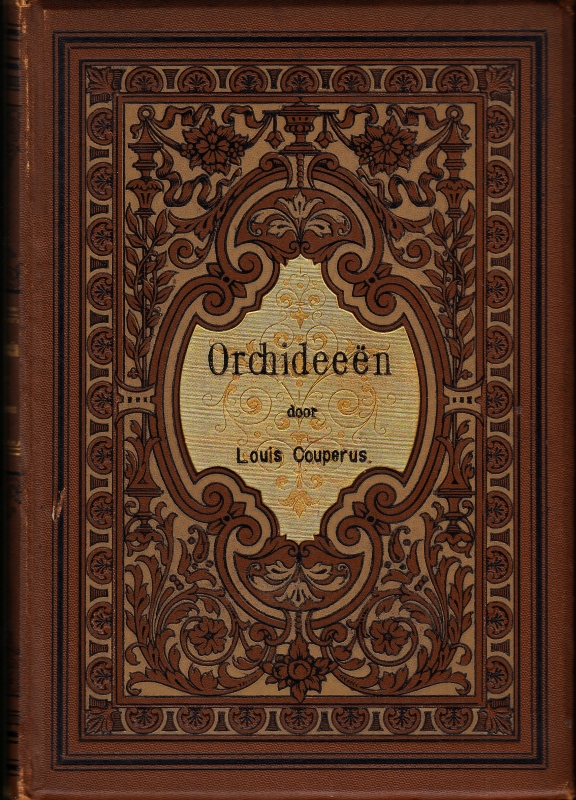 2. COUPERUS, Louis Orchideeën. Een bundel poëzie en proza. Amsterdam, Rössing, 1886. Versierd en verguld bruin linnen met versierde schutbladen. Kop verguld. (8), 208 p. 1e druk. Exlibris, enkele hakjes en plekjes op de band, verder een zeer goed exemplaar.
Verkocht
* Uiterst zeldzame eerste druk, zeker in deze goede staat. Couperus’ tweede boek, dat ondanks zijn hogere oplage een stuk zeldzamer is dan zijn debuut van twee jaar eerder. VV 108, 2 (‘De bundel verscheen in een neo-renaissanceband, waarvan drie kleurenvariaties bekend zijn’). Collectie Veen 1.2. Matla 2 ab.
3. HART, Maarten ‘t A study of a short term behaviour cycle creeping through in the three-spined stickleback. Proefschrift ter verkrijging van de graad van doctor (…). Leiden, E.J. Brill, 1978. Ingenaaid. (2), 68 p. Met tabellen. 1e druk. Met los vel Stellingen.
Verkocht
* Exemplaar met handgeschreven opdracht op de titelpagina: ‘Leiden, 5 aug ’81/ Voor Rob Molin/ Met hartelijke groeten/ van/ Maarten ’t Hart’. Zeldzame proefschrift-editie, waarin nergens wordt verwezen naar ’t Harts literaire carrière – al noemen Stellingen 10 en 15 resp. Karel van ’t Reve en Rudy Kousbroek.
4. HERMANS, W.F. Dood en weggeraakt. [Antwerpen], Ziggurat, 1980. Lichtgroen linnen. (32) p. Leeslint. Gezet uit de Avant Garde semi bold en gedrukt in verschillende kleuren in irisdruk op zwaar Rives-papier in een oplage van slechts 70 genummerde en door de auteur gesigneerde exemplaren. 1e druk. Zeer fraai exemplaar.
Verkocht
* Prachtig, autobiografisch verhaal met hoofdpersoon Richard Simmillion. JS 355.
 5. (JONG, Frans de) Telefoongids voor Amsterdam. Amsterdam, De Bijenkorf, ca. 1960. 20 x 14 cm. Geniet met flappen. 16 p. 1e druk. Zeer gaaf.
Verkocht
* Tamelijk waanzinnige interne gids voor het telefoneren bij De Bijenkorf, waar Frans de Jong (1921-2010) van 1956-1963 de leiding had over de huisdrukkerij. De voorkant van het boekje reproduceert een officiële telefoongids, maar het binnenwerk bevat teksten over hoe men moet telefoneren (‘laat uw telefoon niet meer dan driemaal rinkelen/ noem eerst de naam van uw afdeling [zeg geen “hallo”]’, ‘vermijd de uitdrukking “moet u eens luisteren” dat doet de ander al’, ‘het woordje “hoor” is te vriendschappelijk om tegen onze klanten te gebruiken’). Deels afgedrukt op pijnlijk rood getint papier, en voorzien van allerlei grappige tekeningetjes en fotootjes van medewerkers. Het lijkt onwaarschijnlijk dat zo’n speels boekje, een telefoongids zonder telefoonnummers, echt gebruikt is bij de Amsterdamse Bijenkorf. Het is dan ook niet te vinden in de NCC’s, Picarta’s en Worldcats van dit zonnestelsel. Met inliggend briefje geschreven door Lida, de vrouw van Frans de Jong.
 6. MOERKERKEN, E. van Originele foto. 39,0 x 28,2 cm. Op karton. 1956. Met op de achterzijde zijn copyrightstempel en ‘(print 1957)/ EvMoerkerken’ en het negatiefnummer in inkt.
€ 350
* Met linksonder een getypte en opgeplakte titel: ‘Bij Lake Pond Oreille, Idaho’. We zien een vrouw bij een oever voorover liggen met haar weelderige donkere haar als een waterval over een boomstam.
7. MORTIER, Erwin Godenslaap. (Gesigneerd luxe-exemplaar). Amsterdam, De Bezige Bij, 2008. Kartonnen lamellenband in papieren foedraal (Pau Groenendijk Mooie Boeken). 412 p. Belettering door de kalligrafe Karina Meister. 1e druk.
Verkocht
* Eén van de 30 genummerde en gesigneerde luxe-exemplaren, door Pau Groenendijk met de hand gebonden in een voor haar zo karakteristieke, flexibele lamellenband en voorzien van een pagina origineel handschrift.
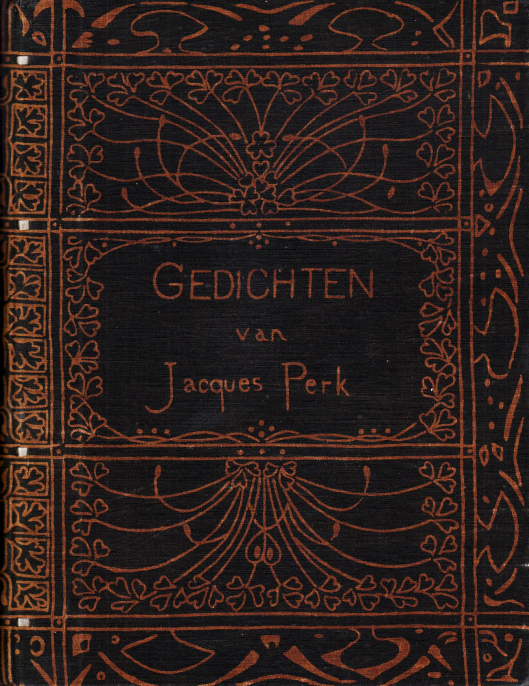 8. PERK, Jacques Gedichten. Met Voorrede van Mr. C. Vosmaer en Inleiding van Willem Kloos. (…) Vercierd door T. Nieuwenhuis. Amsterdam, Van Looy, 1897. Linnen. (2), 198 p. 2e druk. Hoekjes en boven- en onderrand van de rug netjes gerestaureerd. Zwevende schutbladen als altijd iets verbruind.
€ 300
* Eén van de fraaiste voorbeelden van Nederlandse boekkunst rond 1900. Volgens opgave in het Nieuwsblad voor de Boekhandel bedroeg de oplage 400 exemplaren. De nieuwprijs was maar liefst tien gulden. Eerste versie van de band met iets hoger bovenstuk, waardoor de twee bolders bovenin geheel te zien zijn. Braches 970409.
9. REVE, Gerard De avonden. Een winterverhaal. Amsterdam, De Bezige Bij, (1947). Verguld heelmarokijn in cassette (Binderij Phoenix; blindstempel binnenzijde achterplat). (2), 240, (2) p. 1e druk.
Verkocht
* Een unieke luxe boekband, vervaardigd door Philipp Janssen in 2014. Het boek is gebonden in zwart marokijn van de beste kwaliteit, auteur en titel staan in goud op de rug, op het voorplat zijn naast elkaar twee vergulde vette schreefloze i’s gedrukt: de suggestie van een raam met een knipoog naar de oorspronkelijke omslagtekening. De cassette is uitgevoerd in zwart karton, waarop dezelfde i’s in zwart zijn herhaald, met boven- en onderzijde in zwart marokijn. Subtiel en subliem!
10. REVE, Karel van het Verzameld werk. (Compleet in 7 delen, de luxe editie). Amsterdam, Van Oorschot, 2008-2011. Zeven delen. Verguld zwart heelmarokijn. Dundruk, leeslint. 1e druk. Nieuw.
Verkocht
* Eén van een beperkt aantal zeer luxe gebonden sets: Fraai marokijn, op de rug verguld en met de naam van de auteur in blinddruk op het voorplat. Voornaam en majestueus!
 11. VOSS, H.D. De Uitgever onder de Loupe. Geheel op perkament gecalligrafeerd manuscript. 15,3 x 10,2 cm. Perkament met doorgehaalde rug met geschreven titel op de rug en monogram JCW in goud op voorplat. In linnen cassette.
Verkocht
* Gecalligrafeerd door H.D. Voss voor J.C. Winterink ter gelegenheid van diens veertigjarig jubu=ileum als durecteur van de Wereldbibliotheek. De inhoud bestaat uit twaalf teksten over boeken en het boekenvak van o.a. De Balzac, W.L. Brusse, Goethe en Schiller. Met een los visitekaartje van het echtpaar Voss waarop geschreven ‘met onze hartelijke gelukwensen!’
Uniek en museaal!
CATALOGUE 91
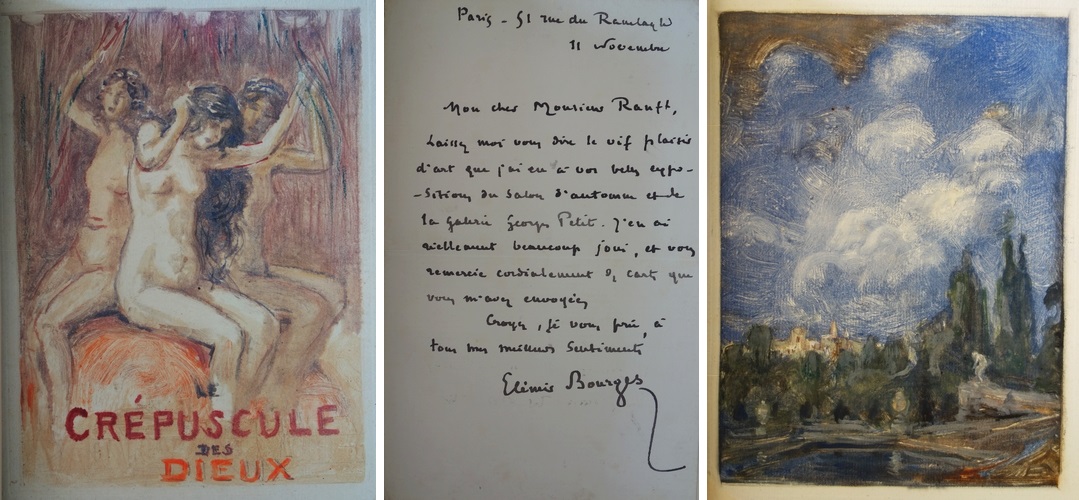 12. BOURGES, Elémir Le Crépuscule des Dieux. (With 26 original etchings by Richard Ranft). Paris, Le Livre Contemporain, 1905. 27 x 20 cm. Richly decorated brown polished full morocco with slipcase. Gilt spine with five ribs. Covers with six gilt frames of straight lines alternating with dotted lines and ornate corners. Marbled endpapers with gilt line decorations on the edges and sides. Uncut, yet all edges gilt (Weckesser et ses fils). (4), 264 p. Printed in 119 numbered copies. In excellent condition.
Sold
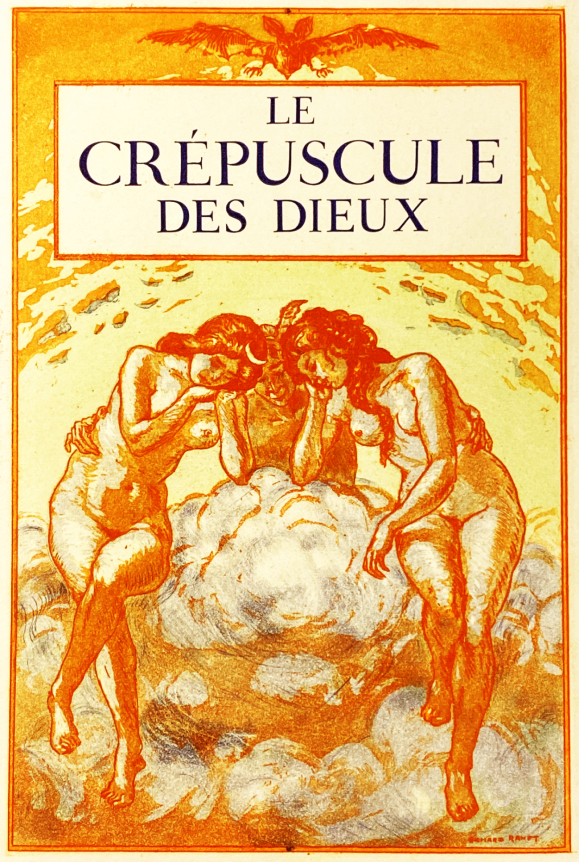
 * This copy was printed for the illustrator and enriched with four original watercolors (including a rejected sketch for the cover), three letters of the writer to the embellisher Ranft and one from the professor of medicine S. Baudry, who was very enthusiastic about this book.
“Twilight of the Gods” (1884), yes, with a role for Richard Wagner, was Bourges’s most famous novel, a decadentistic monument of the late 19th century, said to have been based on the life of Charles II, Duke of Brunswick.
A book that is absolutely Right: an exquisite early bibliophile edition, printed in a low number and illustrated with splendid color etchings, gorgeously bound by one of the most prominent binders. Moreover, the copy of the illustrator, festively enhanced with watercolors and author’s correspondence!

13. CALDER, Alexander Handwritten letter signed to ‘Dear Willi’, Willem Sandberg. Written with marker pen on writing paper, one side only. 27 x 21 cm. Dated ‘Saché/ I. et L./ France/ 17 Feb. 65’. 13 lines. Signed ‘Cordially/ Sandy’. Twice folded.
€ 500
* Letter of the great sculptor Alexander Calder (1898-1976), born in the USA but living in the department Indre et Loire (‘I. et L.’) in France, to Willem Sandberg, who at this time had retired from his tenure as director of the Stedelijk Museum. It’s about two of Calder’s sculptures that Sandberg 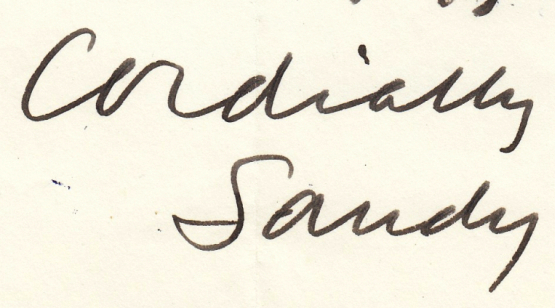 possibly was to ‘have’, though it’s unclear where this ‘have’ would be. The “Guichet” may be destined for the Lincoln Centre, but ‘I might even send you the “Guillotine pour huit” which was in the Guggenheim…’ However, the Guillotine is now in the Musée LaM in Lille.
 14. D’ANNUNZIO, Gabriele Forse che si forse que no. Roman traduit de l’italien par Donatella Cross. (With a handwritten, signed letter to Jane Catulle Mendès). Paris, Calmann-Lévy, 1910. Contemporary binding in full snake leather!! Original cover included. (8), 484 p. One of 60 large paper copies on Hollande. Édition originale. Pasted in is a letter by the author (‘Pneumatique’) to Jane Catulle Mendès, the widow of Catulle Mendès, written on paper with printed heading of the Hôtel Meurice. The envelope from the Hôtel Meurice is also present.
Sold
* The letter dates from 1910. Just about a failed appointment, but the tone is over the top (as is the handwriting): ‘Madame, veuilllez m’infliger le châtiment le plus cruel’. ‘Je vous baise, à genoux, les deux mains’. Catulle and Jane Mendès, like D’Annunzio, published several poems in Marinetti’s ground-breaking magazine Poesia.
“Maybe yes, maybe no”. This novel is set in the nascent world of aviation, when daredevil heroes defied gravity with speed. Flying is the counterpoint, but love between a couple and three siblings the melody. It ends helter-skelter with blood and drama.
 15. ESCHER, M.C. Wij komen er uit! Original wood engraving. In: Gedenkboek 1947. [Wassenaar], Nederlandsche exlibris-kring, 1947. 11.7 x 10.1 cm. Original wrappers. 92 p. Printed in 1000 copies. Spine a bit hollow, cover slightly browned along edges.
Verkocht
* “We are coming out!” Escher’s wood engraving is included in an article by G.H. ‘s-Gravesande (p. 43-53).
Added: Rickey TAX, Met Escher uit de put. Pag.1-3 in Leeslint, no. 59 (June 2020).
 16. (INCUNABLE). INNOCENTIUS VIII Regulae cancellariae apostolicae. Lectae 3 Apr. 1487. [Rome, Bartholomaeus Guldinbeck, after 21 Feb. 1488]. Decorated boards covered with a rubricated incunable leaf (recent binding). Title neatly written on spine. (48) p. Text rubricated. With one handwritten marginal note. Several lightly inked bearer slugs visible in the margins. Some paper faults outside the text, otherwise fine.
Sold
* Laws of the papal chancery. Attractive little incunable printed on rough paper. The modern cover is decorated with a leaf taken from the German Bible issued by Koberger in 1483 (Goff B632), page 335v (from ‘Das Buch der geystlichen Zucht’, i.e. the Book of Sirach). Ex collection of Georges Petit with his date of acquisition ‘mars 1930’. This book was bought at the Menno Hertzberger auction of March 12, 1930 (lot 81). Goff suppl. I151. Only 6 copies in ISTC, nr. ii00151000.
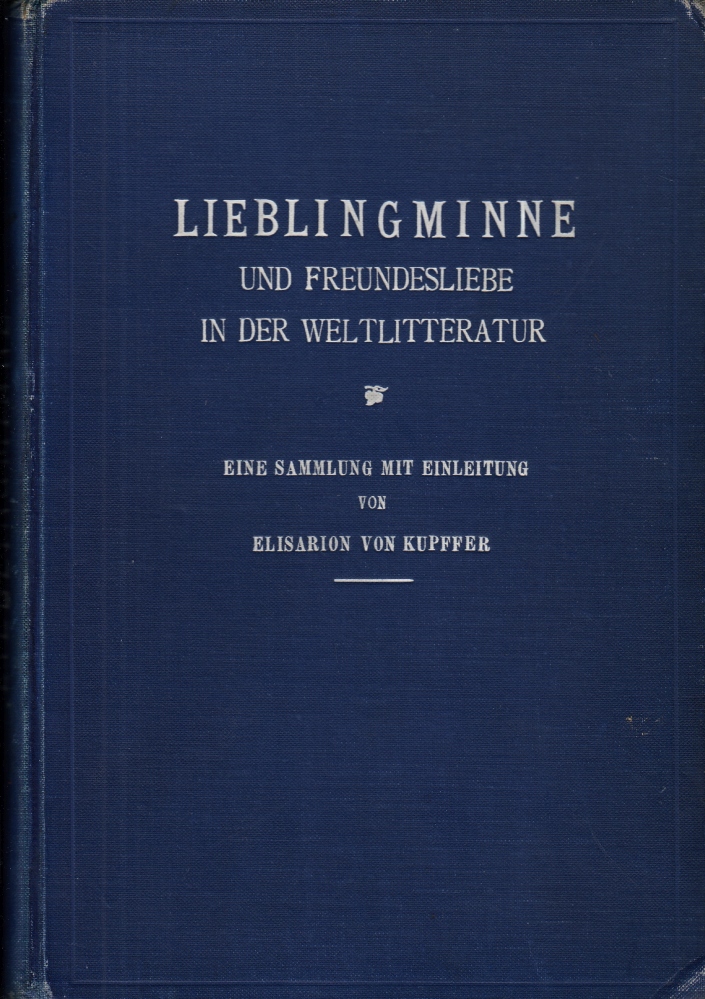 17. KUPFFER, Elisarion von Lieblingminne und Freundschaftsliebe in der Weltliteratur. Eine Sammlung imit einer ethisch-politischen Einleitung von Elisarion von Kupffer. Leipzig, Max Spohr, [1903]. Original blue cloth. (4), 226 p. 1st edition. Small strip of first flyleaf cut out. A little wear.
€ 950
* The attractive first anthology of gay literature in a title edition: publisher Max Spohr took over the remainder copies of the first edition from Adolf Brand in 1903 and replaced the old title page with his own. Lehmstedt 309.
 18. (LECK, Bart van der). ANDERSEN, H.C. Het vlas. (Translated from the Danish by Marie Nijland-van der Meer de Walcheren. Handwriting and color drawings designed by Bart van der Leck). Amsterdam, De Spieghel, (1941). Original folding wrappers. 10 (= 24) p. Printed at De IJsel in Deventer in 550 numbered copies. 1st edition. Cover slightly browned and with some inevitable creasing of the edges. Good copy.
Sold
* One of the highlights of Dutch twentieth-century book design. This edition was, from the illustrations, cover, and text to the last exclamation mark, hand-drawn by Bart van der Leck in his typical angular, geometric style (the style of De Stijl). Text and image are interspersed with lines and areas in the primary colours blue, yellow, and red.
‘The Flax’ (‘Hørren’ in Danish) is an early tale by Andersen (1849)—an extraordinary message of hope and fulfillment in adverse times.
 19. (MAGRITTE, René). ELUARD, Paul Les nécessités de la vie et les conséquences des rêves précédé d’Exemples. Note de Jean Paulhan. Orné de douze dessins de René Magritte. Paris-Brussels, Les éditions Lumière, 1946. Loose sections in wrappers. 108 p. Title in blue and black. Printed in 512 numbered copies. A few small dents in the front cover. Nice copy.
€ 1250
* This is one of 12 deluxe copies on Madagascar paper (no. 8, only deluxe version), but lacking the original drawing by Magritte promised in the colophon. The typographic design of the first edition of this surrealist poetry collection, published in 1921, has been followed completely, in accordance with the author’s wishes.

20. (SANDBERG). LIPCHITZ, Jacques Handwritten letter signed ‘Jacques’ to ‘Chère Jeo’, dated ‘Le 3 mai 1958’. Elegantly written in French with ink on thin paper, recto only. 28 x 21 cm. 28 lines. Folded, two little holes (wear or paper fault), but in very good condition.
€ 650
* Lipchitz (1891-1973) writes to an otherwise unknown woman ‘Jeo’, possibly ‘Geo’, whom he had wanted to write for a long time, but he is ashamed to confess he doesn’t know her last name. He profits from the amiable proposition of ‘notre bon ami, le Dr. Sandberg, qui vous transmettra ce message’. (Transl:) ‘You guess my unrest: since a long time Ruda sends me letters, that seem completely incoherent to me. What has happened with him?’ ‘Humbly I want to ask you for advice. What can I do to make him a bit more happy?’. He also asks her personal address, and ends ‘Croyez moi bien fraternellement votre Jacques’, followed by his own address in Hastings-on-Hudson, New York.
‘Ruda’ is the pet name of Lipchitz’ youngest brother and heir Rubin Lipchitz (1908-1993), who lived in France. The brothers had last seen each other in 1946. Possibly, ‘Geo’ or ‘Jeo’ is Rubin’s girlfriend.
A little note by Sandberg to Jacques Lipchitz in the Smithsonian Archives of American Art, dated September 23, 1958, gives a hint about this letter: Sandberg never had the chance to deliver the letter, because he never met the woman alone… imagine the predicament of world famous museum curator, Jonkheer Willem Sandberg on pins and needles for delivering an intimate letter to someone else’s girlfriend. But probably the matter was solved in another way, which explains the presence of the letter among others adressed to Sandberg, not in a Lipchitz archive.
 21. TÀPIES, Antoni, en Shuzo TAKIGUCHI Llambrec Material. (With twelve original hors text lithographs by Antoni Tàpies). Barcelona, Edicions Polígrafa, (1975). 47.5 x 35 cm. Loose-leaf in paper and cardboard covers and in printed cloth slipcase. (102) p. Printed in 526 numbered copies signed by the artist.
€ 950
* Twelve original colour lithographs (three of which double-page) with poetry in Japanese by Shuzo Takiguchi in a rough, tactile box. With Catalan, English and French translations. This is one of 300 copies printed on offset paper.
SOME EXTRA FAVOURITES
 22. ANDERSEN, H.C. Sprookjens en verhalen. In dichtmaat naverteld door J.J.L. ten Kate. Leiden, A.W. Sijthoff, [1869]. Linnen band met bestempeling in goud en zwart, achterop blind. VIII, 184 p. Als frontispice een originele foto van Andersen ingeplakt in een rood kader, met facsimile-handtekening. 1e druk. Rugje ligt open.
Verkocht
* Sprookjes van Andersen als kindergedichtjes vertaald! Bevat bewerkingen van o.a. Het lelijke eendje, Het meisje met de zwavelstokjes en De sneeuwkoningin. De foto is gemaakt in 1868 in de studio van Budtz Müller te Kopenhagen.
 23. ANDERSEN, H.C. ’t Was maar een speelman. Amsterdam, H. Frijlink, 1840. Twee delen. Contemporaine halflinnen banden met roodleren rugschildjes en gemarmerde platten. XXXII, 232; 188, (4) p. Twee lithografische titelpagina’s met identieke illustratie van H.J. Backer. Uitvoerige inleiding van G.F. von Jensen. 1e Nederlandse druk. Wat roest, litho van deel I met waterrand.
€ 250
* Vertaling van Andersens roman Kun en Spillemand (1837). De drie delen van de roman zijn in het Nederlands twee delen geworden. Aardige boekbanden.
 24. DOMELA, Harry Extensive file with original letters from Domela to Jef Last and also copies, with correspondence from Jef Last and Hans van Straten. Ruim 80 kantjes dichtbeschreven of getypte brieven van Harry Domela, gericht aan Jef Last, grotendeels onder zijn pseudoniem Victor Zsajka, hoofdzakelijk uit 1938-1940. Met getypte afschriften, ook van brieven die hier niet in origineel bijliggen (behalve aan Last ook aan Jan H. de Groot), enkele concepten van antwoorden, correspondentie over Domela en over mogelijke uitgave van een boek waarvoor deze brieven de basis zouden moeten vormen, o.a. van Hans van Straten uit de jaren 1986-1987 aan uitgever Wim J. Simons, die deze papieren tot zijn overlijden in 2008 in bezit had. Gebruikssporen, maar nog in zeer goede staat.
= More than 80 pages of written or typed letters from Harry Domela, addressed to Jef Last, largely under Domela’s pseudonym Victor Zsajka, mainly from 1938-1940. With typed copies, also of letters that are not included here in the original (to Last, but also to the poet Jan H. de Groot) and some drafts of answers. With correspondence about Domela and about the possible publication of a book for which these letters should form the basis, including letters by Hans van Straten from 1986-1987 to publisher Wim J. Simons, who had these papers in possession until his death in 2008. Signs of use, but still in very good condition.
€ 750
* Harry Domela, born in 1905 (?) in present-day Lithuania and uprooted by the First World War, left for Germany in the 1920s as an orphan without money. There he managed to become world famous for a while by pretending to be Wilhelm, Prince of Prussia – a grandson of Kaiser Wilhelm II. After some time he was caught and imprisoned after a sensational trial, but his memoirs were published by the Berlin Malik-Verlag as ‘Der falsche Prinz’ (also translated into Dutch and other languages, and made into a film). That earned him a fortune, but not for long. He tried to join the communist party, but was refused. In 1932 he fled to Austria, where he acquired a new pass with a new name, which he would wear for the rest of his life: Victor Zsajka.
In 1934 Domela/Zsajka fled to France, then to Amsterdam, where he met Jef Last through Maurits Dekker, with whom he became intimate friends. Domela first lived with Jan H. de Groot, then with the house painter Bertus Meijer (who also was a writer) in Rotterdam. In that year 1935 he met, among others, Victor van Vriesland and Menno ter Braak. In March 1936 he moved to Antwerp, where he became friends with the poet Freek van Leeuwen. In September of that year Domela tried to become a war volunteer in Spain. That only worked after Jef Last had taken care of him.
Through a visit to André Gide, Last and Domela left for the Republican Spanish front north of Madrid, where they fought together for a long time. Last became a captain, Domela first lieutenant. In early 1939 Domela fled to France. After a number of adventures in Luxemburg and in Antwerp prisons, thanks to André Gide’s papers he managed to escape in the nick of time (mid-May 1940) from Marseille to Venezuela, where he would lead a relatively peaceful life as a teacher in Maracaibo. Correspondence with Jef Last started again in 1965, but contact was soon lost, perhaps because Domela did not want a new book about him to be published – Dutch journalist Igor Cornelissen was involved.
The original letters in this collection came through Wim ’t Hart, the secretary of Last, to Wim J. Simons of the publishing house Stichting De Beuk, who wanted to publish a biography of Harry Domela. The writer Hans van Straten was called in, who acted as a sleuth in archives and had the letters typed with the critical eye of his sister, the translator C.E. van Amerongen-van Straten – these copies were and are very welcome! But it never came to an edition either: Van Straten and Simons did not find out whether Domela was still alive, and there were also copyright problems lurking.
Copies of Hans van Straten’s copies are available at the IISH: the letters from 1938-1940 can be read on the website. In terms of content, this file therefore does not add much to the Domelalogy, so to speak – but these are the originals, moving witnesses of an uprooted life.
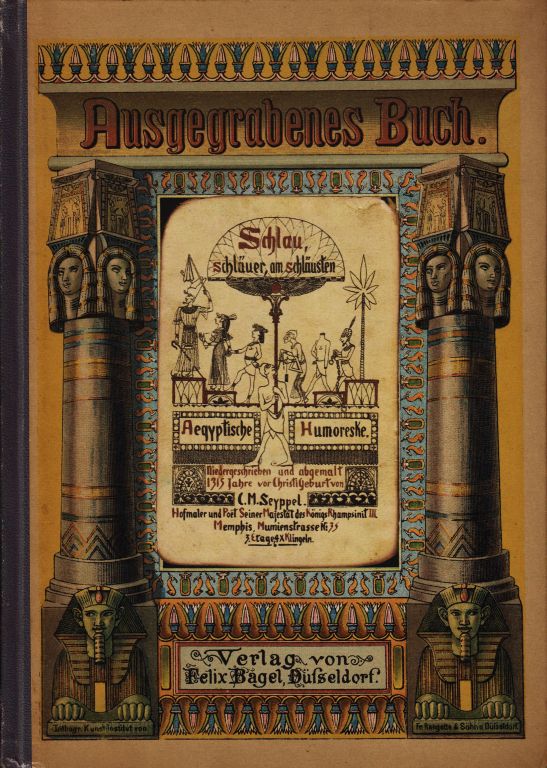 25. (EGYPTIAN HUMOR). SEYPPEL, C.M. Schlau, schläuer, am schläusten. Aegyptische Humoreske. Niedergeschrieben und abgemalt 1315 Jahre vor Christi Geburt von C.M. Seyppel. Hofmaler und Poet seiner Majestät des Königs Rhampsinit III. Memphis, Mumienstrasse No. 35, 3. Etage, 4 x Klingeln. Düsseldorf, Felix Bagel/ Mumiendruck F. Rangette & Söhne, (1882). Original illustrated cloth-backed boards. (4), (2), 40 p. The very first, fully illustrated “Mummy printed” romantic novelette, in fact an early comic book. First edition. Spine a bit worn at the foot, but the covers are in unusually excellent condition, binding inside strengthened with neat strips of grey paper.
€ 90
* Those funny Pharaos with their preposterous Pyramids! This book purports to be an original grave find by Scottish archeologists in Gizeh, 1882, after being buried for 3000 years in the sands of Egypt. It has been printed on thick drab paper resembling papyrus (covered between beautifully lithographed stiff covers) and tells a romantic story about a fictitious pharao of the 20th dynasty, inspired by Herodotus’s story about the Masterthief. Dedicated in print to Wilhelm Schliemann in a 4-p. introduction. An amusing German book if ever there was one!
26. GEAY, Jean-Pierre, & Henri GOETZ Ce qui m’emporte. Nice, Jacques Matarasso, 1989. Oblong 8 x 11 cm. Folded in wrappers. 36, recte 24 p. With 3 colour etchings by Henri GOETZ, all signed in pencil. Printed on heavy handmade paper in 60 numbered copies, all signed by Geay. 1st edition. 12 pages of text missing!
€ 200
* Stirring and beautiful tiny opuscule. The publisher wrote about it: “Goetz did not see this little book! He had given me 3 pretty little colored etchings for the text by Jean-Pierre Geay, the only ones he had made in this format, all signed. Alas, he disappeared during the printing of the book.” Almost 80 years old and very infirm, Goetz ended his life on August 12, 1989, during printing of this petite volume of poetry. With a signed dedication by the poet: “ce chemin/ ce sentier/ ce parcours/ qu’ Henri Goetz et moi/ avons fait en commun”, dated “le 3.07.90”. Incomplete, but still a poignant little volume with its painful history and attractive etchings.

27. GROOT, Hugo de Handwritten letter to ‘Grootmogende Heeren’, the States of Holland. (Original copy handwritten by a clerk in 1634). Copy for the States of Holland. 31.5 x 19.9 cm. Folded sheet of which p. 1 is described; on p. 4 only (in later handwriting): ‘Een brief van H. de Groot/ a dato 29 Juli 1634’. Paper with watermark star-dragon-house (= Bohemia, 17th century). Folded. Small piece cut out of the paper, at the bottom, outside the text.
Verkocht
* De Groot declares that his new employment with the kingdom of Sweden will hopefully also benefit his native country, the Republic of the United Netherlands.
The handwriting of this document, although from the time of writing, does not correspond to that of Hugo de Groot. It is probably a contemporary copy for the benefit of the members of the States of Holland; perhaps more of them were made. This copy largely corresponds to the letter as included in Historie van het leven des Heeren Huig de Groot by Brandt en Cattenburgh (1727), part II, p. 7. However, the spelling there has been changed to the 18th century and some words have been changed: from affection > zucht and from Conservatie >behoudenis, Regierijnge > Regering, niet(sch?) > noit. The date is also missing from this copy, it only says underneath (transl.): ‘Delivered at the meeting of the Lords of Holland ’s Gravenhaghe 28 July 1634′. From the archive of a family that for centuries served the States of Holland and (after 1838) the Dutch Supreme Court.
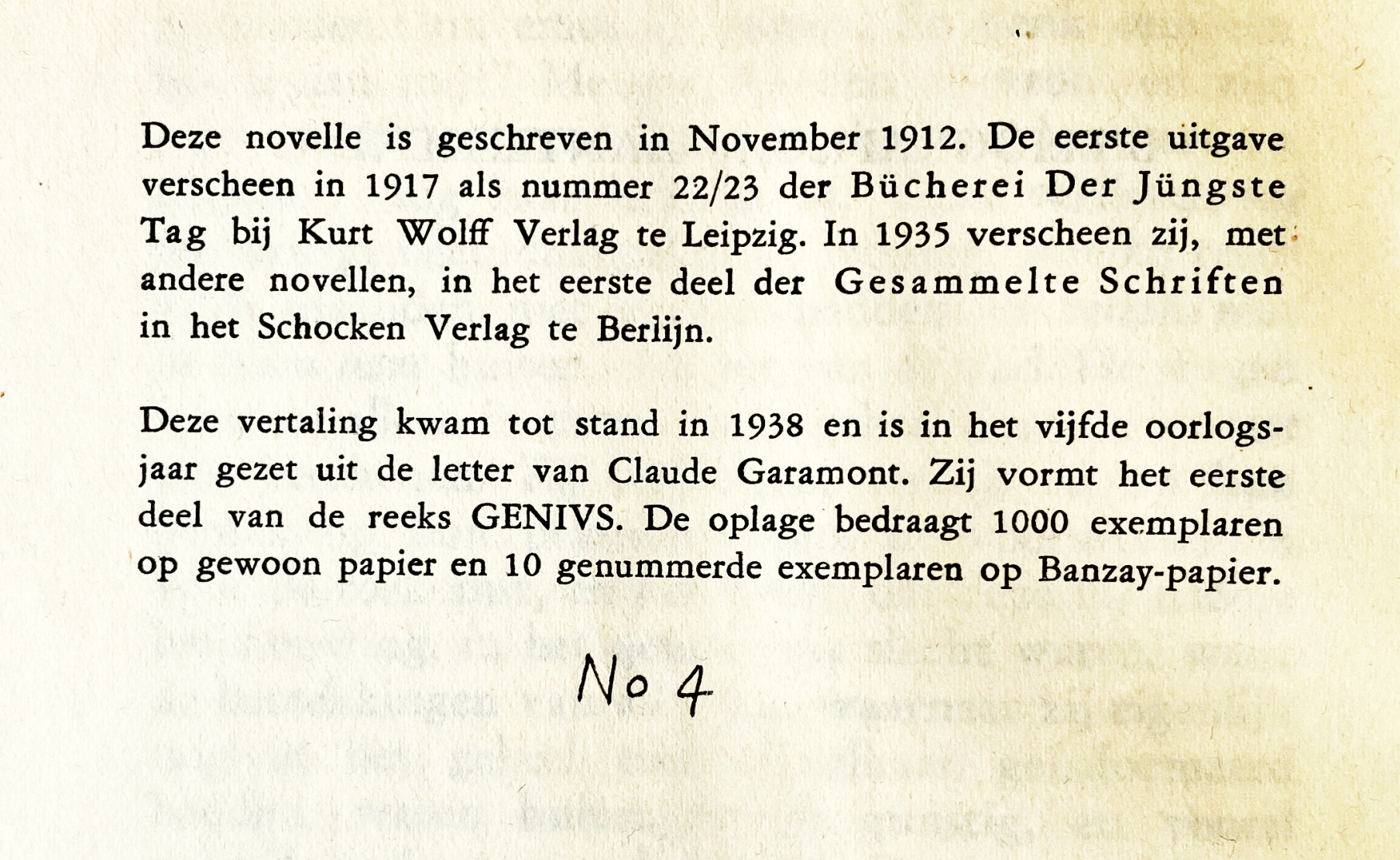 28. KAFKA, Franz De gedaanteverwisseling. (Translated by Nini Brunt). [Den Haag, H. van Krimpen], 1944. Verguld halfperkament. 82 p. Deels onopengesneden. Gedrukt in een oplage van 1010 exemplaren. 1e druk. Enkele vlekjes rond de rug, band deels iets verbleekt. Papier wat rubbelig in de rug, verkeerde looprichting?[The Hague, H. van Krimpen], 1944. Gilt vellum-backed boards. 82 p. Printed in an edition of 1010 copies. 1st edition. A few spots around the spine, binding partly somewhat faded. Paper somewhat bumpy in the spine, wrong paper grain direction?
€ 950
* One of only 10 numbered deluxe copies on Banzay paper, without the colour drawing by Bertram Weihs promised in De Jong (but which is not mentioned in the colophon). This is no. 4, from the library of the printer-publisher Huib van Krimpen, who wrote his initials on the inside of the front cover. Within the deluxe copies, only 4 copies not intended for trade were bound in half vellum. Incidentally, the translator is the mother of the printer! Genius Series No. 1. De Jong 439. Simoni K2. Bokhove A3.
 29. KAFKA, Franz Das Stadtwappen. Kleine Fabel. Heimkehr. Der Aufbruch. Eine alltägliche Verwirrung. Er. Der Schlag ans Hoftor. (With 7 original lithographs by Jan BONS). [Amsterdam, privately printed], 1943. 29 x 20 cm. Original wrappers. (40) p. Printed on Barcham Green [by J.F. Duwaer] in 30 numbered copies only. Lower cover partly very slightly discoloured, nice copy.
€ 850
* This is no. 27 of the edition. Published in secret during the German occupation. De Jong 438. Simoni K 4.
30. (LEONARD, Jos). VANDERBORGHT FRÈRES Bibelots. Brussels, Vanderborght Frères, [1930]. 20 x 15 cm. Original wrappers. 23 p. With color and b/w photos of lamps, tableware and vases and other objects, with little color pictures of people handling such objects. Text set from the Futura. Fine condition.
Sold
* Beautiful trade catalog, typographical design by Jos Leonard. Fine condition. Van Haute A002/009, p. 366.
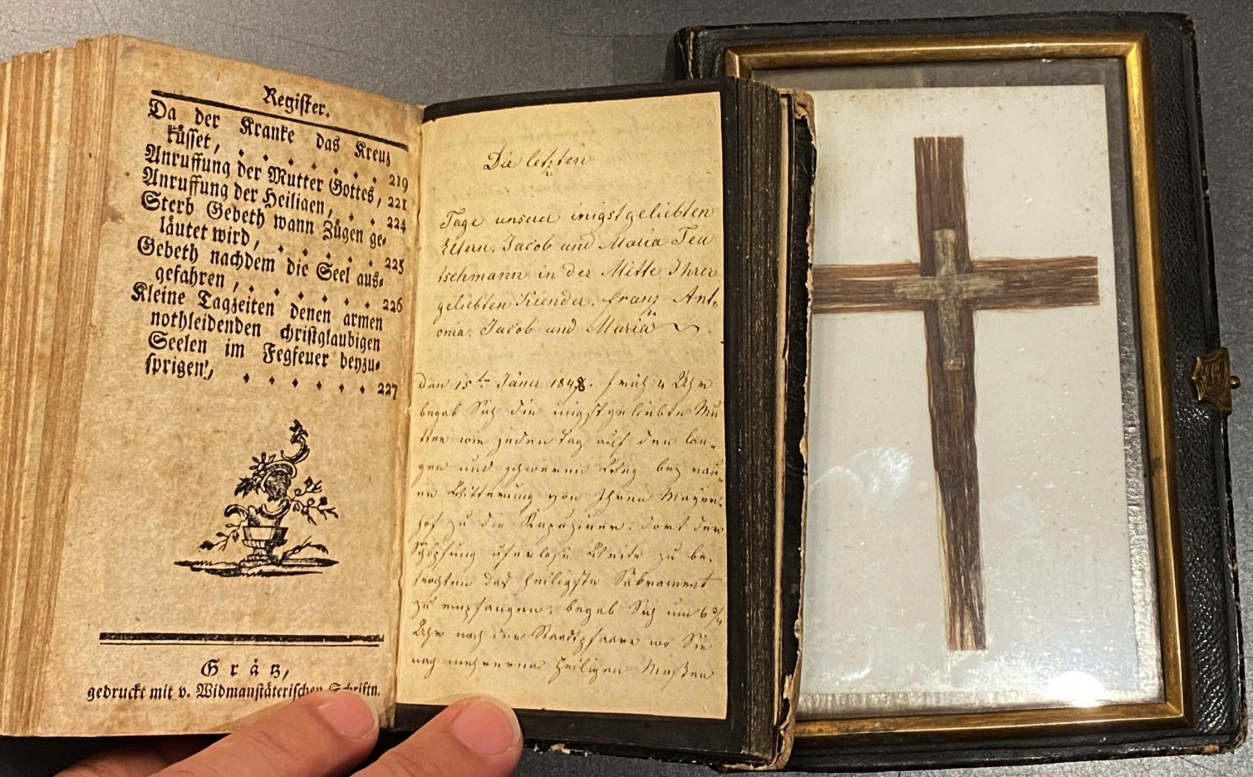 31. (MENSCHLICHES HAAR). TEUTSCHMANN, Jacob Die letzten Tage unserer innigstgeliebten Eltern, Jacob und Maria Teutschmann in der Mitte Ihrer geliebten Kinder, Franz, Antonia, Jacob und Maria. (Österreich, Steiermark), 1848. Zwei gedruckten Gebet- oder Erbauungsbücher mit beigefügtem identischen handschriftlichen Text von Sohn Jacob Teutschmann, dieser in gebundenen Lagen mit Trauerpapier. Bzw. 52 und 64 Seiten beschrieben.
1. J. A. BIGGEL: Des Christen Wandel im Erdenthale und seine Sehnsucht nach der himmlischen Heimat. Stuttgart, Ad. Becher, 1849. Schwarzes Leder mit Blindprägung und einverleibtem Menschenhaarkreuz in Kupferrahmen, hinter Glas, mit einer Buchschliesse. Etwas fleckig, Gebrauchsspuren. Zweite Buchschliesse fehlt.
2. Königliche Halszierde, bestehend in auserlesenen Morgen, Abend, Meß, Beicht und Communiongebettern. Fürstenfeld / Graz, Joh. Michael Wurst, um 1790. Papiereinband der Zeit mit Reliefzierde. Berieben und fleckig. (Dieser Titel nicht in Worldcat).
€ 250
* Ein erschütterndes Bücherpaar ist diese österreichische Familiengeschichte in zwei Büchern! Eine Geschichte in zwei identischen Texten von Jacob Teutschmann jun. über den Tod seiner beiden Eltern: Jacob Teutschmann Senior und Maria Teutschmann. Mit der Hand geschrieben in zwei frommen Gebetbüchern, die wahrscheinlich für Jakob und seine Geschwister bestimmt. Vermutlich wurde das Haarkreuz (dunkelbraun und silbergrau) aus Haarsträhnen der beiden Verstorbenen gefertigt. Der Text ist für mich, in Altdeutsch unerfahren, schwer zu lesen. Auf die genaue Identität und Wohnort der Familie Teutschmann gibt es wohl Hinweise im Text.
Doch alles deutet auf einen Ursprung in der Oststeiermark, dem heutigen Grenzgebiet zwischen Graz und Pettau (heute Ptuj) zwischen Österreich und Slowenien, hin. Diese beiden Bücher sind im Laufe mehrerer Jahre einzeln zu uns gekommen. Jedoch ist es wohl kein Zufall, dass beide in den Niederlanden gefunden wurden. == Heimat/ Familiengeschichte Austria. (This description is not in Dutch but in German).
 32. (QUEEN EMMA). J.J.L. ten KATE Italië. Reisherinneringen. (Fine Victorian deluxe binding from Utrecht). Arnhem, J.W. Swaan, [1857]. Full morocco with rich decoration on both sides (identical). xxviii, 404 pp. All edges gilt. With a full-page tinted lithograph as title page and three tinted lithographed extratext illustrations. List of subscribers after the title. 1st edition. Very light wear on corners, but a crisp and shiny book. Binder’s mark of J. Herfkens Fz., Utrecht.
Verkocht
* The front and back covers have the same decoration: an elegant rococo frame with a lavish gatehouse behind which can be seen St. Peter’s and the Forum, furnished with some typical Italians. In gold the name of cliché maker S.J. de Vries, Rokin. The lithographic title page seems to have served as the model for the binding decoration.
The text describes an eight-week trip to Italy, interspersed with lofty poetry. With tinted lithographs of Vesuvius, the Forum Romanum and the Canal Grande, by C.C.A. Last. With a unique book binding, a true jewel!
This book is said to come from Queen Emma (1858-1934) or a 19th-century Dutch royal collection.
 33. RENFNER, Heinrich Handwritten letter by a German diplomat in French to the Dutch merchant Pierre Chomel, dated 2 May 1781. Complete folding letter dated ‘Mercredi, 2. Mai 1781’, addressed to ‘Monsieur Chomel/ Negociant très renommé/ à/ Amsterdam’. 40 lines. With wax seal and stamp ’s Haage’. With note by the recipient: ‘2. may 1781/ Renfner/ rep. le 6me’. Two pieces have been cut out or torn (as is usually the case with sealed letters from this period), but the letter is complete.
* Intimate, somewhat conspiratorial letter from the young embassy secretary Heinrich Renfner (1752-1819) to the wealthy merchant Pierre Chomel in Amsterdam, whose interests spread throughout Europe. Renfner is attached to the diplomatic staff of the Prussian embassy in The Hague. He writes from his girlfriend’s house, because his new house is not ready yet. ‘Je vous écris mon cher ami, de la table de ma petite, ou je suis en penfrois jusqu’a que je soye en ordre dans la nouvelle maison. (…) Je puis vous annoncer une grande nouvelle que pourtant n’est pas encore publi. Mr. the Th. [= Ambassador F.W. von Thulemeyer] vient de declarer aux Etats GG [States General] l’accession du Roi [=Frederick the Great] a l’association maritime en conséquence de laquelle sa majesté se lie avec les Puissances neutres (…). (On the effect of a treaty of the Prussian king. The English will be angry.)
‘L’avis de la prise d’Essequibo et de Demerary sera vraisemblablement confirmé par la première malle de Londres (…). J’espère que l’escadre de Zoutmann sera actuellement partie.’ The Dutch colony of Essequibo and Demerary in present-day Guyana was conquered by the French. Zoutman had to protect the recruits of Brunswick and Hanau who were on their way from the port city of Stade (near Hamburg) to America, an idea of Admiral Van Kinsbergen.
‘Sous le sceau du plus grand secret’: a marriage is planned between the Crown Prince of Denmark and the eldest daughter of the Prince of Prussia, Friederike (1767-1820). (However, this did not happen and nothing of it can be found in the history books). The author promises Chomel a shipment of two pounds (livres) of tea, which is bought from the merchant Herfst ‘at the price of 6 fl du livre’, or about a gold ducat per pound (which seems pretty stiff).
Furthermore, there is mention of trade contacts concerning coal and Schiedam brandy. Renfner ends most cordially with ‘je vous embrasse d’avance et n’ajouterai plus rien de Tout à vous’.
All this in a beautiful, regular and very legible handwriting.
Things were going brightly for Renfner: he acted as a deputy to Von Thulemeyer and had contacts with Johann Caspar Lavater; correspondence between him and Lavater has been preserved, and he was also involved in Lavater’s physiognomy publications in Dutch. Renfner translated German political works into French and in the post-Napoleonic era he was appointed censor of the Prussian state: a powerful position.
For Chomel, business did not go so well. His company fell victim to a large-scale fraud, in which even Casanova played a small role. This affair led to sabre-rattling between the Republic of the United Netherlands and the Republic of Venice over embezzled ships – which had been paid for by Chomel’s firm, but turned out to be fabrications. It was all over the 18th century papers for years! After many fruitless lawsuits and hundreds of thousands of guilders poorer, Chomel left embittered for France, where we hear nothing more from him after 1796.
A letter that touches on various interesting subjects, a.o. the slave colonies Essequibo and Demerary in Guyana, Prussian-Dutch liaisons and other high politics, and even the price of tea.
 34. RIMBAUD, Arthur Poèmes. Les Stupra. Album dit Zutique (extraits). (With 17 erotic copper engravings (of which 13 hors-texte) by Jean-Paul Vroom). (Paris, l’Angelot Maudit, 1948). Loose as issued in a cardboard portfolio, in cardboard slipcase. (48) p. Set by hand and printed on Marais paper in a limited, numbered edition. A bit foxed throughout.
€ 350
* A mysterious erotic Rimbaud edition of high artistic quality, that was published anonymously. This is number ’11-H.C.’ with a handwritten dedication by the illustrator on the halftitle: ‘à Nora/ humble témoignage/ d’un amour/ transposé/ en ambigue/ affection/ Sjampool’. Various names are circulating about the anonymous illustrator: Élie Grekoff, Mario Prassinos and Jean-Paul Vroom. We stick to the latter. (‘Sjampool’ is Dutch street dialect for ‘Jean-Paul’).
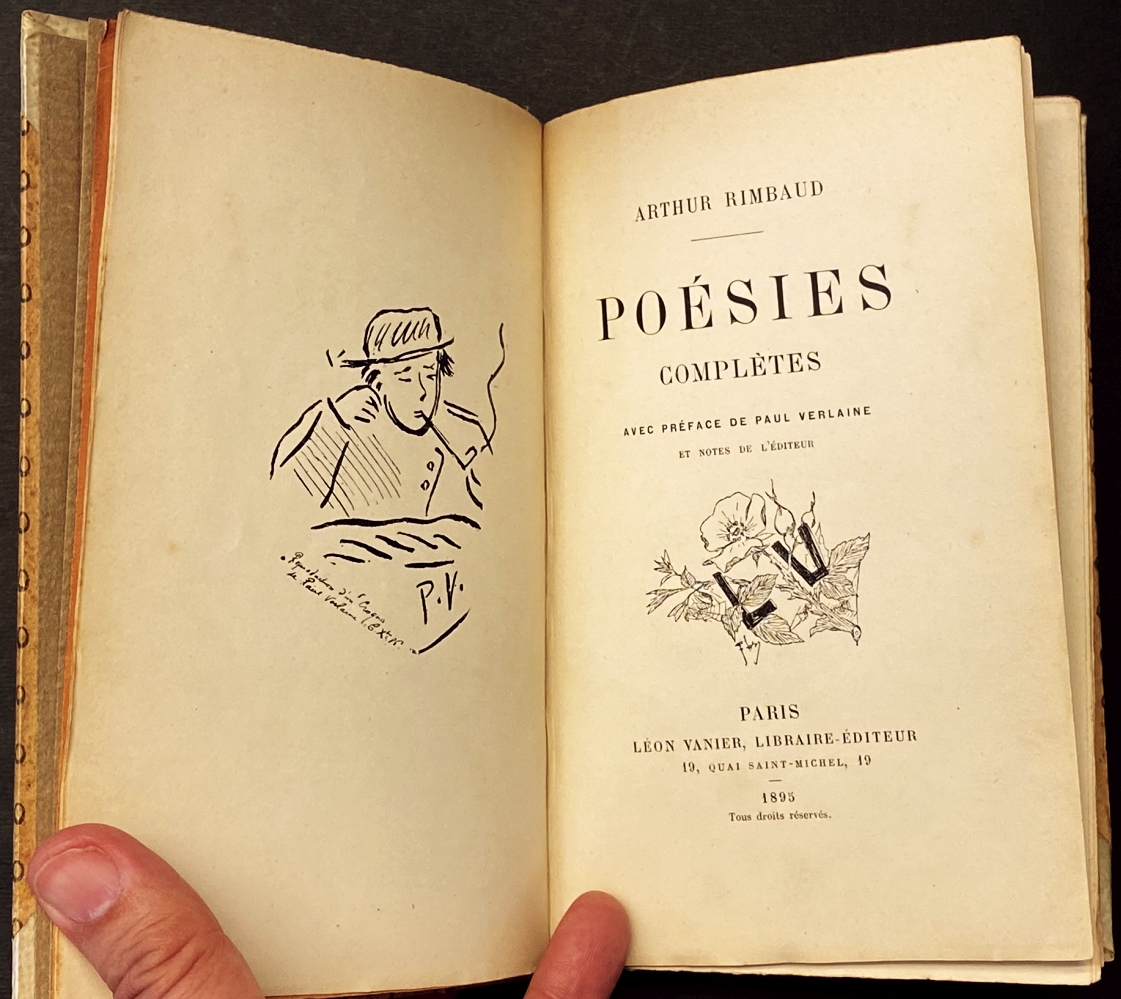 35. RIMBAUD, Arthur Poésies complètes. Avec préface de Paul Verlaine et notes de l’éditeur. (Édition 1895). Paris, Léon Vanier, 1895. Demi maroquin doré à plats marbrés (signé Ad. Lavaux; couverture et dos d’origine reliés). (4), 104 p. Tête dorée. Tiré à 600 exemplaires. 2e édition augmentée.
Sold
* La première édition de la poésie de Rimbaud sous forme de livre paraît en 1891 sous le titre Réliquaire (voir notre catalogue). Cette édition de 1895 est augmentée de dix poèmes inédits. Les deux portraits de Rimbaud par Verlaine y sont publiés pour la première fois (Petitfils IX, II, 1a, 1 et 2), ainsi que la préface de Verlaine et les “Notes de l’éditeur” de Vanier. Petitfils I,5.
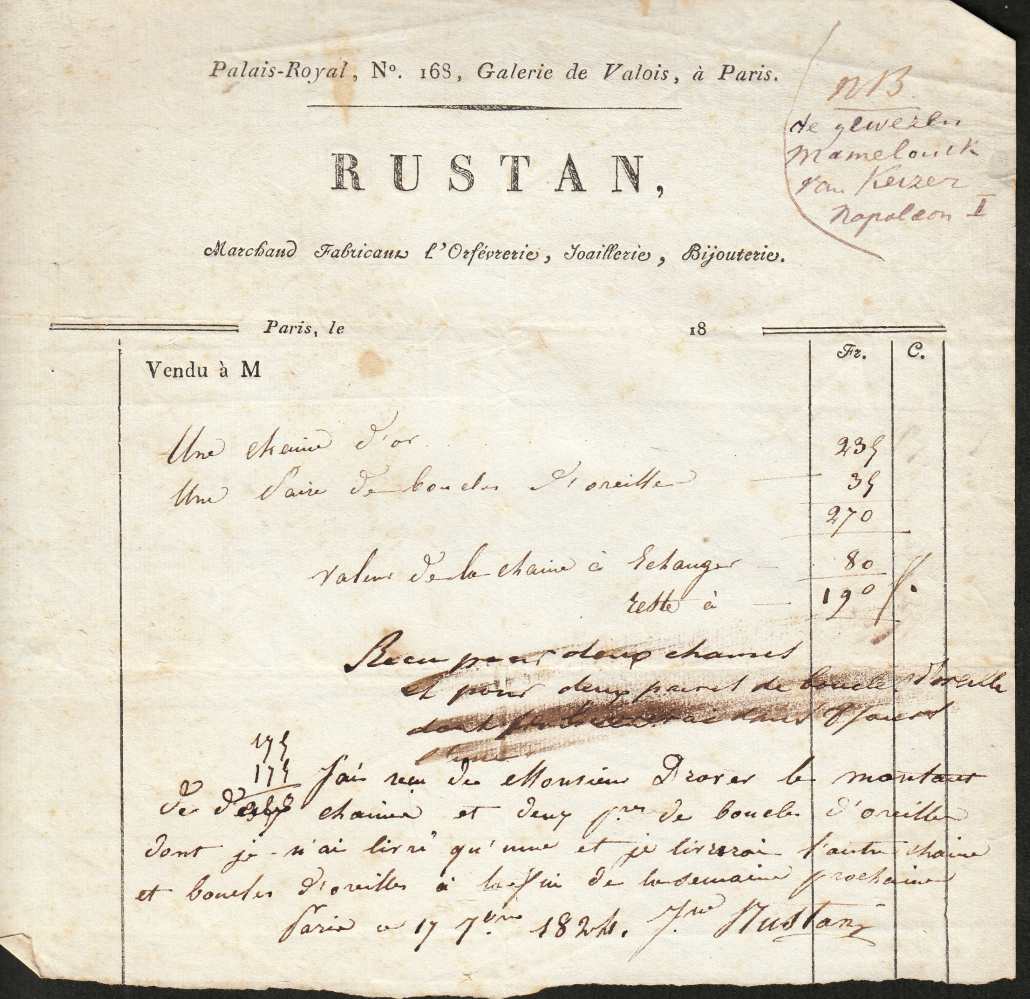 36. ROUSTAN Facture pour une chaîne en or et une boucle d’oreille en or. Avec la signature de Rustan, ‘l’ancien Mamelouck de l’Empereur Napoléon Ier’ (1824). 18,0 x 18,5 cm. Billet original à en-tête ‘Rustan, Marchand Fabricant l’Orfèvreris, Joailleries, Bijouteries’, avec l’adresse ‘Palais-Royal No. 169, Galerie de Valois, Paris. Avec le texte de deux employés et sous la signature « Rustan ». Légende d’un membre ultérieur de la famille, Jhr. de Rovere van Breugel (1867-1937), vers 1900 : ‘NB. l’ancien mamelouck de l’empereur Napoléon Ier. Adressé au dos à ‘Monsieur Drover/ hôtel Brittanique/ rue Louis le Grand No. 4’ et quelques notes supplémentaires ‘Rustan fr 190/ 17 Sept Paris’.
€ 750
* ‘Jai reçu de Monsieur Drover (= De Rovere) le montant (…)’, avec la date ‘Paris le 17 7me 1824’. Écrit sur le dossier ‘reçu de ma grand-mère A.M. le Rovere van Breugel’. Roustan (1781-1845), né à Tiflis, était soldat dans la cavalerie légère des mamelouks, un corps d’armée égyptien composé de Géorgiens asservis. Il fut garde du corps de Napoléon de 1799 à 1814, mais se sépara de lui en 1814. Il acquit un statut légendaire grâce à des publications sur lui et à des peintures impressionnantes. Après 1815, il aurait continué à vivre comme un petit rentier, mais il semble qu’il ait également travaillé comme bijoutier. Cette facture de 190 francs, où l’on voit un échange d’une chaîne en or contre une chaîne plus chère et une boucle d’oreille pour Jan de Rovere van Breugel (1757-1829) et sa fille Anna Maria, a apparemment été vu dès le départ comme une curiosité intéressante.
 37. (VERLAINE, Paul). ZORN, Anders Original portrait etching, 1895. Paper size 28.9 x 19.8 cm, image size 23.6 x 15.9 cm. Signed and dated ’18 ZORN 95′ lower left of the plate. Printed on beige paper. Very slight discolouration due to previous framing.
€ 500
Orders and remarks: please send us an email.
We are at the bookfair in booth 68.

English

 antiquariaat Fokas Holthuis