
Cat. 89 – Attitudes to Alternative Sex 1472-1800
STRANGE DESIRES
Attitudes to Alternative Sex 1472-1800
List of available titles (in December, 2025) with their original numbers, corresponding with the original catalogue that you may find further down. Some of our notes have been abridged, more details below.
 1. 1472. GERSON, Johannes De cognitione castitatis et de pollutionibus diurnis. Forma absolutionis sacramentalis. [Cologne, Printer of Dares (=Johannes Solidi (Schilling)), about 1472]. 20 x 15 cm. Recently bound in a handwritten vellum leaf dating from the earlier fifteenth century (with a fragment of the commentary by the Venerable Bede on the Gospel of St. Luke, chapter 19, incl. some music). 16 leaves (complete). Latin text. Many ligatures and abbreviations. Rubricated and with decorative initials with simple extensions. Several marginal reader’s remarks plus a drawing of a cross, some underlining. Professional paper repairs to blank upper margins. Eleven editions were published between 1467 and 1490. The first was issued in Cologne (1467); this is the fourth, printed anonymously by Johann Schilling – whose name was latinized as Solidi. Excellent condition.
€ 11 500
* ‘On the knowledge of chastity and pollutions in the daytime. The form of sacramental absolution’. A short essay, written about 1412, about chastity and involuntary discharge of semen during the day (as opposed to pollutions in sleep, about which Gerson wrote another essay). In Gerson’s eyes, both men and women can produce body fluids (‘humores’) when they are sexually stimulated, even without wanting to.
Among other things, the text is about the question of whether a priest is unclean after a pollution and whether he may then still perform sacred acts. A priest who goes to a parishioner on horseback may become excited by the ride and thus come to emission. According to Gerson, this is not a mortal sin, as long as he does not focus on the sexual pleasure.
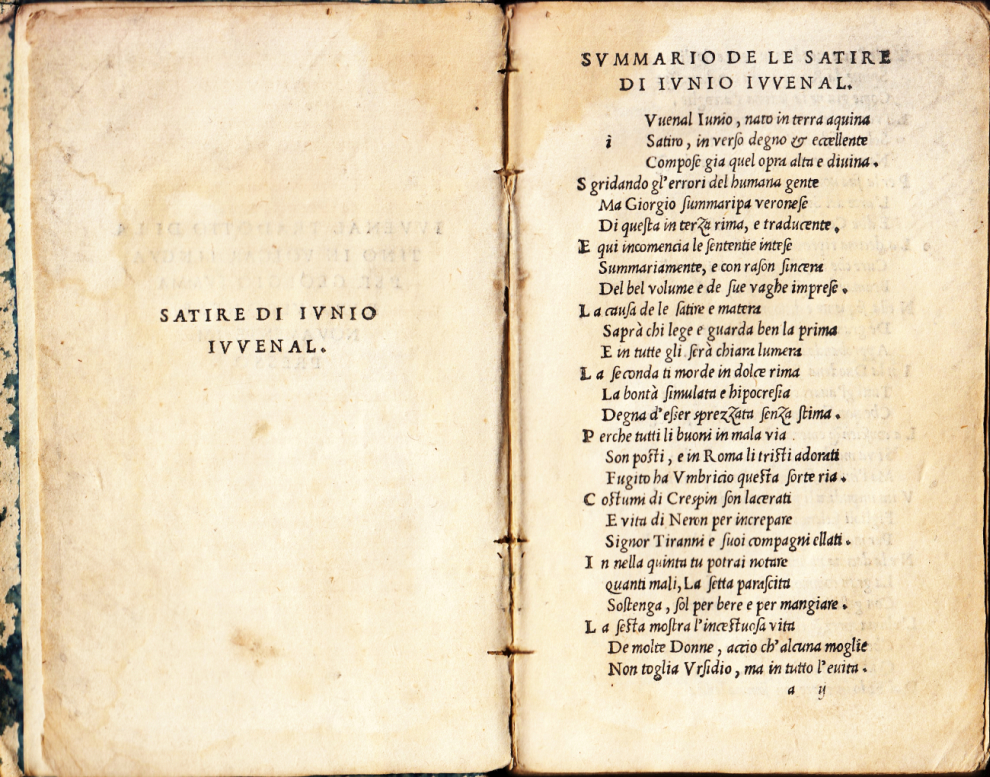 4. 1527. IUVENALIS, Decimus Iunius Iuvenal tradotto di latino in volgar lingua per Georgio Summa Ripa veronese, novamente impresso. Toscolano, Alessandro Paganini, (between 1527 and 1533). 15 x 9.5 cm. 18th century boards. Signatures a-q8. (128) p. including two blanks at the end. Translation of the sixteen Satires of Juvenal into Italian by Giorgio Sommariva. The text is mainly printed in a cursive type, with the addition of several printed pointing hands. Guide letters in capital spaces. 2nd edition: this translation was first published in 1480 (Treviso). Spine worn blank, sides of the decorated paper also worn.
€ 1200
* Faithful translation into Italian by Giorgio Sommariva (1435-1497), a lawyer and member of the City Council of Verona. With an introduction by Summa Ripa / Sommariva in verse, where he sums up the themes in the sixteen Satires. In the three poems where homosexual love and sex is alluded to, it is consequently called sodomy, or the sodomitical sin, that to judge from these poems was considered well-known in his days. In Mediterranean countries, sodomy was often part of male socialization. The late fifteenth century saw attempts to eradicate this behaviour.
 8. 1648. IUVENALIS, D. IUNIUS, & Aulus PERSIUS FLACCUS Satyrae cum veteris scholiastae & variorum commentariis. Accurante Cornelio Schrevelio. Leiden, Franciscus Hackius, 1648. Contemporary vellum. Marbled endpapers and matching marbled edge decoration. (16), 641, (41) p. Engraved title. All text in Latin. 1st edition. Spine darkened. Binding slightly worn and with various spots. 18th century? name on title: ‘F. ab Heerdt’.
€ 250
* A compact yet complete Latin Juvenal and Persius edition with small-type remarks and annotations on every page. Edited by the famous Leiden philologist Cornelius Schrevelius. Reprinted several times in the 17th century (see no. 10 of this catalogue).
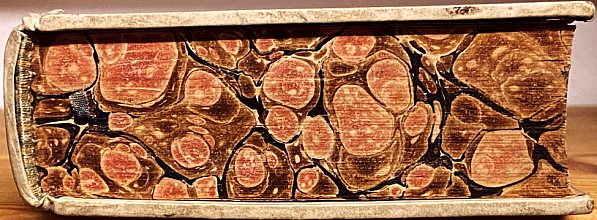 10. 1684. IUVENALIS, D. IUNIUS, & Aulus PERSIUS FLACCUS Satyrae cum veteris scholiastae & variorum commentariis. Editio nova. Qua quid praestitum sit, praefatio ad Lectorem docebit. Amsterdam, Henricus Wetstenius, 1684. 19th century vellum with 5 ribs and leather title ticket. Marbled endpapers and matching marbled edge decoration (see the picture!). (48), 525, (110); 112, 22 p. With title engraving. Reprint edition (first: 1648). All text in Latin. Upper joint cracked. Save for this fault a handsome book!
€ 300
* Later edition of no. 8 of this catalogue.
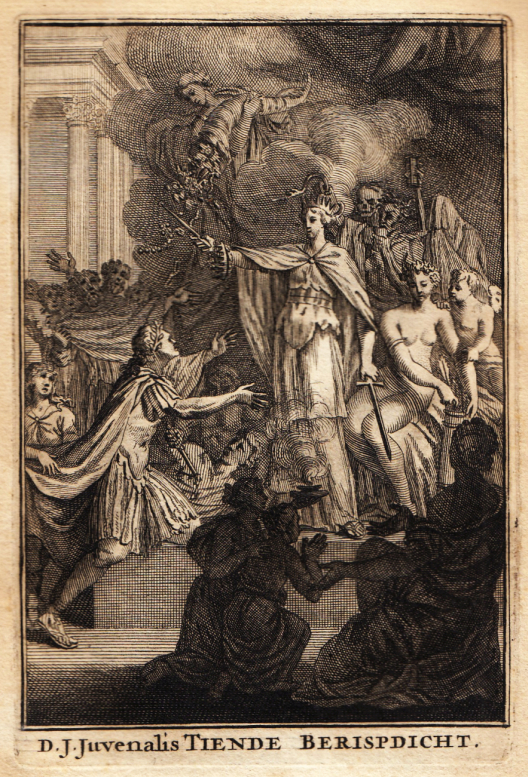 11. 1700. JUVENALIS Satyra X, of Tiende Berispdicht. In Nederduitsche Vaerzen vertaald, én met Aantekeningen vermeerdert. De twede Druk overzien, en van veele misslagen gezuivert. Amsterdam, Nil Volentibus Arduum, 1700. Sewn with contemporary marbled paper. (16), 48 p. With engraved frontispiece and etched title page by Gerard de Lairesse. Signed in writing under the preface by ‘Y.W.’ alias Ysbrand Vincent (1641-1718), paper manufacturer and secretary of the theatre company Nil Volentibus Arduum. Uncut. 2nd revised edition.
€ 325
* ‘Satyra X, or Tenth Poem of Reproof. Translated into Dutch Verses and augmented with Notes. The second edition reviewed and corrected of many errors’. Bilingual edition in Latin and Dutch. Extensive introduction about the life of Juvenal. With footnotes. It appears from the preface that ‘in order to avoid offence, the Poet has deliberately not been followed exactly in a few places’.
 12. 1709. JUVENALIS, Decius Junius, & Aulus Persius FLACCUS Alle de schimpdigten van Decius Junius Juvenalis en A. Persius Flaccus door verscheide Dichteren in Nederduitse vaarzen overgebracht. Haarlem, Wilhelmus van Kessel, 1709. Leather-backed boards. 2 parts in 1 volume. (38), 330; (20), 66p. Masterly engraved frontispiece by J. Goeree. 1st edition. Some colouring of the frontispiece and a few other little stains.
€ 300
* ‘All the satirical poems of Decius Junius Juvenalis and A. Persius Flaccus translated into Dutch verse by various poets.’ Dedicated in print to the young and gifted poet and translator Lukas Schermer (1688–1712), who was already terminally ill and doomed to die. Nevertheless, Schermer produced a large body of work in his brief lifetime, including numerous translations from Greek and Latin. Several of Juvenal’s satirical works that feature homosexual parts have been translated into Dutch by various poets and included in this anthology. Comparing gives us an idea of how certain Dutchmen perceived the enigmatic, damning phenomenon of homosexuality in the 17th century. / A modern translation by Marietje d’Hane-Scheltema (2007) may be added to this anthology.
 13. 1713. JUVENALIS, Decius Junius, & Aulus Persius FLACCUS The satires of Decimus Junius Juvenalis and of Aulus Persius Flaccus. Translated into English verse by Mr. Dryden, and other eminent hands. Together with the Satires of Aulus Persius Flaccus. Made into English by Mr. Dryden. With explanatory notes at the end of each satire. To which is prefix’d a discourse concerning the original and progress of satire. London, Jacob Tonson, 1713. 13.5 x 8 cm. Contemporary calf. (162) [misnumbered for (142), 2], 372 p. Frontispiece, 22 plates (one for each poem) and 2 portraits. Separate title page for Persius’s ‘Satyrs’. Contemporary calf, a bit rubbed, corners worn, hinges starting. With inscriptions: page numbers pointing to marked passages, and two owner’s signatures, of Henry Blackwall and Daniel Astle[y].
€ 300
* Complete translation of the satires of Juvenal and Persius with notes at the end, by several authors, first published in 1693. Adorned with plates. This is a nice and compact little volume that you could carry in your breast pocket, getting you pleasant smirks when traveling. These ‘Satyrs’ do not conceal anything, but rather reveal in a light-hearted manner.
Ownership inscriptions of Henry Blackwall (1699-1728), a Cambridge alumnus in 1717. And Daniel Astle[y], 1777 and 1778 of the 46th Regiment. During the American War of Independence, this unit (officially known as the 46th (South Devonshire) unit of Foot) was fighting in the British Philadelphia Campaign.
 15. 1727. CHRIST, Johann Friedrich Historia legis Scatiniae. Antiquorum codicum testimoniis emendandis illustrandis passim distincta. Halle, Johannes Christophorus Krebs, 1727. Without wrappers. 28 p. In Latin. 1st edition. Paper a bit browned.
€ 200
* ‘The History of Scatinian Law. Illustrating and rectifying the various evidences from ancient codices’. A detailed examination of the name, history, and substance of the Lex Scatinia (or Scantinia), a Roman law meant to punish sexual contact between men and freeborn boys. The text of the law (from around 225 BC) has not survived, but there are several references to it, including Juvenal’s poetry. Early modern authors saw the Scatinia as the Roman equivalent to sodomy laws, but now there are more nuanced views on this.
16. 1730. BEELS, L. Sodoms Zonde en Straffe of Streng Wraakrecht over Vervloekte Boosheidt, en Loths Vrouw, verandert in een Zoutpilaar. Amsterdam, A. Wor & Erve G. Onder de Linden, 1730. 18th century leather-backed marbled boards. (24), 154, (12) p. 2nd edition. The binding is overly large; very likely, a second book was removed from it. Bookplate and signature of hispanist Dr. J.A. van Praag, registration date ‘Santpoort, 20 Nov. ’47’. Erased old notes on and preceding page 1. Stains on the title and elsewhere. Pencil notes by A.G. van der Steur at the conclusion of the book include the acquisition year ‘1991’.
€ 500
* ‘Sodom’s Sin and Punishment, or Severe Vengeance for Cursed Wickedness, and Lot’s Wife, transformed into a Pillar of Salt’. Leonard Beels (1674-1756), an Amsterdam clergyman, describes sodomy as a crime that incites God’s wrath and depicts the disasters in Genesis 19 in detail, including the roles of salt, sulphur, and fire. He connects God’s anger also with prior calamities, such as the St. Elizabeth’s Flood of 1421, which destroyed large parts of Holland.
17. 1730. BEELS, L. Sodoms Zonde en Straffe of Streng Wraakrecht over Vervloekte Boosheidt, en Loths Vrouw, verandert in een Zoutpilaar. Amsterdam, A. Wor and Erve G. Onder de Linden, 1730. Modern artificial leather-backed boards. (24), 154, (12) p. Title printed in red and black and with a small engraving. With a useful register. 1st edition. Some stains in the preliminaries, otherwise fine.
€ 450
* As before. First edition in a modern binding.
 19. 1730. (SUMMONSES) Alle de copyen van indagingen, als mede alle de gedichten op de tegenwoordige tyd toepasselyk. (&) Vervolg op alle de copyen van indagingen, alsmede alle de gedichten op de tegenwoordige tyd toepasselyk. No place or publisher (c.1731). Two volumes in one binding. Vellum. 170, (6 blanks), 154 (incl. 3 p. register), one blank in between after p. 78. Binding a bit worn, tiny piece of flyleaf missing. Bookplate of Gerrit Komrij.
€ 2000
* The title literally: ‘All the copies of the summonses, as well as all the poems applied to the time of the present day. (&) Continuation of (same)’.
Very rare, unusual publication of the names of the men who had indulged in the ‘shameful sin of sodomy’, with charges and sentences sorted by place: Amsterdam, Utrecht, but also Groningen, Voorburg, Zutphen, and many other towns. Long, moralistic poems about this ‘disgusting’, ‘notorious atrocity’ lace the book. Approximately 400 men faced prosecution between 1730 and 1732, with 100 receiving death sentences. Many managed to evade the horrific punishments by fleeing their homes or by committing suicide.
There are several versions, sometimes consisting of merged impressions, not all the same. To clarify the structure, the first part contains 11 quires A-G, H, I, K, and L of 16 pages each. Pages 3-11 show summonses of June 1730, last date June 24. Pages 12-142 contain a number of shorter and longer anonymous poems, sometimes with footnotes mentioning names, dates, and Bible passages. On p. 143-170 we see summonses again, all dating from July 1730 plus the first of August, followed by six blanks. Second part: 6 quires A-F, last date October 30, 1730; G, last date March 9, 1731; H: last date October 5, 1731; and I: last date October 5, 1731, mentioning all victims of Faan with a brief description of what they had done. K (12 p.): last date November 19, 1731, followed by an index for the second and first part (folded in reverse).
All of this points to a significant rush to catch up with reality during the publishing of this title.
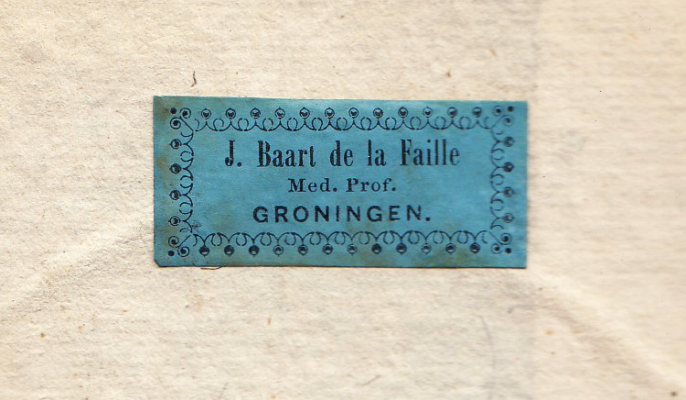 20. 1730. (SUMMONSES) Alle de copyen van indagingen, als mede alle de gedichten op de tegenwoordige tyd toepasselyk. Vervolg op alle de copyen van indagingen, alsmede alle de gedichten op de tegenwoordige tyd toepasselyk. No place or publisher, (1730). Two parts in one binding. Boards with title label. 170, (6 blank), 94 p., and one inserted blank page. Neat volume with the bookplate of J. Baart de la Faille (1795-1867), professor of medicine in Groningen.
€ 950
* As before. The second part exists in different variations of size. This copy ends (as often) with the poem by Pieter Schim and has as its most recent date 30 October 1730, before section G, which was not printed until March 1731 (last date 9 March 1731).
This copy notably lacks pages 79-80, which contain the verdict of the city of Delft against Jacob van Wouw, a ‘Council and former Chief Officer of this City, but fugitive’, in which Willem van Buuren is also mentioned with his ‘word for word unanimous’ verdict, ditto Cornelis della Faille, councillor and former alderman of Delft. This Cornelis was probably an ancestor or relative of Professor Baart de la Faille. All three of these important and wealthy fugitives were banished from Holland and West-Friesland, and their possessions confiscated. Over the seizure of their belongings a legal battle was fought with their relatives.
21. 1730. (CHOICE POEMS) Zesde (-) tiende vervolg van de Latynsche en Nederduitsche keurdichten. Rotterdam-Utrecht, Pieter van der Goes, 1733-1734. Old calf. With two folding plates. Top of first title page torn off, containing the words ‘Zesde vervolg van de’. A bit of wear and tear in some pages (also in the plates). Partly browned.
€ 350
* ‘6th-10th continuation of the Latin and Dutch Choice Poems’. With some poems condemning sodomites: vol. VI p. 133-137 against sodomy itself, vol. VII p. 104 against Ignatius of Loyola, the founder of the Jesuit order in 1539, who in heaven became enamoured of Ganymede and was transposed to hell after the boy discovered it was Ignatius, not his lover Zeus who was possessing him! And vol. IX p. 79 and 88.
22. 1730. MEL, Coenraat Het Gruwlyk Sodom Gestraft, Ter waarschuwinge aan Israel voorgestelt; in verscheide Boet- en Bededaags Predikaatsien Beneffens de gantsche Historie van Sodom, uit Genesis XVIII en XIX. Amsterdam, A. Wor & Erve Onder de Linden, 1731. Modern leather-backed boards. (22), 264 p. Title page printed in red and black. 1st edition. Some use and waterstaining.
€ 500
* ‘Horrible Sodom Punished, Shown as a Warning to Israel, in various Sermons for Days of Prayer and Penitence, as Well as the Complete History of Sodom, from Genesis 18 and 19’. The well-known German theologian Conrad Mel (1666-1733) describes the sins of the biblical Sodomites as fivefold: shedding innocent blood, depriving workers of their wages, oppressing widows and orphans, robbery and theft, and to violate boys and mingle with unwitting animals. Only these last sins are named as Sodomitical. The Pope and the Vatican are described as fomenting the sins of the Sodomites, Mel identifies Sodom outright with Rome. The book was six times reprinted, from 1750-2017.
23. 1730. MEL, Coenraat Sodom. Het Gruwelijk Sodom Gestraft. Negental Boetpredikatiën van den vermaarden Godzaligen Heer Coenraad Mel, Leeraar en algemeen opziener over alle de Kerken en Scholen in het vorstendom Hersfelt. Rotterdam, H. van der Meulen, [1920]. Later cloth. 208 p. Adapted from German texts. Printed on cheap and thin paper. Some browning. Tear in p. 162-165.
€ 50
* ‘Horrible Sodom Punished. Nine Penitential Sermons by the renowned Blessed Sir Coenraad Mel, Teacher and general overseer of all the Churches and Schools in the principality of Hersfelt’. A summary of Mel’s writings, preceded by an introduction and an overview of the relevant Bible passages – in a cheap version sold by an orthodox protestant publisher, who probably was concerned about the early twentieth century publicity surrounding homosexuality.
24. 1730. MEL, Coenraat Sodom. Gruwelijke Sódom gestraft. Tot waarschuwing aan Israël voorgesteld in enkele boet- en biddagpredicaties, naast de gehele historie van Sódom, uit Genesis 18 en 19. Wijk en Aalburg, Landelijke Stichting ter bevordering van de Staatkundig Gereformeerde beginselen, 2017. Illustrated boards. 200 p. A few pictures. Current spelling by W. Noorlander and J.A. Bunt. Reprint.
€ 25
* A recent version of the 1730 book revised by an orthodox protestant foundation styling itself as ‘objectors inside and outside the SGP’, a Dutch political party at the theocratic side of the voter spectrum. This is the seventh and last edition, after 1731, 1750 (titled Boet- en bededaags predikaatien), 1861, 1904, 1920 and 2004.
26. 1730. ROYAARDS, Albertus Nodige en tydige waarschouwing tegens de gemeenschap aan Sodoms grouwelyke zonde en vreeselyke straffe, op den plegtigen dank- vast- en bededag van den 28. Febr. 1731. Afgeleid en voorgesteld uit Jes. 1:vs. 9. vergel. met Ezech. 16:vs. 49, 50. Nijmegen, Wilhelmus Bongaards, 1731. Rebound in vellum-backed marbled boards. (8), 74 p. 1st edition. Paper (water)stained. With a handwritten leaf mentioning various owners of the book with the years 1860 and 1893. And a handwritten index of Bible texts.
€ 950
* ‘Necessary and timely warning against the community of Sodom’s heinous sin and dreadful punishment, on the solemn Day of Thanksgiving, fasting and prayer of February 28, 1731. Derived and presented from Isaiah 1:9 compared with Ezekiel 16:49, 50.’ An extensive exposition of the sin of Sodom, that unnatural lust was just one of its many aspects, with arrogance and a lack of compassion being equally important. According to Royaards, lustful excess led to lascivious and indecent behaviour, and in the end, men could only resort to sodomy as the last way to find satisfaction, the usual explanation of the time.
27. 1730. (SENTENCES for FUGITIVES) Sententien van den Hove van Holland, tegens verscheide Persoonen ter saake van gepleegde Sodomie. In dato 5 October 1731. Den Haag, Paulus & Isaac Scheltus, 1731. No wrappers, just sewn (from a convolute). 72 p. Outside a bit worn and dusty and a little foxed. Inside very good.
€ 1200
* ‘Court cases of the Court of Holland in The Hague against a number of people because they were accused of committing sodomy’. 35 cases, all these men were fugitives (‘Latitant & Defaillant’), all were banished forever from Holland, Zeeland, Friesland and Utrecht on pain of the death penalty, and all their property was confiscated. All received the same sentence and on the same day, October 5, 1731. Knuttel Pamphlets 16816a.
 28. 1730. (SODOMY SPECTACLE) Schouw-tooneel soo der geëxecuteerde als ingedaagde over de verfoeielijke Misdaad van sodomie tot waarschouwinge der goede en afschrik der booze geopent in de voornaemste Steeden van Hollandt en Over-yssel &c. No place or publisher, 1730. 31 x 20 cm. Two volumes in one binding. Contemporary half roan. 84; 78 p. 1st edition. Cut rather short. Binding worn. Some pages loose, edges browned.
€ 2500
* ‘Spectacle of both the executed and the accused for the abominable Crime of sodomy, opened in the principal Cities of Holland and Over-yssel, etc., as a warning to the good and a deterrent to the evil.’ This large-format book, with its headlines set in big capital letters, spreads dread and terror with its summonses, verdicts, and long lists of culprits, followed by 42 thundering poems.
Most of the sodomites suffered horrendous torture and death, as if their souls needed to be excised from earth and memory: they were either burnt to ashes or, ‘after being hung, transported by cart to the coast, where they were thrown into the sea with 50 pounds of weight on their bodies and 50 pounds on their legs’. Some managed to flee before being caught, having their possessions and money confiscated and being exiled forever on pain of execution. That was probably often a sentence to beggary in a foreign country, language unknown.
29. 1730. (SUMMONSES) Versameling van alle Actens van Dagvaardingen en Executien, gedaan over Zonden van Sodomie, in den Jaare 1730. Mitsgaders Sententien, gepronuntieert binnen de Stadt Haarlem. Den Haag, Cornelis van Zanten, 1730. Cloth-backed marbled boards. (2), 110 p. 1st edition. Paper a bit soft.
€ 2000
* Early publication about the sodomy trials in the Netherlands, not only in Haarlem but in many other Dutch cities. Contains poetry, sentences, poster texts (‘Placcaat tegen het plegen vande Zodomitische Zonden’), and summonses of fugitives. Not the crimes, but the punishments are described in grisly detail. Apparently not in Worldcat. (See inside rear cover).
30. 1730. EFFEN, Justus van De Hollandsche Spectator. August 30, 1731 – December 19, 1732. 120 issues in one binding. Amsterdam, Hermanus Uytwerf, 1731-1732. 4 volumes (= 120 issues) in a single volume. (8), 240; (2), 240; (2), 240; (2), 248 p. With preface. Last page of last volume missing. With 4 identical title engravings by Claude Duflos after Gabriel F.L. Debrie.
€ 200
* ‘The Dutch Spectator’ is a talkative, candid magazine that was entirely written by Dutch author Justus van Effen. Despite its frequent serial publication during the second part of the sodomite persecutions in the 1730s, ‘The Dutch Spectator’ only mentions them covertly and discreetly in one issue, that of November 21, 1732: ‘Suddenly a horrible sin is revealed’, without specifying the nature of this sin. God’s punishments for those unmentionable sins include the naval shipworm plague: ‘despised animals, which hardly have any rank among creatures’, floods, and contagious cattle diseases.
32. 1730. VALK, Emanuel Brief aen een vrient, behelzende het voorgevallene in de zaak van ds. E. Valk, zo te Vianen als Utrecht, tot hier toe. Benevens eenige aenmerkingen over ’t zelve. (No place, self-published, 1731-1732). No wrappers. 20 p. Uncut. Some creasing, but an excellent copy.
€ 900
* ‘Letter to a friend about what happened in the case of the minister E. Valk, in Vianen and in Utrecht, until now. And some remarks about this.’ One of several pamphlets about the case of Emanuel Valk, who was continuously harassed under unknown allegations of sodomitic behaviour.
The clergyman found himself entangled in a legal maze, received a summons, and ultimately committed suicide in prison.
33. 1730. VRIJER, M.J.A. de De storm om het crimen nefandum in de jaren 1730-1732. Page 192-238 in: Nederlandsch archief voor kerkgeschiedenis Vol. 25, 1932. Den Haag, Martinus Nijhoff, 1932. Half cloth. VIII, 256 p. 1st edition.
€ 75
* Important essay in fine writing style about the sodomy persecutions seen from an ecclesiastical point of view. A lot of De Vrijer’s information comes from church council records and theological works. Though filled with pity and appalled by the cruelties, he defends the pastoral attitude and the thunderous books of the various ministers concerned, such as Van Byler and Beels, especially in response to the accusations of inhumanity by Cohen Tervaert and Poort. Remarkably, he also defends the Vianen clergyman Emanuel Valk, who in 1730 had been a victim of unclear accusations of sodomitic behaviour.
 34. 1730. BYLER, Hendrik Carolus van Helsche boosheit of Grouwelyke zonde van sodomie, in haar afschouwelykheit, en welverdiende straffe uit goddelyke, en menschelyke schriften tot een spiegel voor het tegenwoordige, en toekomende geslagte opentlyk ten toon gestelt. Groningen, Jacobus Sipkes, 1731. Full calf. 60, 256 p. Title printed in red and black. Errata list. 1st edition. Spine damaged, edges worn. With name of former owner: ‘P.D. Koopman 1870’.
€ 750
* Literally ‘Infernal evil or horrible sin of sodomy, in its horror, and well-deserved punishment from divine, and human scriptures openly displayed as a mirror to the present and future generations’. Henricus Carolus van Byler was minister for the villages of Faan, Niekerk and others in the rural northern part of the Netherlands, where grietman (lord and judge) Rudolf de Mepsche (1695-1754) was relentlessly prosecuting sodomites and others falsely accused of this sin. We don’t know who was the first to take up the scourge, but probably Byler and De Mepsche mutually excited each other to punish the enemies of God and themselves with horrible penalties. (Picture on the inside rear of this catalogue).
A second edition came out in 1741. The text is identical; even the errata have not been used to enhance the book.
36. 1731. FAAN Criminele Proceduiren door het Hoog-Edel Gerichte van Oosterdeel Langewold, in d’Ommelanden tusschen d’Eems en de Lauwers, tegens vierentwintig Sodomiten uitgevoert op Maandag den 24 Septemb. Anno 1731, met bijvoeging van eenige noodsakelyke Stukken en Blyken daar toe specterende, uit kragt van welcke deselve, als meede de vordere Proceduiren tegens de noch overige Gevangens voor de Hooge Justitiekamer der Provincie van Stad en Lande van tyd tot tyd zijn gewettigt. & Korte Aenmerkingen en Consideratien met de daar toe dienende Justificatoire bylagen geformeert op de gehoudene Crimineele proceduiren by den Heere de Mepsche van Faen ten Reguarde van veele personen, by hem betigt, geapprendeert gevonnist en geëxecuteert, wegens het Crimen van Sodomie waar van deselve naer syn voorgeven souden wesen geconvinceert. No place or publisher, (1732). 32 x 20 cm. 3 parts in 2 vols. Rebound including 18th century marbled wrappers in 20th-century cloth-backed marbled boards. (12), 72; 180, (6); 78 p. Stains of the rebinding process visible on flyleaves. A little foxing, but both books attractive and in excellent condition.
€ 2950
* ‘Criminal Procedures by the Justice of Oosterdeel Langewold (a rural area in the western part of the province of Groningen) against 24 Sodomites, acted on Monday Sept. 24, 1731. With the addition of applicable testimonials. And brief comments on the legal appendices regarding the many persons accused, arrested, convicted and executed by Squire De Mepsche van Faan for the crime of sodomy.
A heart-rending account of the trial against two dozen men who were accused of sodomy with each other, including detailed ‘how, when and where’s’. Almost all of them were to be executed on one single day; the youngest was sentenced to lifelong prison, which in his case took more than thirty years.
These two volumes contain the voluminous official documents by the instigator of the trial, ‘grietman’ (rural judge and mayor) Rudolf de Mepsche of Groningen, the summing up of the sodomitical acts of the accused, and a lot of testimonies by a variety of people. Partly written in De Mepsche’s defence, by his clergymen Van Byler and Metelerkamp, partly emotional letters and protests by the accused and their family, who were generally inexperienced as writers. Followed by complaints of wives and mothers about De Mepsche’s violent handling of the case. Apart from judicial tormenting, several soldiers and officials testified (see second and third volume) as to the blood, the knocks and the blows by De Mepsche and his helpers, an accused’s back ‘as blue as a curtain’, all to press them to confess. The violence was to be hidden for others, but seen and heard, nevertheless.
37. 1731. FAAN Memorie tot redres van de crimineele proceduren in de Ommelanden. Omme de aldaar Gedetineerde voor een Neutraal Regter te Regt te doen stellen. En om de heer van Faan te necessiteeren, om sigh voor een Neutraal Hof van Justitie te purgeeren. No place or publisher, 1734. 32 x 21 cm. Later vellum-backed marbled boards. (2), 174 (one blank between 94 and 95), (68) p. Dutch text, some in Groningen dialect.
€ 2500
* ‘Memorandum to redress the criminal procedures in the Ommelanden. To have the Detainee there brought before a Neutral Judge. And to necessitate the Lord of Faan to purge himself before a Neutral Court of Justice.’ This is a most distressing book because all the citations of the confessions and the verbatim letters of bereaved relations that may be viewed as horrible sadistic pornography. Very rare. The three copies in Worldcat apparently miss some pages containing the confessions.
38. 1731. FAAN Missive door de ses Onder Quartieren inde Ommelanden tusschen d’Eems, ende Lauwers namentlyk Marnsteradeel (…) omme aen de eene kant nader te justificeeren de billykheyd van het by welgemelde 6. onder Quartieren gerequireert werdende Redres in de administratie der Criminele Justitie in capitale, of dood straffelyke saaken in de Ommelanden voorvallende, En omme aen de andere kant te wederleggen, en weg te neemen de tegenwerpingen en uytvlugten daer jegens, soo by het Lidt van de Stadt, als by de dissentierende Heeren van de drie overige Onder Quartieren in derselver successive Missivens aan hoogst gemelte haar Hoog Mog. gemoveert Met het daer aghter gevoeghde Project Reglement, van de ses Onder Quartieren tot het voorschreeve Redres dienende. No place or publisher, (1732). 30 x 19 cm. No binding (taken from a convolute). 28 p. Fine condition.
€ 750
* ‘Letter from the six Sub-Quartiers in the Ommelanden between the Eems and Lauwers, namely (…) Written to the Honourable Gentlemen to justify on the one hand the fairness of the Redress demanded by the aforementioned six Sub-Quartiers in the administration of Criminal Justice in capital or death penalty cases occurring in the Ommelanden, And on the other hand to refute and remove the objections and evasions thereto, both by the Member of the City, and by the dissenting Lords of the three other Sub-Quartiers (…).’ Purely legal argument about the division of power of the lords of the western lands of the province of Groningen, directed against Rudolf de Mepsche and his associates, signed in print by Lewe, Clant and the five other lords that De Mepsche tried to harm with his sodomite trial. The memorandum of redress is announced here.
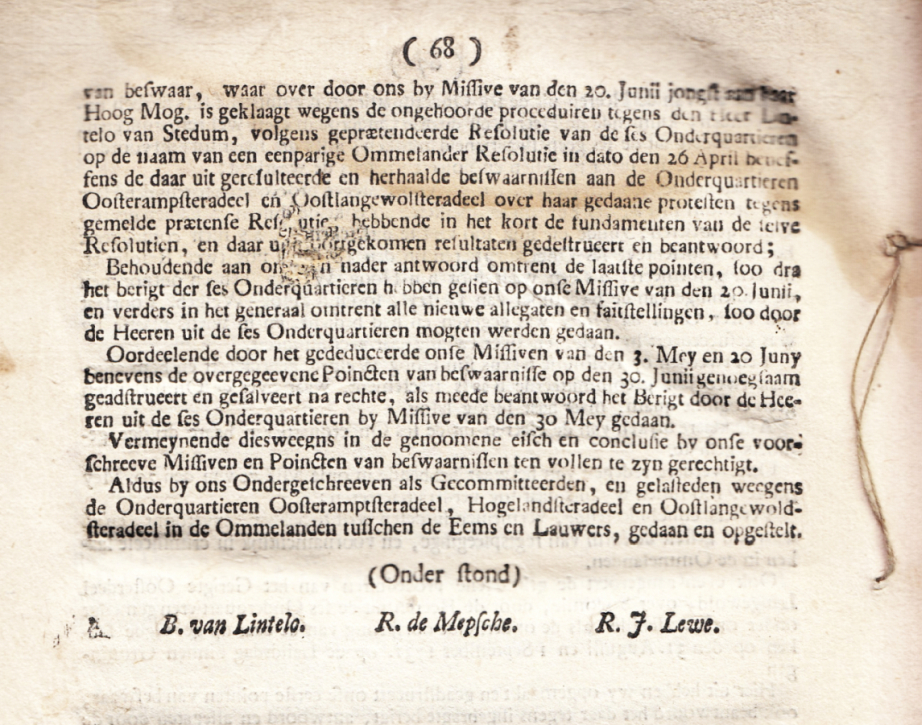 39. 1731. MEPSCHE, Rudolph de Na dat het Hoog Ed. Gerigte van Oosterdeel-Langewold ons onderschreevene had versogt, om voorschreeve Gerigte in des selfs swaarwigtige beesoignes noopens vier en twintig Prsoonen, soo over de verfoeyelyke sonde van Sodomie by voorschreeve Gerigte in detentie genoomen waaren, te adsisteeren. (Sic). & Hoog Mog. Heeren, Jonkeren, Hovelingen, Eygen-Erfden en Volmagten der Onderquartieren Oosteramptsteradeel, Hoogeland-steradeel en Oostlangewoldsteradeel (…) vinden sigh gedrongen (…). & Memorie, dienende tot adstructie van soodane poincten van bewaarnis, als op den 30 Juny 1732 in Conferentie zyn overgegeven aan haar Hoog Mog. Gecommitteerden de Heer Tork en andere, door de Heeren Lintelo, Heer van Stedum, en Mepsche, Heer van Faan (…). No place or publisher, 1732. No binding, just sewn together. 20; 32; 68 p. 1st editions. Uncut. Outside and edges a bit worn. Some unimportant stains. The last pages have a hole, causing the loss of some letters.
€ 2500
* Advice issued at the request of the Court of Oosterdeel-Langewold in the Province of Groningen by lawyers Arnoldus Rotgers, A. Reichle, P. Alberthoma and G. Froon about the criminal proceedings concerning sodomy. All these lawyers sided with De Mepsche. Endless deliberations peppered with historical grievances dating back for centuries. The first of the three books is titled ‘After the Honourable Court of Oosterdeel-Langewold had requested us undersigned, to assist the said Court in its own serious affairs concerning twenty-four Persons, who were taken into custody by the said Court for the abominable sin of Sodomy’.
This long-winded title is a summary of lists of sodomitic acts of the 24 accused. Some random examples: ‘Once on the jetty at the Luyck on the north-west side; that Ian had said, that it would have been on the north side, but it could not have happened there, because there was wood there at the time; a year and a half ago, reciprocal.’
‘With Ouge van Garnwert twice, reciprocal’.
‘Gerrit Frerixs declared on 1 June 1731: that Sicke Arents ‘first persuaded him to do it, that he truly did not know about it before; that the Devil blinded his senses to such an extent that he could not fight against it.’
The second, ‘Honourable Gentlemen, Squires, Courtiers (…), Owners and Proxies of the Sub-Quarters of (…) find themselves compelled’. Tedious legal details.
The third, ‘Detailed outline of the relations and legal obligations of the administration of the surrounding areas of the province of Groningen’ dated June 30, 1732, after a historical sketch of the practice of law since 1594, about the accusation of bias because many of those accused of sodomy were landowners or their relatives of the opposing party in the provincial government.
40. 1731. (FAAN). TRESLING, T.P. De Warven en de Hoofdmannen-kamer, of het voormalige Provinciaal Geregtshof, binnen de stad Groningen, in verband beschouwd met de Staatkundige Geschiedenis van dit Gewest door Mr. T.P. Tresling. Groningen, J. Oomkens, 1839. Original printed wrappers. (8), 152 p. 1st edition. Spine covering at the bottom is missing, otherwise a very bright and beautiful copy. Inscription on p. (1): ‘Kloosterburen, 5 Nov. 1903’ and a number 997.
€ 150
* ‘The ‘Warven’ and the Headmen’s Chamber, or the former Provincial Court, within the city of Groningen, considered in connection with the Political History of this Region’. A Warf, plural Warven, was a meeting of judges where serious legal questions were decided. On p. 103-125 an extensive description of the De Mepsche affair from around 1731-1734, especially from a legal point of view.
41. 1731. (FAAN). ZIJLMA, G. Een monsterproces. Bijdrage uit de lijfstraffelijke rechtspleging der Ommelanden in de eerste helft der achttiende eeuw. Overgedrukt uit de Provinciale Groninger Courant, Januari 1889. Modern half-cloth. 98 p. With library stamps of, a.o. the Reading Society of the town of Leens. Some wear.
€ 100
* ‘A monster trial. Contribution from the corporal criminal justice of the Ommelanden (= rural Groningen) in the first half of the eighteenth century. Reprinted from the Provinciale Groninger Courant, January 1889′. Romanticized story about the persecutions of sodomites by the lord of Faan, Rudolph de Mepsche, and his accomplices, written by Geuchien Zijlma (1842-1922), a gentleman farmer from rural Groningen and a liberal politician.
42. 1731. (FAAN). POORT, H.F. Rudolph de Mepsche of de Faansche gruwelen 1731. Noordhorn, self-published, 1925. Original burgundy cloth. 100 p. With four illustrations. 2nd revised edition. Spine slightly worn, but in very good condition.
€ 100
* About the excessive persecution by rural lord and judge Rudolf de Mepsche, who accused a number of political enemies of sodomy and had them executed in a travesty of justice. This version bound in cloth is very rare; most copies were sewn. With two little notepads (one dated 1969) carrying densely written remarks about both this book and another. We have a sewn copy for you for € 25.
43. 1731. (FAAN). VISSER, Ab Rudolf de Mepse. Het monsterproces van Faan. Rotterdam, Nijgh & Van Ditmar, 1945. Cloth-backed boards. 228 p. 1st edition. Worn and discoloured.
€ 25
* Historical novel.
 47. 1748. NAME LIST OF CRIMINALS Naam-Lyst van alle persoonen, die binnen Amsterdam door beuls handen zyn ter dood gebragt; sedert het Jaar 1693 tot 1746 ingesloten. Met een korte aanwyzing van hunne Afkomst, de Misdaden om welke zy gevonnist zyn, en de wyze hoe zy hunne Executie ontvangen hebben. Amersfoort, M. Langewagen, 1748. 18th century marbled wrappers with oval handwritten title ticket. 44 p. Cover discoloured and worn at the sides.
€ 750
* ‘Name-List of all persons who were put to death by the executioner in Amsterdam; from the year 1693 up to and including 1746. With a brief indication of their origin, the crimes for which they were sentenced, and the way in which they received their execution.’ With a lot of attention for ‘sodomites’ (p. 33-36 and 42). Not in NCC, one in Worldcat (Staatsbibliothek Berlin).
 48. 1753. (BLACKMAIL) Advijs Decisoir No. 44. (Court martial case about accusations of sodomy and blackmail, manuscript). Manuscript written with brown ink on good quality paper, marked as ‘Copia’, a copy. Dated May 30, 1753. 32 x 20 cm. No binding. 48 p., of which 5 are blank. 33-35 lines per page. Excellent condition.
€ 1250
* Extensive, beautifully written manuscript, the very detailed report of a court martial case where an officer Borkensteijn had accused the elderly custos (verger) of the Broederenkerk (‘Brothers Church’) in Nijmegen of pointing to his pants to entice him to sodomy and then Borkensteijn blackmailed him. In the end, the officer and an accomplice were demoted and dismissed from service, their swords broken, before being handed over to a civil court. The verger was cleared of all blame, released and given his money back. This account of 42 handwritten pages largely corresponds to a printed article in the Nieuwe Nederlandsche Jaerboeken (August 1753, Vol. VII/2, p. 699-724).
 49. 1763. PEIFFERS, Wilhelmus Sodoms ongerechtigheit en straffe, weleer, op ’s Heren uitdrukkelyk bevel, door zynen knecht Ezechiël, (by afwezen, waarschynlyk in geschrifte,) aan Jerusalem ten spiegel voorgestelt, volgens Ezechiël XVI: 49, 50. Nu, met uitvoeriger Verklaringe en Toepassinge, (bij gebrek van uitspraak, ook in geschrifte,) aan de Gemeente van Amsterdam, ter gelegenheit van den algemenen Dank- Vast- en Bededag, op den 2 Maart 1763. Door haren Dienaar in ’t Euangelium Wilhelmus Peiffers. Met aantekeningen, over den oorsprong van de dode Zee, over de hedendaagsche wereldsche levenswijze enz. en over enige woordenverschillen in ’t stuk van de Rechtvaardigmakinge enz. door Denzelven. Als mede nog ene uitbreidinge en gebruikmakinge van Act. XXIV:24, 25. Door den heer Doddridge. Amsterdam, Hendrik Vieroot, 1763. Marbled wrappers. XII, 116 p. Uncut. Edges a bit worn.
€ 850
* The spacious title summarized: ‘Sodom’s iniquity and punishment, formerly, at the Lord’s express command, by his servant Ezekiel, (in absence, probably in writing,) presented as a mirror to Jerusalem. Now, with more extensive Explanation and Application, (in absence of pronouncement, also in writing,) to the Community of Amsterdam. With notes, about the origin of the Dead Sea, about the present worldly way of life, etc.’ Extended sermon from the senior years of Peiffers (1705-1779), an Amsterdam pastor.
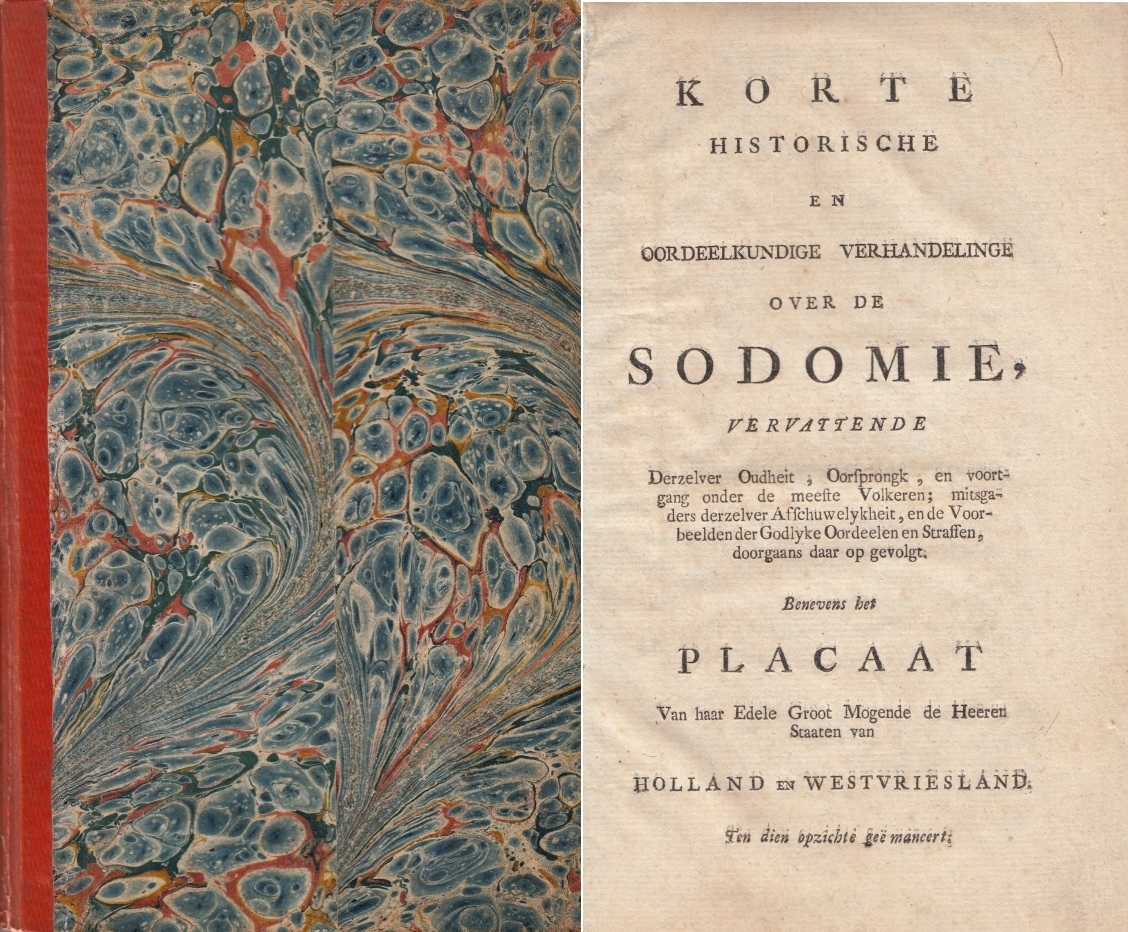 51. 1765. (SODOMY) Korte historische en oordeelkundige verhandelinge over de Sodomie, vervattende derzelver Oudheit, Oorsprongk, en voortgang onder de meeste Volkeren; mitsgaders derzelver Afschuwelykheit; en de Voorbeelden der Godlyke Oordeelen en Straffen, doorgaans daar op gevolgt. Benevens het Placaat van haar Edele Groot Mogende de Heeren Staaten van Holland en Westvriesland ten dien opzichte geëmaneert. Haarlem etc., Van Lee etc., [1765]. Paper-backed marbled boards. (4), 42 p. Little hole in the spine, otherwise a nice 18th century binding. Repair paper on last page covering some lettering.
€ 750
* “Short Historical and Judgmental Treatise on Sodomy, containing its Antiquity, Origin, and Progress among most Nations; together with its Abomination; and the Examples of the Divine Judgments and Punishments that generally followed. Together with the Placaat of the Noble and Mighty Lords States of Holland and West Friesland.” Excerpt, signed ‘L:W:K:’, from the article with the same title in the Europische Mercurius, 1730 (see no. 25 of this catalogue). Not updated: all cases are from 1730, as if nothing happened between 1730 and 1765.
 52 a. 1772. SWIETEN, Johan Fredrik van De Juichende Gevangenis van Johan Fredrik van Swieten, Burger en Inwoner der Stad’ Rotterdam, en Lidmaat der Hervormde Kerk’ aldaar: door hemzelf’ in het licht gegeven. Rotterdam, Joost vander Laan, 1772. Contemporary marbled wrappers. 30 p. 1st edition. Some brown staining splashes (like tea). Traces of use.
€ 450
* ‘The Jubilant Prison of Johan Fredrik van Swieten, Citizen and Inhabitant of the City of Rotterdam, and Member of the Reformed Church there: given into the light by himself’.
J.F. van Swieten, an esteemed baker in Rotterdam, was accused and soon acquitted of committing homosexual acts, commonly titled sodomy at the time: he had proven his innocence, citing numerous Bible passages. Rare (2 copies in Dutch libraries). See also the satirical answer to it, (Anonymous:) Krouwzel, voor de Jeukende Eerzucht van Johan Fredrik van Swieten (1772), that you may find as nr. 52 b in this catalogue.
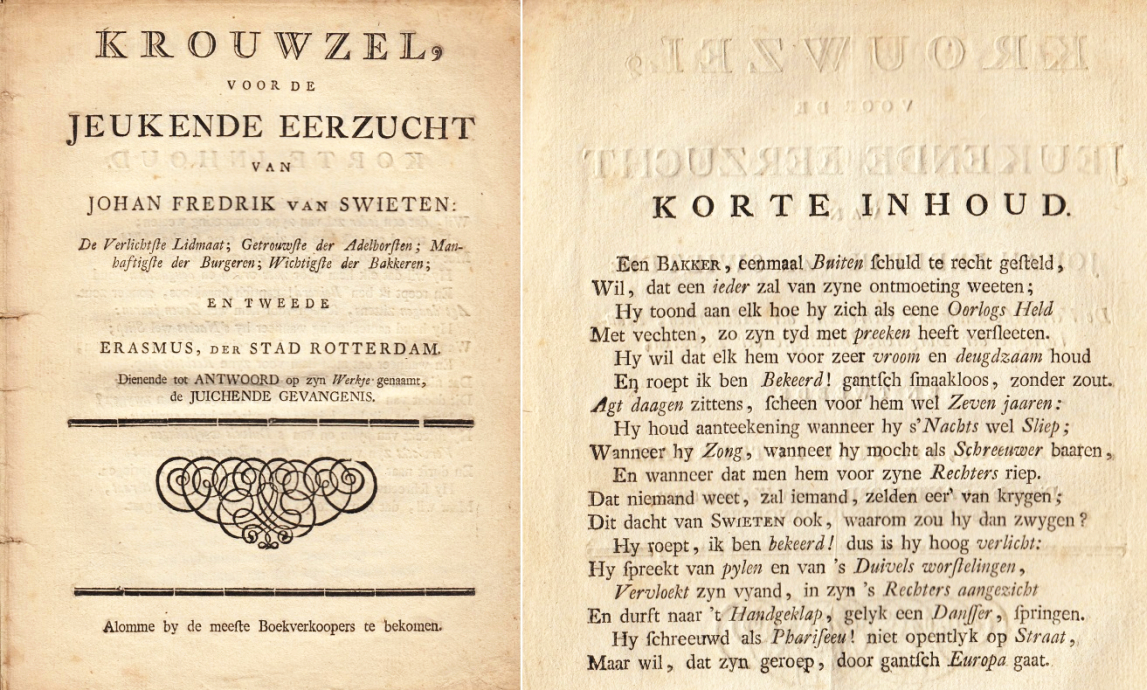
52 b. 1772. (SWIETEN, Johan Fredrik van) Krouwzel, voor de Jeukende Eerzucht van Johan Fredrik van Swieten: De Verlichtste Lidmaat; Getrouwste der Adelborsten; Manhaftigste der Burgeren; Wichtigste der Bakkeren; en Tweede Erasmus, der Stad Rotterdam. Dienende tot Antwoord op zyn Werkje genaamt, de Juichende Gevangenis. [Rotterdam], no publisher, [1772]. No wrappers. 20 p. Loose and a bit creased, partly browned.
€ 650
* ‘Scratching, for the Itching Ambition of Johan Fredrik van Swieten: The Most Enlightened Member; Most Faithful of the Midshipmen; Most Manly of the Citizens; Most Important of the Bakers; and Second Erasmus, of the City of Rotterdam. Serving as an Answer to his Work called, the Jubilant Prison.’
This is an anonymous, satirical pamphlet, a long rhyming poem, directed against Van Swieten. The ‘Krouwzel’ pokes fun at Van Swieten’s jubilant, biblical thunder and satirizes his self-righteousness. This pamphlet is virtually unknown (no copies in the libraries), the text not published elsewhere.
An advertisement for this libellous publication appeared in several Dutch newspapers in the days before Christmas 1772.
 53. 1771. (ONANISMUS). TISSOT, S.A.A.D. Verhandeling over de kenmerken, oorzaken, toevallen, behoedmiddelen en geneeswijze van het onanismus, of de zelfbesmetting, door den heer Tissot. Vermeerderd met een aanhangsel en op nieuw verbeterd door H.J. Schouten, Med. Doct. te Amsterdam. Amsterdam, Lodewijk van Es, 1827. Original flexible printed boards. (2), xxviii, 270, (2) p. Uncut. Revised and extended 4th edition. Cover repaired with glue, location numbers, some foxing.
€ 250
* First published in Latin in 1758 (as Tentamen de morbis ex manustupratione), this book by a Swiss medical doctor had an enormous influence on the perception of masturbation in the 18th century. A German and a French translation soon followed, and the first Dutch one in 1771. Tissot’s teaching was based on the ‘humours’ (as we already touched on in the first book in our catalogue) that should be in balance. The humoral theory (from Latin ‘humor’ and Greek ‘chymos’, meaning ‘juice’), which was in use at the time of the ancient Greeks and continued to prevail in ever-renewed form throughout the Middle Ages and into the Modern era. It only fell into disuse definitively in the second half of the 19th century.
An uncontrolled ejectment of the wrong fluids, Tissot supposed to be the cause of all sorts of ailments. Fatigue, lethargy, and early death are commonly observed symptoms. This is a post-1800 edition, but nevertheless should fit in here.
 54. 1790. VOGEL, S.G. Onderwijs voor ouders, opvoeders en opzieners van kinderen, over de manier, hoe de ondeugd der verwoestende zelfbevlekking, die zo verbaazend algemeen is, op de veiligste wijze kan ontdekt, verhoed en geneezen worden. Haarlem, A. Loosjes Pz., 1790. Contemporary calf-backed boards. XXXVI, 196 p., with two tiny illustrations of children’s straitjackets. 1st edition. Binding rather worn, too large for this book, and casing loosening. Lacks halftitle. Inside a very good copy, uncut and clean.
€ 390
* ‘Instruction for parents, educators, and guardians of children, in the safest manner in which the vice of destructive self-pollution, so astonishingly common, may be discovered, prevented, and cured.’ A guide for the educator of young children against masturbation looking scientific but also radiating child love. Any self-induced pleasure is combated with a firm hand, such as straitjackets to sleep in, if necessary, with infibulation of the penis or vagina that must be checked every morning.
 55. 1794. VOGEL, S.G. Onderwijs voor ouders, opvoeders en opzieners van kinderen, over de manier, hoe de ondeugd der verwoestende zelfbevlekking, die zo verbaazend algemeen is, op de veiligste wijze kan ontdekt, verhoed en geneezen worden. Haarlem, A. Loosjes Pz., 1794. Contemporary plain limp boards. XXXIV (+ 2, register), 194 p., with two tiny illustrations of children’s straitjackets. 2nd edition. Binding a bit loosening and worn. Some pages loose, inside bright and uncut.
€ 300
* As before.
59. 1798. OEST, J.F. Allernoodzakelijkste raad en waarschouwing voor jongelingen en jonge dochters, ter vermijding der onkuischheid in het algemeen en der zelfbevlekking in het bijzonder. Vertaald naar den tweeden Hoogduitschen druk van een bekroond prijsschrift. Benevens eene onderrigting voor ouders en opvoeders, hoe men de jeugd op eene veilige en gepaste wijze, met ’s menschen voortteeling en de gevolgen der zelfbevlekking kan en moet bekend maken. Zijnde een bijvoegsel tot S.G. Vogel’s Onderwijs voor ouders enz. Hoe de ondeugd der zelfbevlekking op de veiligste wijze kan ontdekt, verhoed en genezen worden. Rotterdam, J. Bronkhorst a.o., 1798. Modern cloth.
€ 490
* ‘Most necessary advice and warning for young men and young daughters, to avoid unchastity in general and self-defilement in particular. Translated from the second German edition of an award-winning prize book. In addition to an instruction for parents and educators, how one can and should familiarize young people in a safe and appropriate manner with human reproduction and the consequences of self-pollution. An addition to S.G. Vogel’s Education for Parents, etc. How the vice of self-defiling can be discovered, prevented and cured in the safest way.’ A classical book against masturbation.
STRANGE DESIRES
Attitudes to Alternative Sex in Print 1472-1800
Preface
 This catalogue explores the history of homosexuality and some other forms of sex that were frowned upon in the period after the invention of the printing press.
To indicate a few limitations: the primary focus is on men in the Western European world, and the period ends with the year 1800. It is a personal collection of what we have managed to find from this period and therefore has a strong Dutch accent. We have been able to acquire some important items from the extensive collection of A.G. van der Steur (1938–2012), an inspiring collector and befriended bookseller.
According to the prevailing philosophy during the period of this catalogue, sexuality in marriage and the production of offspring expressed order. It was a condition of civilization. Sexuality outside marriage (adultery, homosexuality, masturbation), without the purpose of childbirth and family life, caused disorder and unrest. It should be fought.
In the Christian West of Europe, the attitude towards homosexuality was dominated by a Bible text from the Old Testament, which deals with the destruction of the city of Sodom. It is a chapter from the first book of the Bible: about Lot, a man who welcomes two guests into his house, but the inhabitants of the city want him to hand over his guests ‘so that we may know them,’ a euphemism for sexual possession. Lot and his two guests manage to keep the pushy men outside. The next day, the entire city of Sodom and surrounding areas are destroyed by God’s vengeance. Only Lot and his family escape.
This is the central theme of the Bible chapter Genesis 19, this is the reason why homosexual acts were equated with sodomy. There are all sorts of difficulties with the story and its interpretation—for example, Lot offers his two virgin daughters to the townspeople as compensation, in vain. Moreover, the women of Sodom are not considered anyway: they die by God’s vengeance along with their husbands, who were the actual rapists, after all.
According to other objections, the problem would be the violation of the right of hospitality, or the general arrogance of the citizens of Sodom; it would be coercion, or the impulse to subdue and humiliate strangers or enemies by raping them—but these are all unimportant sidetracks.
 (Nr. 2)
In the Middle Ages and the Early Modern period, the prevailing interpretation was that homosexual acts were sodomy. Sodomy is not always homosexual activity, for the concept encompasses all forms of sexual activity not intended for human reproduction, such as sex with animals or non-vaginal sex between men and women. Then there is masturbation: this can be a solitary pleasure or a mutual, which may lead to sodomy.
Sodomy was a sin that cried out for vengeance, a crime that should be discussed as little as possible, and whoever was a proven sodomite directly deserved the death penalty—especially one of the most painful, humiliating, and human-erasing kinds. In mediaeval Europe, the death penalty was gradually carried out more frequently and more severely for sodomy, yet it remained a rare phenomenon, giving rise to numerous myths.
Thus, sodomy (according to Protestant authors) was chiefly prevalent in Roman Catholic countries, and clearly it was Italy that incurred an accusatory look. Some believed the hot climate fostered sodomy, and a persistent legend suggested that Catholic dignitaries were allowed to indulge in sodomy during the three warmest months. According to others, the hot summer caused listlessness and was the most chaste period of the year.
In Britain, an active homosexual subculture became visible in the late seventeenth century, specifically through the work of the Society for the Reformation of Manners, which intended to capture prominent Britons at their most intimate.
This occurred at an exponential rate in the Netherlands about thirty years later. The national fear of an angry God who struck with wars, floods, cattle diseases, and pileworm (a wood parasite that affected shipping) looked for a culprit and found it in the sodomites who were discovered in droves in the city of Utrecht around the dawn of the year 1730.
A shrill and dangerous light suddenly exposed men who had felt safe in their intimate friendships and in their hidden, unknown pleasures. You might feel like David and Jonathan, but then you wake up in the horror story of a deadly Bible book, where thy neighbour is not loved but executed.
(Nr. 19)
One person reported the next, and in that infamous year 1730, a crusade was launched against the monster that had recently become visible. Prosecution brought about four hundred men (no women, of course) to justice, leading to the execution of a hundred of them; most others managed to escape death by fleeing the Netherlands overnight. Numerous publications exposed each individual by name, while hate-filled pamphlets and other writings openly shamed them.
This judicial frenzy had a gruesome sequel in a remote rural quarter, located west of the ancient city of Groningen. A local squire, Rudolph de Mepsche, ‘discovered’ in 1731 a large number of sodomite farmers and workers’ sons, who were executed en masse: more than twenty men were killed in one day. Such a number was never achieved in other, larger Dutch cities. After that, the judicial frenzy subsided again. Had God’s wrath also ended? The economic decline of the Netherlands? No one knows the answer.
In 1733, the anti-sodomy storm finally died down. Temporarily, because later in the eighteenth century a new crusade was organised from time to time. For example, around 1765, 1776, and 1795-1798. Napoleon’s annexation of the Netherlands and the introduction of French penal legislation in 1811 marked the end of the deadly persecutions.
THE SATIRES OF JUVENAL
But we’d want to discuss another topic in which homosexuality surfaces in writing: classical literature. People in Roman and Greek antiquity had a different attitude towards sexuality outside of heterosexual marriage: the gender of the sexual partner was not important, only the role—active or passive. In the Roman belles-lettres, several characters appear who habitually express love for objects of the same sex. And some of these literary texts remained popular long after the time of the Greeks and Romans: in the Middle Ages, they were spread in the civilised world by copying and reciting. These old poems and other texts brought with them the concept of homosexual love.

(Nr. 10)
One author who made very clear references to homosexuality in his verse is the Roman poet Decimus Iunius Juvenalis (around 100 CE), known for his sixteen Satires, stinging witty poems commenting on society and social morality.
These Latin poems have been preserved almost verbatim. They were read by those who knew that dying language and translated for those who did not—from the time of Juvenal himself until 1800, the end date of this catalogue. Hundreds of mediaeval manuscripts have survived, and the Satires were first printed around 1469. The first translation, into Italian, was printed in 1480, and in our catalogue you will find the second edition of this book.
In my search for texts that bring homosexuality to the surface, I focused on mentions of sodomy, but also on those satires of Juvenal and as well on the attitude towards masturbation, which comes to the spotlight in the eighteenth century.
You will find an essay of mine on this subject (dating from 2002) at the end of this catalogue (readable in Dutch on our website).
Paul Snijders
(Reactions and orders may be sent by answering the email. Our email address is at the foot of each page of our website. All pictures will enlarge if you click on them.)
Attitudes to Alternative Sex 1472-1800. In 50 titles and 10 rare studies
1. 1472. GERSON, Johannes De cognitione castitatis et de pollutionibus diurnis. Forma absolutionis sacramentalis. [Cologne, Printer of Dares (=Johannes Solidi (Schilling)), about 1472]. 20 x 15 cm. Recently bound in a handwritten vellum leaf dating from the earlier fifteenth century (containing a fragment of the commentary by the Venerable Bede on the Gospel of St. Luke, chapter 19, with some music). 16 leaves (complete). Latin text. Many ligatures and abbreviations. Rubricated and with decorative initials with simple extensions. Several marginal reader’s remarks plus a drawing of a cross, some underlining. Professional paper repairs to blank upper margins.
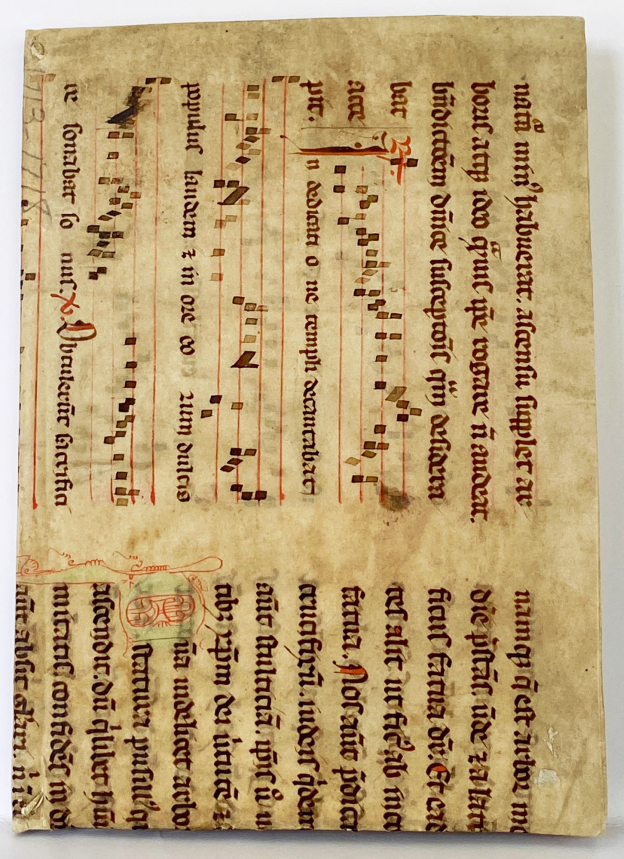 (Binding)
Eleven editions were published between 1467 and 1490. The first was issued in Cologne (1467); this is the fourth, printed anonymously by Johann Schilling – whose name was latinized as Solidi. Excellent condition. 26 copies of this edition in public institutions, none in Belgium or the Netherlands. Goff G197. ISTC ig00197000.
€ 11 500
* ‘On the knowledge of chastity and pollutions in the daytime. The form of sacramental absolution’. A short essay, written about 1412, about chastity and involuntary discharge of semen during the day (as opposed to pollutions in sleep, about which Gerson wrote another essay). In Gerson’s eyes, both men and women can produce body fluids (‘humores’) when they are sexually stimulated, even without wanting to.
Among other things, the text is about the question of whether a priest is unclean after a pollution and whether he may then still perform sacred acts. A priest who goes to a parishioner on horseback may become excited by the ride and thus come to emission. According to Gerson, this is not a mortal sin, as long as he does not focus on sexual pleasure. He warns against intimate friendships that can lead to sensuality. This in turn may evolve in ‘mollicies’, literally softness in Latin, but understood as self-pleasure or masturbation.
On the other hand, in Gerson’s eyes a certain satisfaction about a successful pollution is permitted, because it brings relief. One may pray for physical release while acting as if one did not desire for sexual satisfaction. Gerson has a remarkably light attitude to sexual feelings: don’t worry too much and direct your thoughts on other things! Say to yourself: “phy – phy de vobis cogitationes vilissime procul hinc abite in malam horam veneritis sum aliis occupatus” (p. 21). Go away, away, filthiest thoughts, you have come in a bad hour, I am busy with other things.
 Wear a cross on your chest or your forehead, it will help. (And one of the early readers of this book has drawn a large cross in the margin to stress the point). Keep yourself from thinking about sex and trust in God. Maybe hypocritical, but a rather practical solution.
Thus, a remarkable text, written about 1412 and preserved in several manuscripts as well as eleven printed editions. Johann Schilling’s has been identified as one of the workshops where William Caxton first came to observe the printing process. A rare and early incunable, as well as a highly intriguing text about medieval man and the functions of his body, with significant historical value.
 2. 1479. AUSMO, Nicolaus de Supplementum Summae Pisanellae. & Alexander de Nevo: Consilia contra Judaeos foenerantes; & Astesanus de Ast: Canones poenitentiales. Venice, Leonardus Wild, ‘1489’ [a misprint for 1479]. 4to. 19 x 15 cm. Rather worn supple vellum. Four leaves, v3-6 are missing and were contemporarily replaced by manuscript copies, expertly written by a medieval professional! The rubrication and binding only took place afterwards. The first printed page (A2) is attractively illuminated with a multi-coloured and gilt initial Q, four borders filled with colourful flowers and gold balls, blue-red-green leaves, a shield (still empty), all empty space around it filled with lively and elegant hatching. The text contains numerous small initials in red and blue (some with extensions), rubricated. With many tiny marginal notes, presumably from the 15th century. Two owner inscriptions covered with tipp-ex. One is partly readable and may refer to a Carmelite convent as a previous owner. Strip of unprinted paper missing at the end. Binding restorations by Henk Linde. Goff N72 (this is the variant of N71 with quires a-e reset. Only 9 variant copies mentioned of a total of 180 in the libraries). ISTC in00071000.
Sold
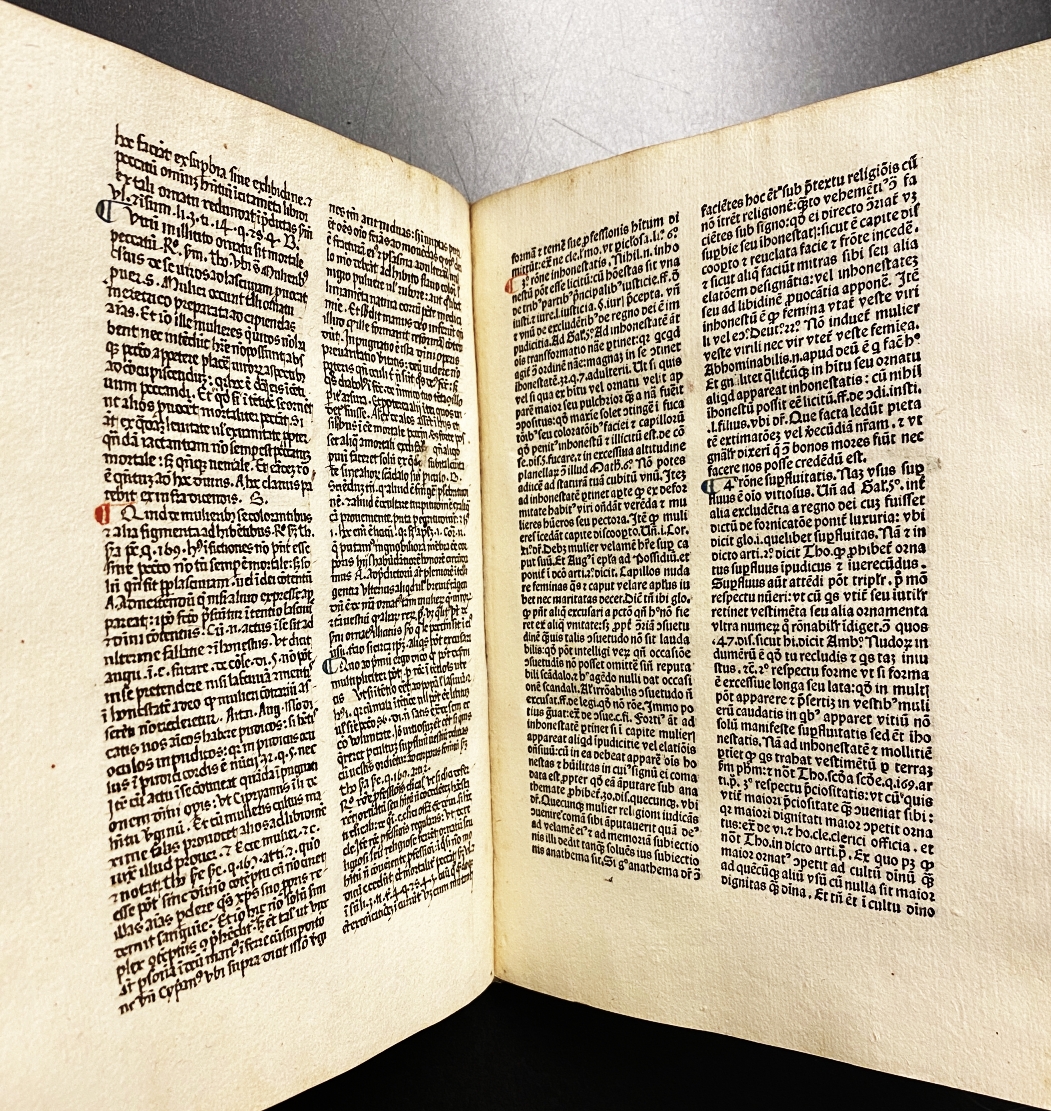 (Left a written page, right a printed one)
 * ‘Supplement to the Summa Pisanella. & Alexander de Nevo: Advice against the moneylending of the Jews; & Astesanus de Ast: Penitential canons.’ Completed in 1444, an encyclopaedia: an alphabetical summary of canonical laws, a revised and extended version of the canon law collection by Bartholomaeus de Sancto Concordio (Pisanus). In this edition, the theological encyclopaedia is followed by two other books by different authors, a tract against Jewish moneylenders plus a piece about penitential law.
For this catalogue, we should mention the paragraphs about erotic sins, like luxuria (lust), mollicies (self-pleasure), pollutio (defiling) and sodomia. What canonic law says about that last word is summed up succinctly: If anyone has sinned against nature, and he is a cleric, he must be deposed. Or if it appears that he can be corrected, he must pay perpetual penance in a cloister. If he is a layman, he is to be excommunicated and alienated from the congregation of the faithful until worthy satisfaction. But condemnation comes with the last punishment. ‘Propter hoc peccatum deus iratus mittit pestilentias fames et terremotus.’ Because of this sin God, irate, sends pestilences, famines and earthquakes. These last were associated with sodomy because God smote the city of Sodom upside down (in ancient Greek: ‘katestrepsen’ = He turned upside down in the Greek Bible).

3. 1493. SCHEDEL, Hartmann ‘Sodom et Gomorra’. From Liber chronicarum, fol. 21. [Nuremberg, Anton Koberger, 1493]. One folded leaf (4 p.), num-bered Folium XXI and XXII. 42 x 30 cm. With 8 larger and smaller hand-coloured woodcuts, one of which depicts the destruction of Sodom and the escape of Lot with his family, led by an angel. This woodcut measures 22 x 12.5 cm. The bifolium is a bit worn and creased; the fold has been repaired (outside the text). Colours paled.
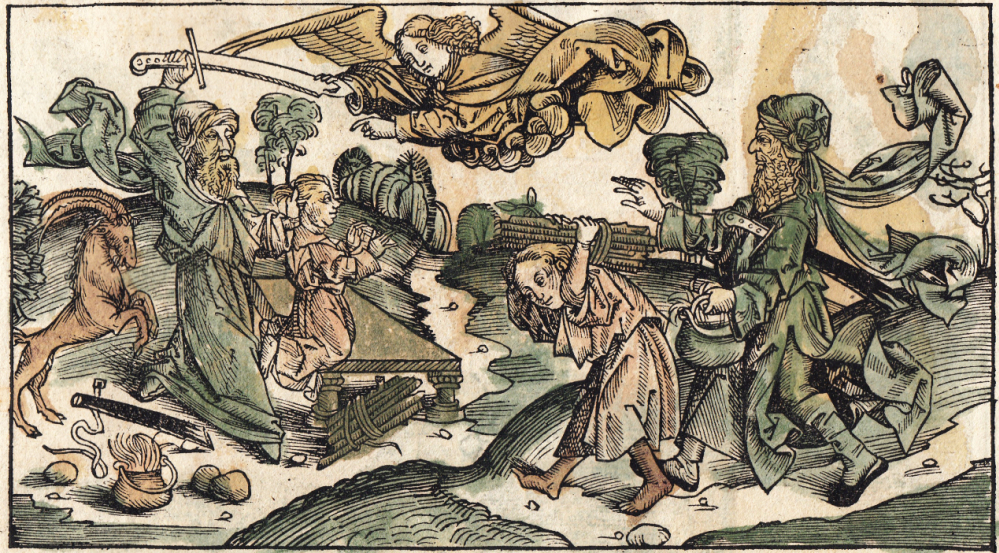 (Sacrifice of Isaac)
The Sodom woodcut is on the first page of the folded leaf. On the verso is a picture of Abraham meeting Melchizedek followed by a family tree. Page 3 shows a large depiction of ‘Memphis vel Chayrum’, Memphis or Cairo, in the form of a strongly walled city; and page 4 depicts Abraham’s sacrifice of his son Isaac: an angel staying Abraham’s hand and a ram practically charging into his back. All the eight woodcuts are beautifully constructed and brilliantly executed, with a hint of fun even. The light colouring makes all the details stand out perfectly.
Sold
* The Liber Chronicarum or Nuremberg Chronicle (Goff S307; is00307000) is an encyclopaedia of world and Bible history, written by a Nuremberg medical doctor based on his own huge personal library. The 645 woodcuts in this amazing book were made by (the workshop of) Michael Wolgemut and his stepson Wilhelm Pleydenwurff. Albrecht Dürer (only 18 years old) was then a pupil of Wolgemut.
Schedel’s text below the woodcut offers a basic Sodom story: in the 99th year of Abraham’s life, his kinsman Lot lived there. God sent two angels to test that proud and hedonistic city. Lot invited them under his roof. Then the people of Sodom gathered to his gate, intending to abuse the two angels who were visiting him. Lot declined and offered them his virgin daughters instead, but the Sodomites refused to listen.
The angels struck the people of Sodom with blindness, leaving them unable to find the door of Lot’s house. Then God decided to destroy the cities of the plain. He rained fire and brimstone and overthrew Sodom, Gomorrah and the other places in the area. The land became salty and sterile, the lake died.
Lot, his wife and his daughters were led away to save themselves on the mountain, and they were not allowed to look back at the destruction. But Lot’s wife disobeyed the command and was transformed into a pillar of salt. On the mountain, Lot’s two daughters got him drunk and mingled with him. The eldest had a son by him, named Moab, and the younger also had a son named Ammon. They became the ancestors of the Moabites and the Ammonites, the peoples who lived there in the ‘Syrian’ valley: the valley east of the Jordan River.
This is shown in the large woodcut above the text: to the left, a walled city is being destroyed, some cathedral-like buildings being overturned by a storm of rays and large objects. To the right in the foreground a small group is walking out: an old man, looking annoyed, is being led away by a smiling angel, followed by two finely dressed young women. A statue-like woman stands in the centre, gazing out at the disintegrating metropolis.
4. 1527. IUVENALIS, Decimus Iunius Iuvenal tradotto di latino in volgar lingua per Georgio Summa Ripa veronese, novamente impresso. Toscolano, Alessandro Paganini, (between 1527 and 1533). 15 x 9.5 cm. 18th century boards. Signatures a-q8. (128) p. including two blanks at the end. Title on the recto of the first leaf, subtitle on verso. Colophon in a double frame on verso of the last text page. Translation of the sixteen Satires of Juvenal into Italian by Giorgio Sommariva. The text is mainly printed in a cursive type, with the addition of several printed pointing hands. Guide letters in capital spaces. 2nd edition: this translation was first published in 1480 (Treviso). Spine worn blank, sides of the decorated paper also worn. Inside the book are some stains and moisture lines. A few notes in pencil and in ink, and some scribbling on p. (122).
€ 1200
* Faithful translation into Italian by Giorgio Sommariva (1435-1497), a lawyer and member of the City Council of Verona. With an introduction by Summa Ripa / Sommariva in verse, where he sums up the themes in the sixteen Satires. In the three poems where homosexual love and sex is alluded to, it is consequently called sodomy, or the sodomitical sin, that to judge from these poems was considered well-known in his days. In Mediterranean countries, sodomy was often part of male socialization. The late fifteenth century saw attempts to eradicate this behaviour, for instance Savonarola’s campaign against vice.
Juvenal’s coarse similes are faithfully translated. See this citation in Latin from Satire II: ‘Taedia non lambit Cluviam, nec Flora Catullam. Hispo [sometimes rendered Hippo] subit juvenes, et morbo pallet utroque.’ Morbo utroque = ‘fellandi et paedicandi, dum agit et patitur’, says Lubinus, one of the scientists quoted in the Schrevelius edition (see no. 8 and 10 of this catalogue) of Juvenal: oral and anal sex, both active and passive. So literally: ‘Taedia does not lick Clivia, nor Flora Catulla. Hispo goes under the boys to turn pale from two-sided passion.’
In Italian:
‘Flora Catulla gia non va lambendo/
Ne Thedia Cluvia. Ma Hispo ben patiente/
Per l’un e l’altro mal va ben pallendo.’
John Dryden would translate this in 1692:
‘Flavia may now and then turn up for Bread,
But chastly with Catulla lies a Bed.
Your Hispo acts both Sexes parts, before
A Fornicator; and behind, a Whore’.
Nothing about an incoming pallor, but the essence is clear.
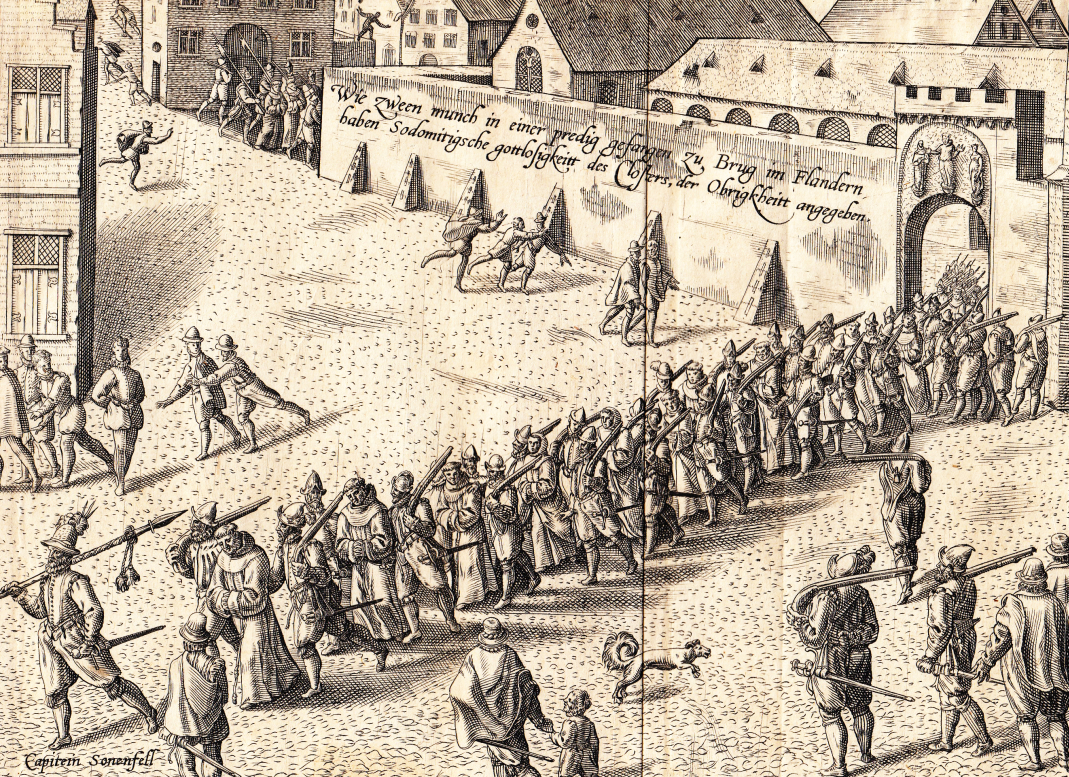
5. 1578. (SODOMY IN BRUGES AND GHENT). HOGENBERG, Frans Two engravings depicting monks punished for sodomy, 1578. Taken from a collection of Geschichtsblätter, Leaves of History. Each engraving pasted on a larger passepartout leaf of much later, yellowed paper, folded to fit on a stub in a book. Two of the very earliest representations of punishing homosexual acts. From the collection of Haarlem historian and antiquarian A.G. van der Steur, with his pencilled numbers.
1. Wie zween munch in einer predig gefangen zu Brug im Flandern haben sodomitigische gottlosigkeit des Closters, der Obrigkheitt angegeben. With caption text in German doggerel (14 lines) under the picture. Dated Anno Dni MDLXXVIII 18 Meij. Oblong 210 x 271 mm.
Sold
 * Literally: ‘How two monks caught in a sermon in Brugge in Flanders have reported the sodomite godlessness of the monastery to the authorities’. Dramatical portrayal of the extradition of at least a dozen monks, firmly escorted by an extensive contingent of soldiers. No. 17 of the Geschichtsblätter by Frans Hogenberg (c. 1535-1590), the foremost topographical engraver of his day. The doggerel says: ‘A miracle has shortly passed in Bruges, that two minorite friars caught in the doctrine of Calvin were delivered to their guardian (father superior), who had them beaten with rods. The monastery was then examined for sodomy, and many turned out to be infected. When the monks had confessed this, they were led as prisoners to the gate because of their impiety, at Bruges in Flanders’.
2. Execution uber sodomitigsche Buben binnen der Statt Gendt. With caption text in German doggerel (10 lines) under the picture. Dated Anno Dni MDLXXVIII XXVIII Junij. Oblong 207 x 279 mm.
* Dramatical depiction of the arrest and execution of monks at a monastery in Ghent (June 28, 1578): Five monks are burned at the stake and three others flogged in front of a crowd. The four mendicant religious orders were expelled from town, the rhyme says.
6. 1578. (SODOMY IN BRUGES). HOGENBERG, Frans Wie zween munch in einer predig gefangen zu Brug im Flandern haben sodomitigsche gottlosigkeit des Closters, der Obrigkheitt angegeben. Taken from a collection of ‘Geschichts-blätter’, Leaves of History. With caption text in German doggerel under the picture. Dated MDLXXVIII 18 Meij (May 18, 1578). Oblong 210 x 273 mm.
Sold
* As before, no. 1 only.
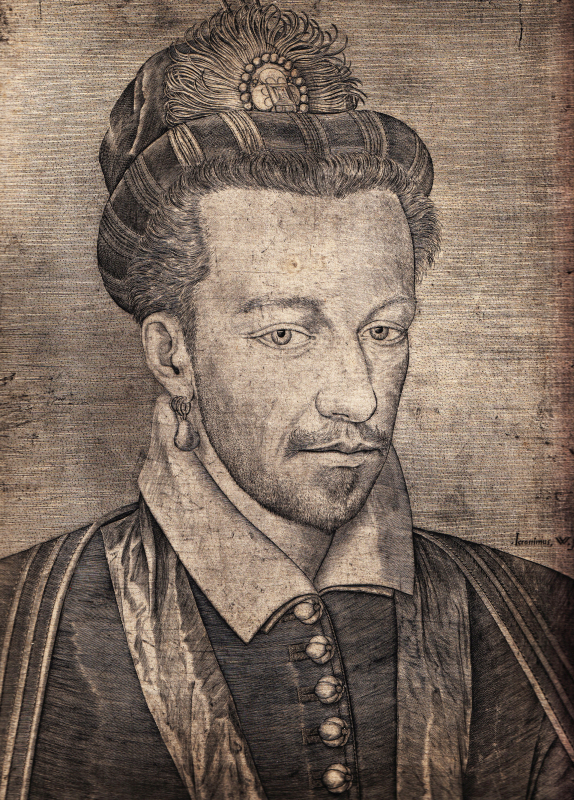 7. 1585. WIERIX, Hieronymus Portrait of King Henry III of France. Copper engraving. 35.4 x 25.1 cm. Trimmed short. Little stains both in the ink and on the paper. Remains of mounting on reverse. Hollstein 2093. BM 1858,0417.1379.
Sold
* Engraving after a painting ascribed to Dumonstier or Quesnel, representing the monarch “with a Polish hat” (Henry had briefly been king of Poland). Signed in the plate ‘Hieronymus W. fc’ and believed to have been engraved between 1580 and 1589. The young king is depicted in fine clothes, rings and with a large pearl dangling from his ear, wearing a feathered hat atop well-coiffed hair. But his low-lidded haunting gaze reveals his public image as ‘king of the mignons’, surrounding himself with smart and handsome young men. The image served opponents well in the early modern period to publicly discredit a man: by labeling him a sodomite (for example, see no. 25 of this catalogue). Whether he was, is a matter of debate.
The couplet under the portrait translates: ‘Painter, that your art imitates Nature/ In the picture of this King whose honour touches the Heavens/ Paint Pallas on his head, Mercury on his lips/ Mars on his face, and Love in his eyes.’ (See inside rear cover).
8. 1648. IUVENALIS, D. IUNIUS, & Aulus PERSIUS FLACCUS Satyrae cum veteris scholiastae & variorum commentariis. Accurante Cornelio Schrevelio. Leiden, Franciscus Hackius, 1648. Contemporary vellum. Marbled endpapers and matching marbled edge decoration. (16), 641, (41) p. Engraved title. All text in Latin. 1st edition. Spine darkened. Binding slightly worn and with various spots. 18th century? name on title: ‘F. ab Heerdt’. Some inked crosses in the margins.
€ 250
* A compact yet complete Latin Juvenal and Persius edition with small-type remarks and annotations on every page. Edited by the famous Leiden philologist Cornelius Schrevelius. Probably the Dutch translators used this excellent text for their interpretations. It was reprinted several times in the 17th century (see no. 10 of this catalogue).
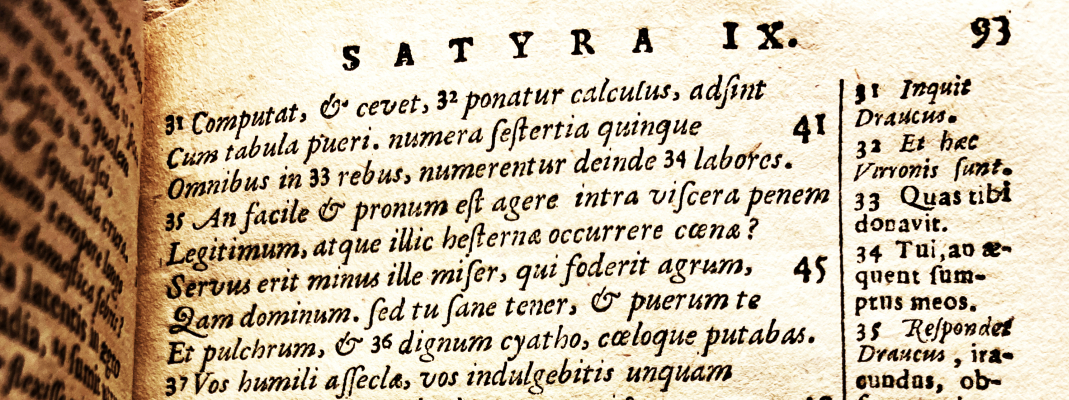 9. 1650. IUVENALIS, D. IUNIUS, & Aulus PERSIUS FLACCUS Satyrae. Cum annotat. Th. Farnabii. Amsterdam, Ioannes Blaeu, 1650. 14 x 8 cm. Vellum. 190 p. With title engraving. All text in Latin. First endpaper repaired. Title pencilled on the spine. Inscriptions by John Morison(e) from 1713 and 1716, and an ‘M’ plus scribble at the bottom of the title.
Sold
* Convenient paperback edition of Thomas Farnaby’s Juvenal edition. The Latin text is set in fine, tiny italics (the picture is a close-up), surrounded by the commentary in easy-to-read minuscule Roman, with a few equally small Greek words in between. The engraving shows a satyr and a jester standing around a sphere with musicians and a dazed dancer. (Picture of this title print in our essay ‘Juvenal’s Bad Figs’ below).
10. 1684. IUVENALIS, D. IUNIUS, & Aulus PERSIUS FLACCUS Satyrae cum veteris scholiastae & variorum commentariis. Editio nova. Qua quid praestitum sit, praefatio ad Lectorem docebit. Amsterdam, Henricus Wetstenius, 1684. 19th century vellum with 5 ribs and leather title ticket. Marbled endpapers and matching marbled edge decoration (see the picture!). (48), 525, (110); 112, 22 p. With title engraving. Reprint edition (first: 1648). All text in Latin. Upper joint cracked. Save for this fault a handsome book!
€ 300
* Later edition of no. 8 of this catalogue.
11. 1700. JUVENALIS Satyra X, of Tiende Berispdicht. In Nederduitsche Vaerzen vertaald, én met Aantekeningen vermeerdert. De twede Druk overzien, en van veele misslagen gezuivert. Amsterdam, Nil Volentibus Arduum, 1700. Sewn with contemporary marbled paper. (16), 48 p. With engraved frontispiece and etched title page by Gerard de Lairesse. Signed in writing under the preface by ‘Y.W.’ alias Ysbrand Vincent (1641-1718), paper manufacturer and secretary of the theatre company Nil Volentibus Arduum. Uncut. 2nd revised edition.
€ 325
* ‘Satyra X, or Tenth Poem of Reproof. Translated into Dutch Verses and augmented with Notes. The second edition reviewed and corrected of many errors’. Bilingual edition in Latin and Dutch. Extensive introduction about the life of Juvenal. With footnotes. It appears from the preface that ‘in order to avoid offence, the Poet has deliberately not been followed exactly in a few places’.
12. 1709. JUVENALIS, Decius Junius, & Aulus Persius FLACCUS Alle de schimpdigten van Decius Junius Juvenalis en A. Persius Flaccus door verscheide Dichteren in Nederduitse vaarzen overgebracht. Haarlem, Wilhelmus van Kessel, 1709. Leather-backed boards. 2 parts in 1 volume. (38), 330; (20), 66p. Masterly engraved frontispiece by J. Goeree. 1st edition. Some colouring of the frontispiece and a few other little stains.
€ 300
* ‘All the satirical poems of Decius Junius Juvenalis and A. Persius Flaccus translated into Dutch verse by various poets.’ Dedicated in print to the young and gifted poet and translator Lukas Schermer (1688–1712), who was already terminally ill and doomed to die. Nevertheless, Schermer produced a large body of work in his brief lifetime, including numerous translations from Greek and Latin. Several of Juvenal’s satirical works that feature homosexual parts have been translated into Dutch by various poets and included in this anthology. Comparing gives us an idea of how certain Dutchmen perceived the enigmatic, damning phenomenon of homosexuality in the 17th century. / A modern translation by Marietje d’Hane-Scheltema (2007) was added to this collection.
13. 1713. JUVENALIS, Decius Junius, & Aulus Persius FLACCUS The satires of Decimus Junius Juvenalis and of Aulus Persius Flaccus. Translated into English verse by Mr. Dryden, and other eminent hands. Together with the Satires of Aulus Persius Flaccus. Made into English by Mr. Dryden. With explanatory notes at the end of each satire. To which is prefix’d a discourse concerning the original and progress of satire. London, Jacob Tonson, 1713. 13.5 x 8 cm. Contemporary calf. (162) [misnumbered for (142), 2], 372 p. Frontispiece, 22 plates (one for each poem) and 2 portraits. Separate title page for Persius’s ‘Satyrs’. Contemporary calf, a bit rubbed, corners worn, hinges starting. Some foxing and browning. With inscriptions: page numbers pointing to marked passages, and two owner’s signatures, of Henry Blackwall and Daniel Astle[y].
Sold
* Complete translation of the satires of Juvenal and Persius with notes at the end, by several authors, first published in 1693. Adorned with plates. This is a nice and compact little volume that you could carry in your breast pocket, getting you pleasant smirks when traveling. These ‘Satyrs’ do not conceal anything, but rather reveal in a light-hearted manner.
Ownership inscriptions of Henry Blackwall (1699-1728), a Cambridge alumnus in 1717. And Daniel Astle[y], 1777 and 1778 of the 46th Regiment. During the American War of Independence, this unit (officially known as the 46th (South Devonshire) unit of Foot) was fighting in the British Philadelphia Campaign.
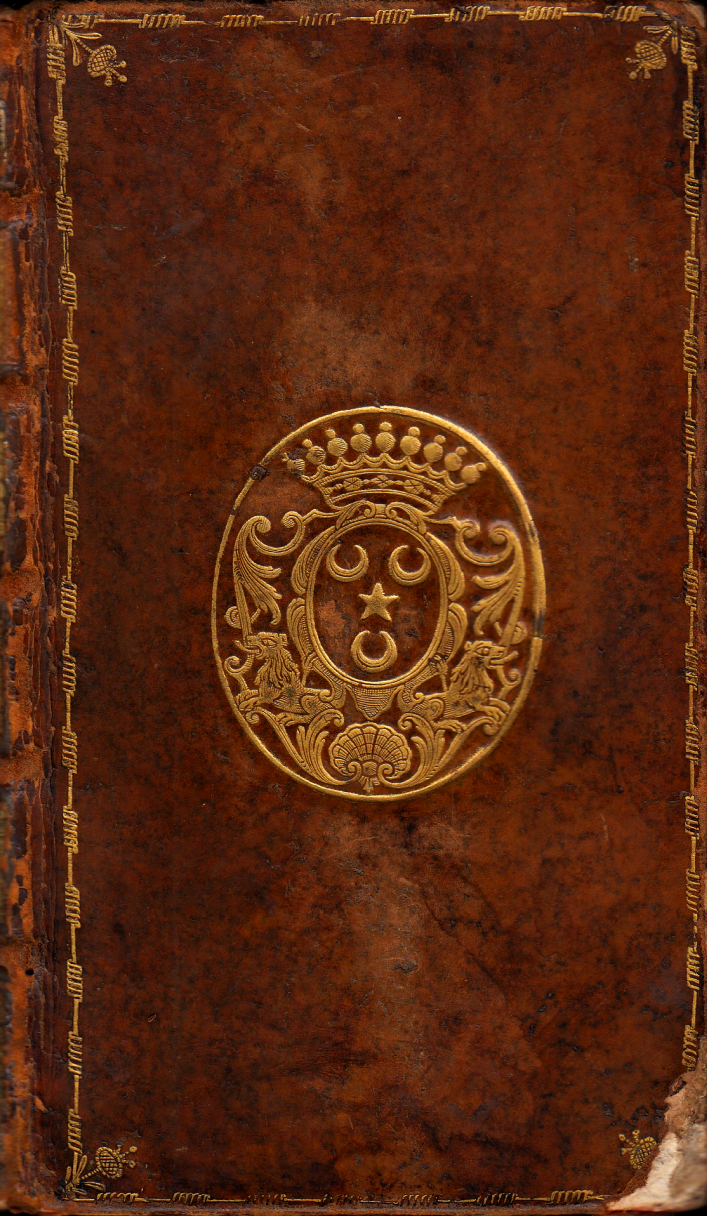 14. 1724. (SAPPHO) L’Histoire et les amours de Sapho de Mytilene avec une lettre qui contient des réflexions sur les accusations formées contre les moeurs. Paris, Musier, 1724. Contemporary calf with richly gilt spine and purple morocoo letterpiece. Supralibros on both sides: the coat of arms of Nicolas Pierre Camus de Pontcarré (1667-1734). VIII, 442 p. Nice marbled endpapers. In French. 1st edition. Corners bumped, attractive binding a bit worn. Old Romanian bookseller’s ticket pasted on last free endpaper.
Sold
* A French study resembling a novel about Sappho of Lesbos, mixed with poems in rhyming French that may be faintly reminiscent of her own poetry. Gay-Lemonnyer II, p. 561, refutes the attribution of this work to Jean du Castre d’Avigny, stating that he was only twelve years old when the first edition was published.
15. 1727. CHRIST, Johann Friedrich Historia legis Scatiniae. Antiquorum codicum testimoniis emendandis illustrandis passim distincta. Halle, Johannes Christophorus Krebs, 1727. Without wrappers. 28 p. In Latin. 1st edition. Paper a bit browned.
€ 200
* ‘The History of Scatinian Law. Illustrating and rectifying the various evidences from ancient codices’. A detailed examination of the name, history, and substance of the Lex Scatinia (or Scantinia), a Roman law meant to punish sexual contact between men and freeborn boys. The text of the law (from around 225 BC) has not survived, but there are several references to it, including Juvenal’s poetry. Early modern authors saw the Scatinia as the Roman equivalent to sodomy laws, but now there are more nuanced views on this.
16. 1730. BEELS, L. Sodoms Zonde en Straffe of Streng Wraakrecht over Vervloekte Boosheidt, en Loths Vrouw, verandert in een Zoutpilaar. Amsterdam, A. Wor & Erve G. Onder de Linden, 1730. 18th century leather-backed marbled boards. (24), 154, (12) p. 2nd edition. The binding is overly large; very likely, a second book was removed from it. Bookplate and signature of hispanist Dr. J.A. van Praag, registration date ‘Santpoort, 20 Nov. ’47’. Erased old notes (unrelated, e.g., ‘Zes maaten boter’ = six kegs of butter) on and preceding page 1. Stains on the title and elsewhere. Pencil notes by A.G. van der Steur at the conclusion of the book include the acquisition year ‘1991’.
€ 500
* ‘Sodom’s Sin and Punishment, or Severe Vengeance for Cursed Wickedness, and Lot’s Wife, transformed into a Pillar of Salt’. Leonard Beels (1674-1756), an Amsterdam clergyman, describes sodomy as a crime that incites God’s wrath and depicts the disasters in Genesis 19 in detail, including the roles of salt, sulphur, and fire. He connects God’s anger also with prior calamities, such as the St. Elizabeth’s Flood of 1421, which destroyed large parts of Holland. This occurred during a period when the inhabitants of Holland according to Beels were ‘zeer dartel en broodtdronken’, very frivolous and shameless, wasteful and arrogant.
Beels also names some famous Roman Catholic sodomites, including a row of popes. A popular work, three editions were published in a month.
17. 1730. BEELS, L. Sodoms Zonde en Straffe of Streng Wraakrecht over Vervloekte Boosheidt, en Loths Vrouw, verandert in een Zoutpilaar. Amsterdam, A. Wor and Erve G. Onder de Linden, 1730. Modern artificial leather-backed boards. (24), 154, (12) p. Title printed in red and black and with a small engraving. With a useful register. 1st edition. Some stains in the preliminaries, otherwise fine.
€ 450
* As before. First edition in a modern binding.

18. 1730. PROCLAMATION Placaat. Gedaan in den Hage onder het klein Zegel van den Lande den 21 Julii 1730. (…) was geteekent/ Willem Buys. Den Haag, no publisher, 1730. 27 x 26 cm. One leaf, printed on recto only. Delicate, some side tears, a bit worn.
Sold
* Very rare original poster (from a convolute) published July 21, 1730, by the government of the province of Holland, informing the public of decisions regarding the punishment of sodomy. All offenders and facilitators should be
publicly executed, but the manner of this is left to the judges. Their bodies must be burned immediately after the execution, thrown into the sea, or displayed, as they are not worthy of burial.
Fugitives must be brought before the court, and those who have been clandestinely absent since the beginning of May last year must be summoned three times if necessary, and they will be permanently banished if they refuse to surrender themselves. The Dutch government was surprised to discover that sodomitical acts were not uncommon and started a harsh prosecution in the spring of 1730. These ephemeral posters are even rarer than the books and other contemporary publications that mention sodomy.
19. 1730. (SUMMONSES) Alle de copyen van indagingen, als mede alle de gedichten op de tegenwoordige tyd toepasselyk. (&) Vervolg op alle de copyen van indagingen, alsmede alle de gedichten op de tegenwoordige tyd toepasselyk. No place or publisher (c.1731). Two volumes in one binding. Vellum. 170, (6 blanks), 154 (incl. 3 p. register), one blank in between after p. 78. Binding a bit worn, tiny piece of flyleaf missing. Bookplate of Gerrit Komrij.
€ 2500
* The title literally: ‘All the copies of the summonses, as well as all the poems applied to the time of the present day. (&) Continuation of (same)’.
Very rare, unusual publication of the names of the men who had indulged in the ‘shameful sin of sodomy’ (sometimes spelled with a z), with charges and sentences sorted by place: Amsterdam, Utrecht, but also Groningen, Voorburg, Zutphen, and many other towns. Long, moralistic poems about this ‘disgusting’, ‘notorious atrocity’ lace the book. Additionally (I, p. 65), we see a kind of play in which fifteen ‘zodomites’ are presented confessing, who without exception are deeply remorseful. Approximately 400 men faced prosecution between 1730 and 1732, with 100 receiving death sentences. Many managed to evade the horrific punishments by fleeing their homes or by committing suicide.
There are several versions, sometimes consisting of merged impressions, not all the same. To clarify the structure, the first part contains 11 quires A-G, H, I, K, and L of 16 pages each. Pages 3-11 show summonses of June 1730, last date June 24. Pages 12-142 contain a number of shorter and longer anonymous poems, sometimes with footnotes mentioning names, dates, and Bible passages. On p. 143-170 we see summonses again, all dating from July 1730 plus the first of August, followed by six blanks. Second part: 6 quires A-F, last date October 30, 1730; G, last date March 9, 1731; H: last date October 5, 1731; and I: last date October 5, 1731, mentioning all victims of Faan with a brief description of what they had done. K (12 p.): last date November 19, 1731, followed by an index for the second and first part (folded in reverse).
All of this points to a significant rush to catch up with reality during the publishing of this title.
20. 1730. (SUMMONSES) Alle de copyen van indagingen, als mede alle de gedichten op de tegenwoordige tyd toepasselyk. Vervolg op alle de copyen van indagingen, alsmede alle de gedichten op de tegenwoordige tyd toepasselyk. No place or publisher, (1730). Two parts in one binding. Boards with title label. 170, (6 blank), 94 p., and one inserted blank page. Neat volume with the bookplate of J. Baart de la Faille (1795-1867), professor of medicine in Groningen.
€ 950
* As before. The second part exists in different variations of size. This copy ends (as often) with the poem by Pieter Schim and has as its most recent date 30 October 1730, before section G, which was not printed until March 1731 (last date 9 March 1731).
This copy notably lacks pages 79-80, which contain the verdict of the city of Delft against Jacob van Wouw, a ‘Council and former Chief Officer of this City, but fugitive’, in which Willem van Buuren is also mentioned with his ‘word for word unanimous’ verdict, ditto Cornelis della Faille, councillor and former alderman of Delft. This Cornelis was probably an ancestor or relative of Professor Baart de la Faille. All three of these important and wealthy fugitives were banished from Holland and West-Friesland, and their possessions confiscated. Over the seizure of their belongings a legal battle was fought with their relatives.
21. 1730. (CHOICE POEMS) Zesde (-) tiende vervolg van de Latynsche en Nederduitsche keurdichten. Rotterdam-Utrecht, Pieter van der Goes, 1733-1734. Old calf. With two folding plates. Top of first title page torn off, containing the words ‘Zesde vervolg van de’. A bit of wear and tear in some pages (also in the plates). Partly browned.
€ 350
* ‘6th-10th continuation of the Latin and Dutch Choice Poems’. With some poems condemning sodomites: vol. VI p. 133-137 against sodomy itself, vol. VII p. 104 against Ignatius of Loyola, the founder of the Jesuit order in 1539, who in heaven became enamoured of Ganymede and was transposed to hell after the boy discovered it was Ignatius, not his lover Zeus who was possessing him! And vol. IX p. 79 and 88.
22. 1730. MEL, Coenraat Het Gruwlyk Sodom Gestraft, Ter waarschuwinge aan Israel voorgestelt; in verscheide Boet- en Bededaags Predikaatsien Beneffens de gantsche Historie van Sodom, uit Genesis XVIII en XIX. Amsterdam, A. Wor & Erve Onder de Linden, 1731. Modern leather-backed boards. (22), 264 p. Title page printed in red and black. 1st edition. Some use and waterstaining.
€ 500
* ‘Horrible Sodom Punished, Shown as a Warning to Israel, in various Sermons for Days of Prayer and Penitence, as Well as the Complete History of Sodom, from Genesis 18 and 19’. The well-known German theologian Conrad Mel (1666-1733) describes the sins of the biblical Sodomites as fivefold: shedding innocent blood, depriving workers of their wages, oppressing widows and orphans, robbery and theft, and to violate boys and mingle with unwitting animals. Only these last sins are named as Sodomitical. The Pope and the Vatican are described as fomenting the sins of the Sodomites, he identifies Sodom outright with Rome. The book was six times reprinted, from 1750-2017.
23. 1730. MEL, Coenraat Sodom. Het Gruwelijk Sodom Gestraft. Negental Boetpredikatiën van den vermaarden Godzaligen Heer Coenraad Mel, Leeraar en algemeen opziener over alle de Kerken en Scholen in het vorstendom Hersfelt. Rotterdam, H. van der Meulen, [1920]. Later cloth. 208 p. Adapted from German texts. Printed on cheap and thin paper. Owner’s stamp on first flyleaf. Some browning. Tear in p. 162-165.
€ 50
* ‘Horrible Sodom Punished. Nine Penitential Sermons by the renowned Blessed Sir Coenraad Mel, Teacher and general overseer of all the Churches and Schools in the principality of Hersfelt’. A summary of Mel’s writings, preceded by an introduction and an overview of the relevant Bible passages – in a cheap version sold by an orthodox protestant publisher, who probably was concerned about the early twentieth century publicity surrounding homosexuality.
24. 1730. MEL, Coenraat Sodom. Gruwelijke Sódom gestraft. Tot waarschuwing aan Israël voorgesteld in enkele boet- en biddagpredicaties, naast de gehele historie van Sódom, uit Genesis 18 en 19. Wijk en Aalburg, Landelijke Stichting ter bevordering van de Staatkundig Gereformeerde beginselen, 2017. Illustrated boards. 200 p. A few pictures. Current spelling by W. Noorlander and J.A. Bunt. Reprint.
€ 25
* A recent version of the 1730 book revised by an orthodox protestant foundation styling itself as ‘objectors inside and outside the SGP’, a Dutch political party at the theocratic side of the voter spectrum. This is the seventh and last edition, after 1731, 1750 (titled Boet- en bededaags predikaatien), 1861, 1904, 1920 and 2004.
 25. 1730. (EUROPISCHE MERCURIUS) Korte Historische en Oordeelkundige Verhandelinge over de Sodomie. Vervattende derzelver Oudheit, Oirsprongk, en Voortgang, onder de meeste Volkeren; mitsgaders derzelver Afschuwelykheit; en de Voorbeelden der Goddelyke Oordeelen en Straffen, doorgaans daar op gevolgd. (&) Aanhangsel van de Korte Historische en Oordeelkundige Verhandelinge over de Sodomie. 1730. Pages 265-314 (50 p.) of Europische Mercurius, berichtende onze Landgenooten, de gesteltenissen der zaaken van Staat en Oorlog, in alle heerschappijen en landschappen van Europa, benevens de aangrenzende Gewesten. Vol XLI (41), first half (June), & Aanhangzel p. 289-304 from Vol XLI, second half (December). 1st edition. Flyleaves and blank margins nibbled by tropical animals. With bookplates and rubber stamp of medical doctor and sexologist (in Malang, Java) Lucien S.A.M. von Römer (1873-1965) and an unidentified bookplate dated 1914.
Sold
* ‘Short Historical and Judgmental Treatise on Sodomy. Containing its Antiquity, Origin, and Progress among most Nations; together with its Abomination; and the Examples of Divine Judgments and Punishments that generally followed. (&) Appendix.’
Important prose texts prompted by the recent discovery of homosexual networks, if not indications of a subculture. ‘Among the perpetrators of this evil were seen persons of every condition, from the first in the country to the least of the inhabitants: the great and the small, the old and the young, the rich and the poor, the wise and the unwise, the Romanists and the Protestants of various churches, the sanctimonious and the openly godless’, a phenomenon that surely must incur the wrath of the Lord. As a sign, He sent plagues upon the Dutch (such as the naval worm to gnaw its harbour poles) and nasty dents in international trade, which was the lifeblood of the economy.
The anonymous premodern journalist, well-versed in the history of sodomitical scandals, references prominent figures such as King Henry III of France, the British Lord Castlehaven, who faced execution in 1631, several Popes, and other clerics. He extensively discusses Della Casa’s De laudibus sodomiae, including a brief mention of the exact location of a copy of this infamous book in the Netherlands.
The author also proves to be well-versed in theology by exactly explaining the Biblical theory about sodomy, including sodomitical sexual techniques of men with women, which he deems worse than men with men. Sodomy of women with women is discussed as well, but he thinks it a misunderstanding of a text of the Apostle Paul, let alone that a wanton woman could have invented the sodomitical technique. However, women must have participated in sodomitical orgies in Sodom, or the Lord would have found among them at least ten righteous people to spare the city of Sodom.
The second part of this publication provides additional information and later developments. The writer delves deeply into the decree ascribed to Pope Sixtus IV (1471–1484), which permitted cardinals to indulge in sodomy during the three hottest months of the year. The author, who does not wish to ‘accuse the Roman Church of untruths as rashly, as is often done, even by theologians, on unfounded testimonies’, cites all sorts of experts to prove that this cannot be true and loses himself for pages in an explanation that in the summer men ‘least desire the exercise of carnal lust: the heat weakens them and makes them powerless’. However, this likely pertains to heterosexual sodomy, while the Dutch prosecutions solely target men involved with homosexual contacts. The text ends with a summing up of many cases in all parts of the Dutch Republic.
Lucien von Römer was one of the first Dutch scientists to work for the emancipation of homosexuals through scientific research. In 1906, his article ‘Der Uranismus in den Niederlanden bis zum 19. Jahrhundert. Mit besonderer Berücksichtigung der groβen Uranierverfolgung im Jahre 1730’, partly based on this exact specimen, was published in the Jahrbuch für sexuelle Zwischenstufen of Magnus Hirschfeld. In other words, a quintessential book with important provenance.
26. 1730. ROYAARDS, Albertus Nodige en tydige waarschouwing tegens de gemeenschap aan Sodoms grouwelyke zonde en vreeselyke straffe, op den plegtigen dank- vast- en bededag van den 28. Febr. 1731. Afgeleid en voorgesteld uit Jes. 1:vs. 9. vergel. met Ezech. 16:vs. 49, 50. Nijmegen, Wilhelmus Bongaards, 1731. Rebound in vellum-backed marbled boards. (8), 74 p. 1st edition. Paper (water)stained. With a handwritten leaf mentioning various owners of the book with the years 1860 and 1893. And a handwritten index of Bible texts.
€ 950
* ‘Necessary and timely warning against the community of Sodom’s heinous sin and dreadful punishment, on the solemn Day of Thanksgiving, fasting and prayer of February 28, 1731. Derived and presented from Isaiah 1:9 compared with Ezekiel 16:49, 50.’ An extensive exposition of the sin of Sodom, that unnatural lust was just one of its many aspects, with arrogance and a lack of compassion being equally important. According to Royaards, lustful excess led to lascivious and indecent behaviour, and in the end, men could only resort to sodomy as the last way to find satisfaction, the usual explanation of the time. In the early 18th century, many viewed homosexuality as a ‘crimen nefandum’ (a crime not to be spoken of). Silence was a strategy to prevent the spread of sodomy. In practice this meant that sodomites were executed secretly and behind closed doors and most documents were destroyed ‘so that it would not be known that this sin was committed in this country’. As a result, the sin was considered to be virtually non-existent in the Netherlands.
Therefore, many Dutch were unaware of the existence of homosexuality in the early 18th century, and men preferring sex with men didn’t recognize the danger. They might feel attraction or even love for other men, without realizing that their proclivities were considered a mortal sin by others. Holland, being a seafaring nation, was afflicted by a shipworm epidemic. How could this be interpreted otherwise than as God’s punishment for man’s sin?
Royaards felt compelled to speak out against sexual deviancy to counteract the recent sodomy spree, as he saw it. He compares Dutch society to Sodom and Gomorra and warns for divine retribution. Apparently, he wasn’t alone in his thoughts: in 1730–31, the Dutch Republic saw a steep increase in the persecution of sodomy, beginning with the infamous Utrecht Sodomy Trials, which would eventually lead to prosecuting some 400 men throughout the country, often resulting in a death penalty. No other European country persecuted homosexuals with such vehemence.
27. 1730. (SENTENCES for FUGITIVES) Sententien van den Hove van Holland, tegens verscheide Persoonen ter saake van gepleegde Sodomie. In dato 5 October 1731. Den Haag, Paulus & Isaac Scheltus, 1731. No wrappers, just sewn (from a convolute). 72 p. Outside a bit worn and dusty and a little foxed. Inside very good.
€ 1200
* ‘Court cases of the Court of Holland in The Hague against a number of people because they were accused of committing sodomy’. 35 cases, all these men were fugitives (‘Latitant & Defaillant’), all were banished forever from Holland, Zeeland, Friesland and Utrecht on pain of the death penalty, and all their property was confiscated. Against the ensign bearer Gerrit de With, who is banished from Holland and Zeeland and forfeited all his possessions; Cornelis Simonis, Petrus de Vos, Abraham la Peer, Gerrit Stronk, Mathys Vermeulen, Huibert Hengelaar, Samuel Cohen de Valenzo alias Belgrado (marked as a Portuguese Jew), N. la Grange, Wolbrand Maas, Hendrik de Cock, the lieutenant Gysbert Ballard, the former Procurator of the Court Daniel vander Burgh, Willem Schaars and several more gentleman’s servants, the court lawyer Nicolaas van Loenen, the medical doctor Hendrik Westenhoven, and several others. All received the same sentence and on the same day, October 5, 1731.
Another suspect, Johannes la Foreest (a wigmaker’s servant who had hidden one of the defendants) was just sentenced to paying for his process. Some others were only mentioned by their first name. Knuttel Pamphlets 16816a.
28. 1730. (SODOMY SPECTACLE) Schouw-tooneel soo der geëxecuteerde als ingedaagde over de verfoeielijke Misdaad van sodomie tot waarschouwinge der goede en afschrik der booze geopent in de voornaemste Steeden van Hollandt en Over-yssel &c. No place or publisher, 1730. 31 x 20 cm. Two volumes in one binding. Contemporary half roan. 84; 78 p. (last blank missing). 1st edition. Cut rather short. Binding worn. Some pages loose, edges browned.
€ 2500
* ‘Spectacle of both the executed and the accused for the abominable Crime of sodomy, opened in the principal Cities of Holland and Over-yssel, etc., as a warning to the good and a deterrent to the evil.’ This large-format book, with its headlines set in big capital letters, spreads dread and terror with its summonses, verdicts, and long lists of culprits, followed by 42 thundering poems.
Most of the sodomites suffered horrendous torture and death, as if their souls needed to be excised from earth and memory: they were either burnt to ashes or, ‘after being hung, transported by cart to the coast, where they were thrown into the sea with 50 pounds of weight on their bodies and 50 pounds on their legs’. Some managed to flee before being caught, having their possessions and money confiscated and being exiled forever on pain of execution. That was probably often a sentence to beggary in a foreign country, language unknown.
In general, no details about the person in question or their crime were given, only their name and occupation. An exception is this farmer from the small town of Woerden: ‘Tys Jansz, farmer, alias Tys the Squeaker, of average height and thickness, yellowish skin, brown face, with jet-black hair, but sometimes wearing a Blond Wig, and with a woman’s voice, being a chairmaker by trade, but last having done shop in Bodegraven: fled from there because of sodomy, and with his wife Maria Elberta van Hummel, is hiding elsewhere.’
The Woerden council is offering a premium of one hundred guilders for information that can lead Tys Jansz into the hands of Justice. The name of the informer can be ‘secreted at his request.’ (I, p. 61). The last cases mentioned in the Schouwtooneel are the 24 victims of De Mepsche’s rage in Groningen and Emanuel Valk, the pastor of Vianen, who hanged himself in prison. In impotent anger because Valk had managed to escape his punishment, the court ordered that his corpse be dragged ‘on a wickerwork through the city, with his head on the stones along the street, dragged to a barge, to be thrown further into the sea above Brielle.’
The poems, though uniform in tendency, are fascinating to study. The first one, four full pages written by one ‘J.V.H.’, explains how the sudden persecution of sodomites fits into the 1720s and 1730s. How many calamities has our free country suffered by God’s severe hand! How often have raging storms and floods devastated the country? How many a person has not been plunged into the grave, during the past ten years, by an unusual punishment? The death of the cattle signaled to us for years that an unknown abomination was on the rise. Mad thunders, lightnings, and hot fevers—that was God’s punishment for some people’s seeming piety, coupled with unnatural sexuality: sodomy.
29. 1730. (SUMMONSES) Versameling van alle Actens van Dagvaardingen en Executien, gedaan over Zonden van Sodomie, in den Jaare 1730. Mitsgaders Sententien, gepronuntieert binnen de Stadt Haarlem. Den Haag, Cornelis van Zanten, 1730. Cloth-backed marbled boards. (2), 110 p. 1st edition. Paper a bit soft.
€ 2000
* Early publication about the sodomy trials in the Netherlands, not only in Haarlem but in many other Dutch cities. Contains poetry, sentences, poster texts (‘Placcaat tegen het plegen vande Zodomitische Zonden’), and summonses of fugitives. Not the crimes, but the punishments are described in grisly detail. Apparently not in Worldcat. (See inside rear cover).
30. 1730. EFFEN, Justus van De Hollandsche Spectator. August 30, 1731 – December 19, 1732. 120 issues in one binding. Amsterdam, Hermanus Uytwerf, 1731-1732. 4 volumes (= 120 issues) in a single volume. (8), 240; (2), 240; (2), 240; (2), 248 p. With preface. Last page of last volume missing. With 4 identical title engravings by Claude Duflos after Gabriel F.L. Debrie.
€ 200
* ‘The Dutch Spectator’ is a talkative, candid magazine that was entirely written by Dutch author Justus van Effen. Despite its frequent serial publication during the second part of the sodomite persecutions in the 1730s, ‘The Dutch Spectator’ only mentions them covertly and discreetly in one issue, that of November 21, 1732: ‘Suddenly a horrible sin is revealed’, without specifying the nature of this sin. God’s punishments for those unmentionable sins include the naval shipworm plague: ‘despised animals, which hardly have any rank among creatures’, floods, and contagious cattle diseases.
 31. 1730. LUYKEN, Jan Sodom door ’t Vuur Vergaan. Large etching (33.3 x 41.5 cm) by Jan Luyken, from Flavius Josephus, Alle de werken van Flavius Josephus, the 3rd edition by Marten Schagen in 1732 (first published in 1708). Cut short, but well outside the plate area. Vertical folds, in very good condition.
Van Eeghen & Van der Kellen 3241.
€ 300
* ‘Sodom consumed by fire.’ The baroque etching, shockingly expressive, depicts the rain of fire falling on the city of Sodom, while another city in the distance faces the same fate. It depicts the fire striking hundreds of men, women, and children, their faces displaying clear panic and dismay. Cows, sheep, pigs, dogs, and camels share in the destruction. (This picture shows only a fragment).
32. 1730. VALK, Emanuel Brief aen een vrient, behelzende het voorgevallene in de zaak van ds. E. Valk, zo te Vianen als Utrecht, tot hier toe. Benevens eenige aenmerkingen over ’t zelve. (No place, self-published, 1731-1732). No wrappers. 20 p. Uncut. Some creasing, but an excellent copy.
€ 900
* ‘Letter to a friend about what happened in the case of the minister E. Valk, in Vianen and in Utrecht, until now. And some remarks about this.’ One of several pamphlets about the case of Emanuel Valk, who was continuously harassed under unknown allegations of sodomitic behaviour.
The clergyman found himself entangled in a legal maze, received a summons, and ultimately committed suicide in prison.
33. 1730. VRIJER, M.J.A. de De storm om het crimen nefandum in de jaren 1730-1732. Page 192-238 in: Nederlandsch archief voor kerkgeschiedenis Vol. 25, 1932. Den Haag, Martinus Nijhoff, 1932. Half cloth. VIII, 256 p. 1st edition.
€ 75
* Important essay in fine writing style about the sodomy persecutions seen from an ecclesiastical point of view. A lot of De Vrijer’s information comes from church council records and theological works. Though filled with pity and appalled by the cruelties, he defends the pastoral attitude and the thunderous books of the various ministers concerned, such as Van Byler and Beels, especially in response to the accusations of inhumanity by Cohen Tervaert and Poort. Remarkably, he also defends the Vianen clergyman Emanuel Valk, who in 1730 had been a victim of unclear accusations of sodomitic behaviour.
34. 1730. BYLER, Hendrik Carolus van Helsche boosheit of Grouwelyke zonde van sodomie, in haar afschouwelykheit, en welverdiende straffe uit goddelyke, en menschelyke schriften tot een spiegel voor het tegenwoordige, en toekomende geslagte opentlyk ten toon gestelt. Groningen, Jacobus Sipkes, 1731. Full calf. 60, 256 p. Title printed in red and black. Errata list. 1st edition. Spine damaged, edges worn. With name of former owner: ‘P.D. Koopman 1870’.
€ 750
* Literally ‘Infernal evil or horrible sin of sodomy, in its horror, and well-deserved punishment from divine, and human scriptures openly displayed as a mirror to the present and future generations’. Henricus Carolus van Byler was minister for the villages of Faan, Niekerk and others in the rural northern part of the Netherlands, where grietman (lord and judge) Rudolf de Mepsche (1695-1754) was relentlessly prosecuting sodomites and others falsely accused of this sin. We don’t know who was the first to take up the scourge, but probably Byler and De Mepsche mutually excited each other to punish the enemies of God and themselves with horrible penalties. (Picture on the inside rear of this catalogue).
A second edition came out in 1741. The text is identical; even the errata have not been used to enhance the book.
35. 1731. (FAAN). BYLER, Henr. Carol. van Helsche boosheit of Grouwelyke zonde van sodomie, in haar afschouwelykheit, en welverdiende straffe uit goddelyke, en menschelyke schriften tot een spiegel voor het tegenwoordige, en toekomende geslagte opentlyk ten toon gestelt. Groningen, Pieter Bandsma, 1741. Calf-backed marbled boards with newer title ticket. 60, 256 p. Title page all in black. 2nd edition. Corners and edges worn. Recased and recut, page edges damaged in the process, some lettering on the title pasted to flyleaf.
Sold
* This book was released ten years later by a different publisher. According to the title page the pastor had moved from Faan to Gieten in Drenthe. Apart from the title and its reverse (with a motto in Latin in the first edition, blank in the second), the type appears to be exactly the same. Even the errata leaf at the end is the same, the various mistakes have not been corrected (a.o. Drabicius that should be Dabricius, Heiddeggerus should be Heideggerus). This second edition not in Worldcat.
36. 1731. FAAN Criminele Proceduiren door het Hoog-Edel Gerichte van Oosterdeel Langewold, in d’Ommelanden tusschen d’Eems en de Lauwers, tegens vierentwintig Sodomiten uitgevoert op Maandag den 24 Septemb. Anno 1731, met bijvoeging van eenige noodsakelyke Stukken en Blyken daar toe specterende, uit kragt van welcke deselve, als meede de vordere Proceduiren tegens de noch overige Gevangens voor de Hooge Justitiekamer der Provincie van Stad en Lande van tyd tot tyd zijn gewettigt. & Korte Aenmerkingen en Consideratien met de daar toe dienende Justificatoire bylagen geformeert op de gehoudene Crimineele proceduiren by den Heere de Mepsche van Faen ten Reguarde van veele personen, by hem betigt, geapprendeert gevonnist en geëxecuteert, wegens het Crimen van Sodomie waar van deselve naer syn voorgeven souden wesen geconvinceert. No place or publisher, (1732). 32 x 20 cm. 3 parts in 2 vols. Rebound including 18th century marbled wrappers in 20th-century cloth-backed marbled boards. (12), 72; 180, (6); 78 p. Stains of the rebinding process visible on flyleaves. A little foxing, but both books attractive and in excellent condition.
€ 2950
* ‘Criminal Procedures by the Justice of Oosterdeel Langewold (a rural area in the western part of the province of Groningen) against 24 Sodomites, acted on Monday Sept. 24, 1731. With the addition of applicable testimonials. And brief comments on the legal appendices regarding the many persons accused, arrested, convicted and executed by Squire De Mepsche van Faan for the crime of sodomy.
A heart-rending account of the trial against two dozen men who were accused of sodomy with each other, including detailed ‘how, when and where’s’. Almost all of them were to be executed on one single day; the youngest was sentenced to lifelong prison, which in his case took more than thirty years.
This was a political process, for local squire Rudolph de Mepsche (1695-1754) had discovered the newly rediscovered crime of sodomy as a means to literally eliminate some of his opponents, farmers and freeholders and their sons of the same district where he exercised his power. Probably the most notorious and glaringly unjust Dutch sodomy trial, resulting in the execution, after cruel torture and subsequent “confessions” of 21 accused men. These two volumes contain the voluminous official documents by the instigator of the trial, ‘grietman’ (rural judge and mayor) Rudolf de Mepsche of Groningen, the summing up of the sodomitical acts of the accused, and a lot of testimonies by a variety of people. Partly written in De Mepsche’s defence, by his clergymen Van Byler and Metelerkamp, partly emotional letters and protests by the accused and their family, who were generally inexperienced as writers. Followed by complaints of wives and mothers about De Mepsche’s violent handling of the case. Apart from judicial tormenting, several soldiers and officials testified (see second and third volume) as to the blood, the knocks and the blows by De Mepsche and his helpers, an accused’s back ‘as blue as a curtain’, all to press them to confess. The violence was to be hidden for others, but seen and heard, nevertheless. In 1734, De Mepsche was forced to lay down his office on suspicion of having started proceedings for personal profit. But that was three years after the death of the victims he had accused of sodomy.
37. 1731. FAAN Memorie tot redres van de crimineele proceduren in de Ommelanden. Omme de aldaar Gedetineerde voor een Neutraal Regter te Regt te doen stellen. En om de heer van Faan te necessiteeren, om sigh voor een Neutraal Hof van Justitie te purgeeren. No place or publisher, 1734. 32 x 21 cm. Later vellum-backed marbled boards. (2), 174 (one blank between 94 and 95), (68) p. Dutch text, some in Groningen dialect.
€ 2500
* ‘Memorandum to redress the criminal procedures in the Ommelanden. To have the Detainee there brought before a Neutral Judge. And to necessitate the Lord of Faan to purge himself before a Neutral Court of Justice.’ This is a most distressing book because all the citations of the confessions and the verbatim letters of bereaved relations that may be viewed as horrible sadistic pornography. Very rare. The three copies in Worldcat apparently miss some pages containing the confessions.
38. 1731. FAAN Missive door de ses Onder Quartieren inde Ommelanden tusschen d’Eems, ende Lauwers namentlyk Marnsteradeel (…) omme aen de eene kant nader te justificeeren de billykheyd van het by welgemelde 6. onder Quartieren gerequireert werdende Redres in de administratie der Criminele Justitie in capitale, of dood straffelyke saaken in de Ommelanden voorvallende, En omme aen de andere kant te wederleggen, en weg te neemen de tegenwerpingen en uytvlugten daer jegens, soo by het Lidt van de Stadt, als by de dissentierende Heeren van de drie overige Onder Quartieren in derselver successive Missivens aan hoogst gemelte haar Hoog Mog. gemoveert Met het daer aghter gevoeghde Project Reglement, van de ses Onder Quartieren tot het voorschreeve Redres dienende. No place or publisher, (1732). 30 x 19 cm. No binding (taken from a convolute). 28 p. Fine condition.
€ 750
* ‘Letter from the six Sub-Quartiers in the Ommelanden between the Eems and Lauwers, namely (…) Written to the Honourable Gentlemen to justify on the one hand the fairness of the Redress demanded by the aforementioned six Sub-Quartiers in the administration of Criminal Justice in capital or death penalty cases occurring in the Ommelanden, And on the other hand to refute and remove the objections and evasions thereto, both by the Member of the City, and by the dissenting Lords of the three other Sub-Quartiers (…).’ Purely legal argument about the division of power of the lords of the western lands of the province of Groningen, directed against Rudolf de Mepsche and his associates, signed in print by Lewe, Clant and the five other lords that De Mepsche tried to harm with his sodomite trial. The memorandum of redress is announced here.
39. 1731. MEPSCHE, Rudolph de Na dat het Hoog Ed. Gerigte van Oosterdeel-Langewold ons onderschreevene had versogt, om voorschreeve Gerigte in des selfs swaarwigtige beesoignes noopens vier en twintig Prsoonen, soo over de verfoeyelyke sonde van Sodomie by voorschreeve Gerigte in detentie genoomen waaren, te adsisteeren. (Sic). & Hoog Mog. Heeren, Jonkeren, Hovelingen, Eygen-Erfden en Volmagten der Onderquartieren Oosteramptsteradeel, Hoogeland-steradeel en Oostlangewoldsteradeel (…) vinden sigh gedrongen (…). & Memorie, dienende tot adstructie van soodane poincten van bewaarnis, als op den 30 Juny 1732 in Conferentie zyn overgegeven aan haar Hoog Mog. Gecommitteerden de Heer Tork en andere, door de Heeren Lintelo, Heer van Stedum, en Mepsche, Heer van Faan (…). No place or publisher, 1732. No binding, just sewn together. 20; 32; 68 p. 1st editions. Uncut. Outside and edges a bit worn. Some unimportant stains. The last pages have a hole, causing the loss of some letters.
€ 2500
* Advice issued at the request of the Court of Oosterdeel-Langewold in the Province of Groningen by lawyers Arnoldus Rotgers, A. Reichle, P. Alberthoma and G. Froon about the criminal proceedings concerning sodomy. All these lawyers sided with De Mepsche. Endless deliberations peppered with historical grievances dating back for centuries. The first of the three books is titled ‘After the Honourable Court of Oosterdeel-Langewold had requested us undersigned, to assist the said Court in its own serious affairs concerning twenty-four Persons, who were taken into custody by the said Court for the abominable sin of Sodomy’.
This long-winded title is a summary of lists of sodomitic acts of the 24 accused. Some random examples: ‘Once on the jetty at the Luyck on the north-west side; that Ian had said, that it would have been on the north side, but it could not have happened there, because there was wood there at the time; a year and a half ago, reciprocal.’
‘With Ouge van Garnwert twice, reciprocal’.
‘Gerrit Frerixs declared on 1 June 1731: that Sicke Arents ‘first persuaded him to do it, that he truly did not know about it before; that the Devil blinded his senses to such an extent that he could not fight against it.’
The second, ‘Honourable Gentlemen, Squires, Courtiers (…), Owners and Proxies of the Sub-Quarters of (…) find themselves compelled’. Tedious legal details.
The third, ‘Detailed outline of the relations and legal obligations of the administration of the surrounding areas of the province of Groningen’ dated June 30, 1732, after a historical sketch of the practice of law since 1594, about the accusation of bias because many of those accused of sodomy were landowners or their relatives of the opposing party in the provincial government.
40. 1731. (FAAN). TRESLING, T.P. De Warven en de Hoofdmannen-kamer, of het voormalige Provinciaal Geregtshof, binnen de stad Groningen, in verband beschouwd met de Staatkundige Geschiedenis van dit Gewest door Mr. T.P. Tresling. Groningen, J. Oomkens, 1839. Original printed wrappers. (8), 152 p. 1st edition. Spine covering at the bottom is missing, otherwise a very bright and beautiful copy. Inscription on p. (1): ‘Kloosterburen, 5 Nov. 1903’ and a number 997.
€ 150
* ‘The ‘Warven’ and the Headmen’s Chamber, or the former Provincial Court, within the city of Groningen, considered in connection with the Political History of this Region’. A Warf, plural Warven, was a meeting of judges where serious legal questions were decided. On p. 103-125 an extensive description of the De Mepsche affair from around 1731-1734, especially from a legal point of view. Tjalling Petrus Tresling (1809-1844) was a talented lawyer and expert on the history of Law.
41. 1731. (FAAN). ZIJLMA, G. Een monsterproces. Bijdrage uit de lijfstraffelijke rechtspleging der Ommelanden in de eerste helft der achttiende eeuw. Overgedrukt uit de Provinciale Groninger Courant, Januari 1889. Modern half-cloth. 98 p. With library stamps of, a.o. the Reading Society of the town of Leens. One crumpled page and a tear repaired with tape, otherwise neat.
€ 100
* ‘A monster trial. Contribution from the corporal criminal justice of the Ommelanden (= rural Groningen) in the first half of the eighteenth century. Reprinted from the Provinciale Groninger Courant, January 1889’. Romanticized story about the persecutions of sodomites by the lord of Faan, Rudolph de Mepsche, and his accomplices, written by Geuchien Zijlma (1842-1922), a gentleman farmer from rural Groningen and a liberal politician.
42. 1731. (FAAN). POORT, H.F. Rudolph de Mepsche of de Faansche gruwelen 1731. Noordhorn, self-published, 1925. Original burgundy cloth. 100 p. With four illustrations. 2nd revised edition. Spine slightly worn, but in very good condition.
€ 100
* About the excessive persecution by rural lord and judge Rudolf de Mepsche, who accused a number of political enemies of sodomy and had them executed in a travesty of justice. This version bound in cloth is very rare; most copies were sewn. With two little notepads (one dated 1969) carrying densely written remarks about both this book and another. We have a sewn copy for you for € 35.
43. 1731. (FAAN). VISSER, Ab Rudolf de Mepse. Het monsterproces van Faan. Rotterdam, Nijgh & Van Ditmar, 1945. Cloth-backed boards. 228 p. 1st edition. Worn and discoloured.
€ 25
* Historical novel.
44. 1731. (FAAN). VLEER, W.T. Sterf sodomieten! Rudolf de Mepsche, de homo-fielenvervolging, het Faanse zedenproces en de massamoord te Zuidhorn. (Norg, Uitgeverij VEJA (= self-published), [1972], as always entirely in photocopy). 27 x 21 cm. Ring binder. 174 p. 1st edition.
Sold
* ‘Die, sodomites! Rudolf de Mepsche, the persecution of homophiles, the Faan morals trial and the ‘mass murder in Zuidhorn.’ Admirable result of Vleer’s extensive own research.
45. 1733. NOORDKERK, Hermannus De matrimoniis, ob turpe facinus, quod peccatum sodomiticum vocant, jure solvendis, dissertatio. Amsterdam, Janssonius van Waesberge, 1733. Later three-quarter vellum. (12), 116 p. First edition. Handwritten spine ticket with shelf number.
Sold
* The Latin title means ‘About marriages dissolved by right, because of the disgusting crime that is called the sodomitic sin’. Noordkerk (1702-1771) was an outstanding lawyer, famous as a counselor at law. In 1730 he was approached by a woman who wanted to separate from her husband, who had left his house and work in May 1730 and was severely suspected to have committed the sodomitic sin. This extensive plea in Latin builds a show of dozens of authors from the classical poet Horace and the emperor Justinian to Dutch lawyers De Damhouder, Voet and Van Leeuwen, not to mention the Bible citations, all damning that heinous peccatum.
 46. 1742. TRIAL COLLECTION Select trials at the Sessions-House in the Old-Bailey, for Murder, Robberies, Rapes, Sodomy, Coining, Frauds, Bigamy and other Offences. To which are added, Genuine Accounts of the Lives, Behaviour, Confessions and Dying Speeches of the Most Eminent Convicts. In Four Volumes. From the year 1720, to this time. London, Printed by J. Applebee for George Strahan and 9 other booksellers, 1742. All the 4 volumes loose from their bindings, some boards missing. (12), 374; (12), 372; (12), 362; (12), 372 p. Every part with a frontispiece partitioned in small crime or trial scenes. All edges gilt. Though worn, well usable for study.
Sold
* This is a collection of crimes from Britain, with salacious yet explicit reports, trials, and penalties. The collection includes several sodomy trials, including that of Molly Clap’s male-to-male brothel. See vol. 1 p. 105-108, 339-340; vol. 2 p. 362-372; vol. 3 p. 36-40 (Molly Clap) and 74-75.
47. 1748. NAME LIST OF CRIMINALS Naam-Lyst van alle persoonen, die binnen Amsterdam door beuls handen zyn ter dood gebragt; sedert het Jaar 1693 tot 1746 ingesloten. Met een korte aanwyzing van hunne Afkomst, de Misdaden om welke zy gevonnist zyn, en de wyze hoe zy hunne Executie ontvangen hebben. Amersfoort, M. Langewagen, 1748. 18th century marbled wrappers with oval handwritten title ticket. 44 p. Cover discoloured and worn at the sides. Old owner’s names ‘Isaac Barre’ (twice) and other inscriptions on inside cover.
€ 750
* ‘Name-List of all persons who were put to death by the executioner in Amsterdam; from the year 1693 up to and including 1746. With a brief indication of their origin, the crimes for which they were sentenced, and the way in which they received their execution.’ With a lot of attention for ‘sodomites’ (p. 33-36 and 42). Not in NCC, one in Worldcat (Staatsbibliothek Berlin).
48. 1753. (BLACKMAIL) Advijs Decisoir No. 44. (Court martial case about accusations of sodomy and blackmail, manuscript). Manuscript written with brown ink on good quality paper, marked as ‘Copia’, a copy. Dated May 30, 1753. 32 x 20 cm. No binding. 48 p., of which 5 are blank. 33-35 lines per page. Excellent condition.
€ 1250
* Extensive, beautifully written manuscript, the very detailed report of a court martial case where an officer Borkensteijn had accused the elderly custos (verger) of the Broederenkerk (‘Brothers Church’) in Nijmegen of pointing to his pants to entice him to sodomy and then blackmailed him. In the end, the officer and an accomplice were demoted and dismissed from service, their swords broken, before being handed over to a civil court. The verger was cleared of all blame, released and given his money back. This account of 42 handwritten pages largely corresponds to a printed article in the Nieuwe Nederlandsche Jaerboeken (August 1753, Vol. VII/2, p. 699-724).
Incidentally, the court martial contains a nice detectivelike passage where the paleness of ink leads to the discovery that some notes were not written at the same instance. The lawyer response brings life’s details very close: ‘Voor redenen van de verandering van inckt geevende: off de verandering van pen, off het te diep instippen, en meerdere of mindere swaere hand, ofte oock het omroeren, off niet omroeren van den inckt, om dat er ook boomwoll in de kooker soude zijn geweest’: For reasons given for the change of ink: either the change of pen, or putting it in the ink too deeply, and a more or less heavy hand, or also the stirring, or not stirring of the ink, because there would also have been cotton in the inkwell. (p. 18 in the written text, p. 711 in the printed one).
49. 1763. PEIFFERS, Wilhelmus Sodoms ongerechtigheit en straffe, weleer, op ’s Heren uitdrukkelyk bevel, door zynen knecht Ezechiël, (by afwezen, waarschynlyk in geschrifte,) aan Jerusalem ten spiegel voorgestelt, volgens Ezechiël XVI: 49, 50. Nu, met uitvoeriger Verklaringe en Toepassinge, (bij gebrek van uitspraak, ook in geschrifte,) aan de Gemeente van Amsterdam, ter gelegenheit van den algemenen Dank- Vast- en Bededag, op den 2 Maart 1763. Door haren Dienaar in ’t Euangelium Wilhelmus Peiffers. Met aantekeningen, over den oorsprong van de dode Zee, over de hedendaagsche wereldsche levenswijze enz. en over enige woordenverschillen in ’t stuk van de Rechtvaardigmakinge enz. door Denzelven. Als mede nog ene uitbreidinge en gebruikmakinge van Act. XXIV:24, 25. Door den heer Doddridge. Amsterdam, Hendrik Vieroot, 1763. Marbled wrappers. XII, 116 p. Uncut. Edges a bit worn.
€ 850
* The spacious title summarized: ‘Sodom’s iniquity and punishment, formerly, at the Lord’s express command, by his servant Ezekiel, (in absence, probably in writing,) presented as a mirror to Jerusalem. Now, with more extensive Explanation and Application, (in absence of pronouncement, also in writing,) to the Community of Amsterdam. With notes, about the origin of the Dead Sea, about the present worldly way of life, etc.’ Extended sermon from the senior years of Peiffers (1705-1779), an Amsterdam pastor.
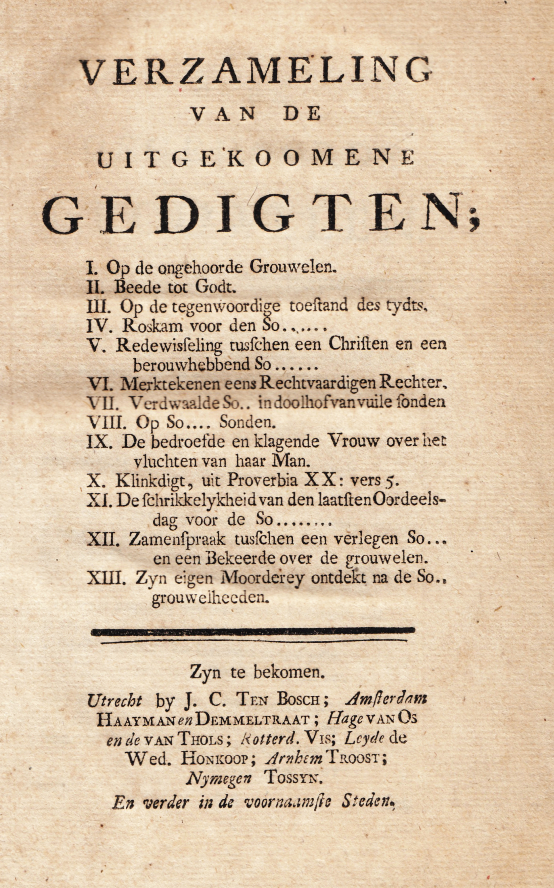 50. 1764. COLLECTION OF POEMS AND OTHER COMMENTS ‘Op de Sodomiet’. Verzameling van de Uitgekoomene Gedigten. (‘”On the Sodomite”. Collection of the Published Poems’). Various publishers, 1764. Collection of songs and poems on sodomy scandals, a treatise and two broadsides. Half roan with decorated boards, with gilt spine title ‘Op de Sodomiet’. Two bookplates, one uncommonly large of H.N. Ouwerling (by J.T.L. Jacobs) and one of F.H.M. Ouwerling. Spine worn. Pamphlets uncut. A few pencilled notes and crosses. From the collection of A.G. van der Steur, and earlier, from that of the Ouwerling brothers.
1. Verzameling van de Uitgekoomene Gedigten. I. Op de ongehoorde Grouwelen. (And 12 others. One by A. Hardy, the others by several pseudonyms and some anonymous). Utrecht etc., J.C. ten Bosch etc., (about 1764). 42 p.
2. Worstelende, Sluymerende en Ziel Angst, Over de Regtveerdige en Schrikkelyke Oordelen Godts, Omtrent de Sondaaren, Betrekkelyk tot deezen tegenwoordige tydt. Benevens de naare uytgang van Do. E.V. [= Emmanuel Valk]. En een Nagedigt op de V.S. Amsterdam, A. Pelser, 1764. 16 p.
3. Het Regtveerdige en Goddelyke Wraak-Toneel, Geopent en uytgevoert door de Ed. Groot Achtbaare, de Heeren Burgemeesteren, Schout en Schepenen der Stad Amsteldam. Op Saturdag 18 Augustus 1764. Over de Zonden van Sodomie. Middelburg etc., Callenfels etc., 1764. IV, 44 p.
4. Incomplete booklet, only p. 5-8 of 8, containing one long poem with title ‘Godvrugtigheid klagende tot, en over Neerland, wegens, Gods Wraakverdienende Onnatuurlyke Zonden, Ontdekt en Gestraft 1764.
5. Het Klagend Nederland over den Grouwel dezer eeu. Of Treurdicht op de herbooren Schenddaaden van Sodomma. (…). Amst. etc., S.J. Baalde etc., [Delpher: 1764], (8), 48 p. One long poem with title ‘The Complaining Netherlands about the Horror of this Century. Or an Elegy on the Reborn Sins of Sodom’ full of learned citations with notes and mentioning Beels, Van Byler and several other authors.
And a treatise, not a poem:
6. Korte historische en oordeelkundige verhandelinge over de Sodomie, vervattende derzelver Oudheid, Oorsprongk, en voortgang onder de meeste Volkeren; mitsgaders derzelver Afschuwelykheit, en de Voorbeelden der Godlyke Oordeelen en Straffen, doorgaans daar op gevolgt. Benevens het Placaat van haar Edele Groot Mogende de Heeren Staaten van Holland en Westvriesland ten dien opzichte geëmaneert. Haarlem etc., Van Lee etc., [1765]. (4), 42 p. ‘Short Historical and Judgmental Treatise on Sodomy, containing its Antiquity, Origin, and Progress among most Nations; together with its Abomination; and the Examples of the Divine Judgments and Punishments that generally followed. Together with the Placaat of the Noble and Mighty Lords States of Holland and West Friesland.’ Excerpt by someone signing ‘L:W:K:’ from the article with the same title in the Europische Mercurius, 1730. Not updated: the cases are all from 1730, as if nothing happened between 1730 and 1764.
7. Het Regtvaerdige en Goddelyke Wraek-Toneel. Geopent en uytgevoerd door de Edele Goot Agtbaeren Heeren, de Heere Burgermeesteren, Schout en Schepene der Stad Amsterdam. Op Saturdag den 18 Augustus 1764. Over de Zonden van Sodomie, in ’t uytvoeren der Executie over de persoonen van: Jan Heemskerk, Waeterhaelder. Hermanus Smit, Koornharper (and others). Amsterdam etc., Wishoff etc., 1764. (2), 6 p. Just names and professions.
8. (Manuscript) De vierde Indaging. 2 p. Mentioning 17 names and professions.
And two folding broadsides, subpoenas from the magistrate’s agenda:
9. Extract Uit de Schouten Rolle der Stad Amsterdam. De Wel-edele Gestrenge Heer Mr. Isaac Sweers (…) Eisscher in Cas Crimineel Tegens Jacob van Chisem, gemeenlyk Koo genaamd/ zynde een Uytdraager (and others).
10. Extract Uit de Schouten Rolle der Stad Amsterdam. De Wel-edele Gestrenge Heer Mr. Isaac Sweers (…) Eisscher in Cas Crimineel Tegens Christiaan Bel zynde een Keurslyfmaaker (and others). Amsterdam, Pieter Mortier, 1765.
Sold
* Very rare publications, some unknown in Worldcat or STCN (nrs. 1, 2, 9 and 10), others only in unique copies, concerning the Amsterdam anti-sodomite actions of 1764-1765. None of these in Knuttel, Pamphlets.
Hendrik Ouwerling (1861-1932) was a teacher from Deurne and a regional historian. F. Ouwerling was his younger brother, the owner of 30 000 books.
A striking feature of these poems is that the tenor is a little more humane than the poems dating from around 1730. Repentant sodomites are admonished, but they are also prayed with, they are not necessarily pushed to the stake.
51. 1765. (SODOMY) Korte historische en oordeelkundige verhandelinge over de Sodomie, vervattende derzelver Oudheit, Oorsprongk, en voortgang onder de meeste Volkeren; mitsgaders derzelver Afschuwelykheit; en de Voorbeelden der Godlyke Oordeelen en Straffen, doorgaans daar op gevolgt. Benevens het Placaat van haar Edele Groot Mogende de Heeren Staaten van Holland en Westvriesland ten dien opzichte geëmaneert. Haarlem etc., Van Lee etc., [1765]. Paper-backed marbled boards. (4), 42 p. Little hole in the spine, otherwise a nice 18th century binding. Repair paper on last page covering some lettering.
€ 750
* “Short Historical and Judgmental Treatise on Sodomy, containing its Antiquity, Origin, and Progress among most Nations; together with its Abomination; and the Examples of the Divine Judgments and Punishments that generally followed. Together with the Placaat of the Noble and Mighty Lords States of Holland and West Friesland.” Excerpt, signed ‘L:W:K:’, from the article with the same title in the Europische Mercurius, 1730 (see no. 25 of this catalogue). Not updated: all cases are from 1730, as if nothing happened between 1730 and 1765.
52. 1772. SWIETEN, Johan Fredrik van De Juichende Gevangenis van Johan Fredrik van Swieten, Burger en Inwoner der Stad’ Rotterdam, en Lidmaat der Hervormde Kerk’ aldaar: door hemzelf’ in het licht gegeven. (&) Krouwzel, voor de Jeukende Eerzucht van Johan Fredrik van Swieten: De Verlichtste Lidmaat; Getrouwste der Adelborsten; Manhaftigste der Burgeren; Wichtigste der Bakkeren; en Tweede Erasmus, der Stad Rotterdam. Dienende tot Antwoord op zyn Werkje genaamt, de Juichende Gevangenis. Rotterdam, Joost vander Laan, 1772. Contemporary marbled wrappers. 30 p. 1st edition. Some brown staining splashes (tea?). Traces of use. (&) No place, publisher or year [1772]. No wrappers. 20 p. Loose and a bit creased, partly browned.
€ 1100
* ‘The Jubilant Prison of Johan Fredrik van Swieten, Citizen and Inhabitant of the City of Rotterdam, and Member of the Reformed Church there: given into the light by himself. (&) Scratching, for the Itching Ambition of Johan Fredrik van Swieten: The Most Enlightened Member; Most Faithful of the Midshipmen; Most Manly of the Citizens; Most Important of the Bakers; and Second Erasmus, of the City of Rotterdam. Serving as an Answer to his Work called the Jubilant Prison.’
J.F. van Swieten, an esteemed baker in Rotterdam, was accused but soon acquitted of sodomy after he had proven his innocence, piously citing numerous psalms and Bible passages. The second pamphlet, a long rhyming poem, is directed against him. The ‘Krouwzel’ pokes sarcastic fun at Van Swieten’s jubilant, biblical thunder and satirises his self-righteousness: Van Swieten doth protest too much. The first pamphlet is rare (2 copies in Dutch libraries), the second virtually unknown (no copies in the libraries), and the text not published elsewhere.
53. 1771. (ONANISMUS). TISSOT, S.A.A.D. Verhandeling over de kenmerken, oorzaken, toevallen, behoedmiddelen en geneeswijze van het onanismus, of de zelfbesmetting, door den heer Tissot. Vermeerderd met een aanhangsel en op nieuw verbeterd door H.J. Schouten, Med. Doct. te Amsterdam. Amsterdam, Lodewijk van Es, 1827. Original flexible printed boards. (2), xxviii, 270, (2) p. Uncut. Revised and extended 4th edition. Cover repaired with glue, location numbers, some foxing.
€ 250
* First published in Latin in 1758 (as Tentamen de morbis ex manustupratione), this book by a Swiss medical doctor had an enormous influence on the perception of masturbation in the 18th century. A German and a French translation soon followed, and the first Dutch one in 1771. Tissot’s teaching was based on the ‘humours’ (as we already touched on in the first book in our catalogue) that should be in balance. The humoral theory (from Latin ‘humor’ and Greek ‘chymos’, meaning ‘juice’), which was in use at the time of the ancient Greeks and continued to prevail in ever-renewed form throughout the Middle Ages and into the Modern era. It only fell into disuse definitively in the second half of the 19th century.
An uncontrolled ejectment of the wrong fluids, Tissot supposed to be the cause of all sorts of ailments. Fatigue, lethargy, and early death are commonly observed symptoms. This is a post-1800 edition, but nevertheless should fit in here.
54. 1790. VOGEL, S.G. Onderwijs voor ouders, opvoeders en opzieners van kinderen, over de manier, hoe de ondeugd der verwoestende zelfbevlekking, die zo verbaazend algemeen is, op de veiligste wijze kan ontdekt, verhoed en geneezen worden. Haarlem, A. Loosjes Pz., 1790. Contemporary calf-backed boards. XXXVI, 196 p., with two tiny illustrations of children’s straitjackets. 1st edition. Binding rather worn, too large for this book, and casing loosening. Lacks halftitle. Inside a very good copy, uncut and clean.
€ 390
* ‘Instruction for parents, educators, and guardians of children, in the safest manner in which the vice of destructive self-pollution, so astonishingly common, may be discovered, prevented, and cured.’ A guide for the educator of young children against masturbation looking scientific but also radiating child love. Any self-induced pleasure is combated with a firm hand, such as straitjackets to sleep in, if necessary, with infibulation of the penis or vagina that must be checked every morning.
55. 1794. VOGEL, S.G. Onderwijs voor ouders, opvoeders en opzieners van kinderen, over de manier, hoe de ondeugd der verwoestende zelfbevlekking, die zo verbaazend algemeen is, op de veiligste wijze kan ontdekt, verhoed en geneezen worden. Haarlem, A. Loosjes Pz., 1794. Contemporary plain limp boards. XXXIV (+ 2, register), 194 p., with two tiny illustrations of children’s straitjackets. 2nd edition. Binding a bit loosening and worn. Some pages loose, inside bright and uncut.
€ 300
* As before.
56. 1795. TISSOT, S.A.A.D. Samenspraaken tusschen den Geneesheer Tissot, en eenen zyner leerlingen, over de Onania of zelf-besmetting en derzelver verschrikkelyke gevolgen. Uit het Fransch vertaald, door ***. (Cover title: Tissot, over de zelfs-besmetting en derzelver verschrikkelyke gevolgen). Amsterdam, Joannes van der Vaart, [1794]. 12mo. Decorative wrappers with large printed title ticket. xiv, 38 p. 1st edition. Nibbling at the foot of the last 20 pages and lower cover, but no lettering missing.
Sold
* ‘Dialogues between the Physician Tissot, and one of his disciples, about Onania or self-infection, and its terrible consequences. Translated from the French by [anonymous]’ (into Dutch). “This booklet, written as a conversation between the physician Tissot and one of his students, is an example of medical education for the common man, in which the dangers of venereal disease and prostitution are also discussed in passing”, says A.G. van der Steur in his photostat reproduction of this copy, published in 2008 in 75 copies only (see next no.). The destruction of Sodom is mentioned at the very end of the book, after Bible citations concerning Onan, Zimri and the Apostle Paul. This title is unknown in Worldcat.
57. 1795. TISSOT, S.A.A.D. Samenspraaken tusschen den Geneesheer Tissot, en eenen zyner leerlingen, over de Onania of zelf-besmetting en derzelver verschrikkelyke gevolgen. Uit het Fransch vertaald, door ***. (Specially bound copy of the reprint). (Haarlem, A.G. van der Steur, 2008). 12mo. Decorated boards in 18th century style. With a black-and-white reproduction of the original wrappers (photocopied nibbling visible!). xiv, 39 = 38 p. Reprint edition (original: 1794), issued in 75 copies by collecting antiquarian A.G. van der Steur. Fine copy.
Sold
* Van der Steur’s own copy of the reprint from the unique copy of ”Samenspraaken”, bound in green boards (the others were sewn in wrappers). Unknown in Worldcat.
 58. 1797. SIEDE, J.C. Gemälde des Physischen Menschen oder die Geheimnisse der Mannbarkeit des Geschlechts Triebes und des Ehebetts. Berlin, C.G. Schoene, 1797. Vol. 3 of 4. Contemporary vellum-backed boards. (12), 260 p. With engraved title page. 1st edition. Halftitle missing. The words ‘3. Theil’ (=Part 3) were scratched away. Modern name in felt tip pen on flyleaf and title page.
Sold
* ‘Paintings of the Physical Man or the Secrets of the Virility of the Sexual Drive and the Marriage Bed’. Part three of a German four volume work, but only the first volume was widely circulated. This third part deals with undesirable ways of sex: the unnatural lust, the ‘Arten der Beiwohnung’ = types of cohabitation, the impotence, the sterility, the abuse of the sex drive in perceptions, the love of the Jews, monks and nuns or celibacy, and the dulled lust. Or in other words, this is the gay part of the series.
59. 1798. OEST, J.F. Allernoodzakelijkste raad en waarschouwing voor jongelingen en jonge dochters, ter vermijding der onkuischheid in het algemeen en der zelfbevlekking in het bijzonder. Vertaald naar den tweeden Hoogduitschen druk van een bekroond prijsschrift. Benevens eene onderrigting voor ouders en opvoeders, hoe men de jeugd op eene veilige en gepaste wijze, met ’s menschen voortteeling en de gevolgen der zelfbevlekking kan en moet bekend maken. Zijnde een bijvoegsel tot S.G. Vogel’s Onderwijs voor ouders enz. Hoe de ondeugd der zelfbevlekking op de veiligste wijze kan ontdekt, verhoed en genezen worden. Rotterdam, J. Bronkhorst a.o., 1798. Modern cloth.
€ 490
* ‘Most necessary advice and warning for young men and young daughters, to avoid unchastity in general and self-defilement in particular. Translated from the second German edition of an award-winning prize book. In addition to an instruction for parents and educators, how one can and should familiarize young people in a safe and appropriate manner with human reproduction and the consequences of self-pollution. An addition to S.G. Vogel’s Education for Parents, etc. How the vice of self-defiling can be discovered, prevented and cured in the safest way.’ A classical book against masturbation.
 60. 1800. (PRISONER’S LAMENT). METEREN, Emanuel van Belgische ofte Nederlantsche historie van onsen tijden. Beschreven door Emanvel van Meteren nu by den autheur selve oversien, verbetert en vermeerdert, wtghegheven. Delft, J.C. Vennecool, 1605. Contemporary vellum (loosening and damaged). With engraved title, double-page map and 41 portrait engravings. Book block splitting from binding, several leaves frayed at the edges, some staining. Inscribed at inside upper cover by an inmate of Gouda prison, lamenting about a friend who turned out less so: ‘Ik had een vrint soo ik dogt/ maar toen ik vrintschap bij hem sogt/ toe waster nimant tuijs/ alevenwel bleef hij mijn vrint kwansuijs/ Jonas van Mourik op de gevangepoort den 2 jannuarij 1800 in bittere droefheijt tot Gouda’.
Sold
* ‘Belgian or Dutch history of our times.’ This book from 1605 has nothing to do with the subject of this catalogue, but we have included it because it concerns a real cry for friendship from prison. Many suspects and convicts were locked up for shorter or longer periods, but there are few testimonies of this, and what it was like there can only be guessed at.
Apparently, a prisoner had this book with him two centuries after its publication, and inside he jotted down a cry from the heart about deceit in friendship. It concerns a certain Jonas van Mourik (1763-1815), a barge shipper on the Rotterdam-Gouda ferry and resident of Gouda, who in 1799 was judged guilty of ‘rebellious sayings and deeds’ against the French occupation of the Netherlands: that ‘he did not hesitate to shout on Thursday, April 25 of the year 1799, while waving his hat: Orange above! And to conduct such public conversations that were suitable to create rumours or to feed hopes of a future Counter-Revolution, through which the previous Government would be restored’. (Goudasche Courant, September 2, 1799). In the winter of 1799, Jonas ended up in prison. The second day of the new century incited him to this cry, which is rhyming in Dutch: ‘I had a friend, as I thought, but when I sought friendship with him, no one was home, nevertheless he remained my friend, as it were. Jonas van Mourik at the prison gate on January 2, 1800, in bitter sorrow in Gouda’.
This rhyme is recognisable as a well-known ‘luifelschrift’, an inscription on a shop or building that comes from a popular published collection of ‘funny inscriptions’ (H. Sweerts, Koddige opschriften III, 1685, p. 27). It probably belonged to the 18th century collective memory.
&&&
JUVENAL’S BAD FIGS – Strange desires in the past
(Text of an article Paul Snijders wrote in 2001, translated into English (by Paul himself) in 2024. Here is the Dutch version)
 In ancient times, sex was a matter of screwing or being screwed. Being free and superior – or else being unfree and passive. In the Roman Empire, man came in three types: freeborn men, slaves and (in between) freed ex-slaves. For these classes, the famous saying applied: For a freeborn man, passivity is a shame, for a slave an absolute duty, for a freedman a moral duty (quoth Seneca senior). Whether it was homosexual, or heterosexual was irrelevant. Many freeborn citizens had a slave for sex in addition to their wife, to use whenever they felt like it. You just had to be wealthy to support such a slave. So, sex started with a hole to stick a pole in. Who sat around it was less important.
But the human around that opening could still benefit from it and get money or maintenance in return. In short: either you were the undisputed boss, or you had to compromise to stay alive. And where compromise occurs, poetry is created. A lot of poetry was written about homosexuality and other forms of sexuality in antiquity.
In the Dutch seventeenth century, this was different. Since the Middle Ages, homosexual contact was gradually more and more abhorred by the ecclesiastical and secular leadership. The word for it was strongly condemnatory: sodomy. This was primarily understood to mean the use of the wrong opening: the anus of a man, animal or woman.
The theories about the origin of sodomy that were devised in the Middle Ages (which are still adhered to today, especially by strict believers) were commonplace in the seventeenth and eighteenth centuries: due to excessive card and dice playing, gluttony, binge drinking, adultery and whoredom – due to an excess of heterosexuality some men developed a dislike for women, and go elsewhere to satisfy their lusts, for example with men. They deserve a death penalty. Then the seduction theory comes into effect: the youngster, the servant or the inferior (or the goat) who was seduced by a superior would always continue to seek sodomy, and therefore deserved the death penalty just as much. Otherwise, this Sin of Vengeance would never be eradicated. And then the Lord God would continue to punish the Netherlands and undermine Dutch prosperity.
In a country where beds and nighttime warmth were precious, and many people shared their beds with each other for warmth, most Dutch people knew very well that warm contact should not lead to anal contact. Sodomy was punished with a particularly nasty kind of death penalty. Mainly the rich sometimes had the chance to flee abroad.
Were there nevertheless men who preferred to seek sexual contact with men, and that at a time when large numbers of fine whores could be found for money?
In a roundabout way, this question can perhaps be answered by comparing widely read texts by classical writers on homosexual acts with translations from the seventeenth century. For example, the Latin Satires by the poet Decimus Junius Juvenalis (± 60-± 140). Almost nothing is known about his person. As a young man, under the tyrannical emperor Domitian, he must have been dependent on the favours of wealthy Romans as an impecunious free citizen. After the turn of the first century, his material situation improved, also because the Golden Age of the Roman Empire began: it lasted from 96 to 180.
Most of the emperors of his time also had sex slaves or even a Young Friend: Domitian, Nerva, Trajan and, the most famous of all, Hadrian with his Antinous. It was not until later in life that Juvenal started publishing. He criticizes the vices of the Romans, such as the glaring greed of the rich towards the less fortunate, who must compromise with social principles in order to make a living. To take society to task, he often uses sex and whoring, and does so in coarse, figurative language. From the fourth century onwards, his work became very popular. Juvenal was devoured by the educated, who could read Latin. Men who had received a good education spoke Latin as we speak English.
In the second half of the seventeenth century, it became a sport in the Netherlands to translate or imitate Latin texts. This was done not only by serious poets such as Vondel and Hooft, but also by humourists or roguish students. A spicy, particularly attractive type of Dutch was used. You could go in all directions with the spelling. There were no strict rules for this, and everyone spelled as he pleased.
We do not know much about the translators mentioned here. Abraham Valentijn was 27 when his prose translation appeared in print. The talented Lukas Schermer died in 1711, only 22 years old, but he is the author of several elegant poems, translations and a play. François van Bergen wrote very anal poetry (‘Ba! I wipe my pooper on your letters: / my filther and my stinker, soon / I will wipe it clean with them’). Jacob Westerbaen was from Vondel’s generation. He died in 1670 after a long and active life, during which he achieved fame and wealth.
Of Juvenal’s sixteen Satires, the second, ninth and tenth contain obvious homosexual passages. The most scabrous poems were translated into Dutch, especially in the period 1655-1710. They became very popular, for a short time. In the 1710s or 1720s all Juvenal voices came to be silent. After that it remained quiet until 1984, when Marietje d’Hane-Scheltema published into Dutch a very faithful, but modern, unvarnished translation of all sixteen poems. We may use that translation perfectly to compare the publications from the time of the Republic of the Seven United Netherlands.
NINTH SATIRE
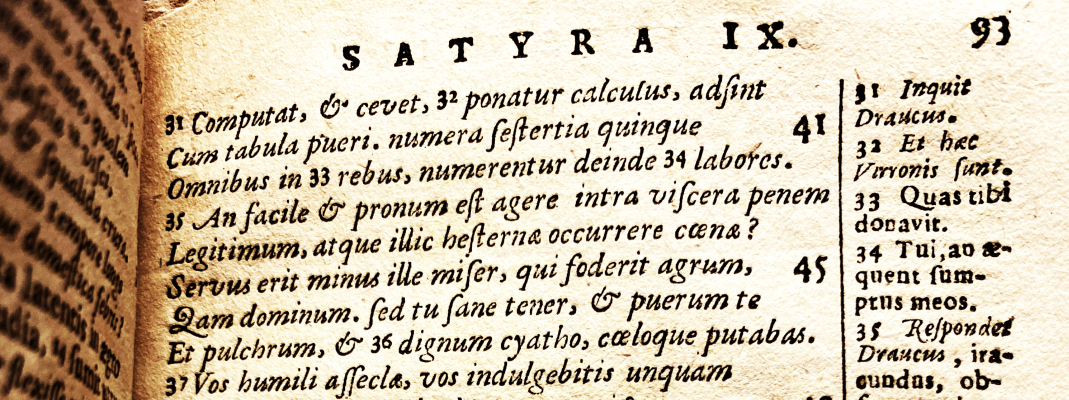
One Dutchman inventively represents Juvenal’s intentions, while another tries to make the most offensive passages seem more innocent. For example, in the ninth Satire, verse 44 et seq., the male prostitute Naevolus says of his greedy client:
‘It doesn’t come naturally, / stirring my hearty tool in his pleasure / until I meet yesterday’s soup! / No, ploughing land is better than your master, / if you must act slavishly anyway…’ (D’Hane-Scheltema 1984).
Abraham Valentijn translates (1682):
‘No, friend, do you consider labour so light and easy when you put a measure of gold sufficiently to the heart, and take it back badly gilded? In this way a slave who digs the land would have better days, than he who does it to his master.’ Although the badly gilded (brown) rod is descriptive enough, Valentine skipped yesterday’s meal. Oh well… Rather rough, but still, the Latin poetry is faithfully transferred, just a little softened in the Dutch prose.
Lukas Schermer (1709) leaves out the first sentence entirely, and turns it into something very innocent:
‘Then a simple slave, / Who has to dig in the country daily with the moat, / Would fare much better than his master in his misery.’
Young Schermer was undoubtedly taken aback by the task of accurately translating the obscene Ninth Satire. Only when his publisher, Willem van Kessel, ‘objected that one could change the most offensive passages with a modest gloss’, did he start the work. And those dirtiest passages were neatly cleaned up.
No modest gloss in Britain: the translation by politician Stephen Hervey, in the populair collection of John Dryden that was instigated by publisher Jacob Tonson and first published 1693, makes it clear as (albeit brown) glass:
‘Was it an Ease and Pleasure, cou’d’st thou say/ (Where Nature’s Law forbids) to force my way/ To the digested Meals of yesterday?/ The Slave more toil’d and harrass’d will be found,/ Who Digs his Master’s Buttocks, than his Ground’.
SECOND SATIRE
 You get the impression that the race of sodomites, the men who preferred to have sex with other men, was not entirely unknown to the attentive seventeenth-century reader. Undoubtedly, the translator’s friendly nudge helped them understand the meaning. Let’s examine two excerpts from the Second Satire to gain further insight. First, we have the contemporary translation by d’Hane (from line 8).
‘Every street is teeming with / doom-mongering, half-soft scribes / preaching good and evil, / while they are precisely the biggest perverts / of all those soft Socrates-types / and with their rustic, hairy limbs / suggest a lot of toughness, but still like to have castrated/ the ripe figs from their smooth asses / to the amusement of the doctors. / Their language is scarce, because they prefer to keep quiet, / their hair even shorter than an eyebrow… / Certainly, / a real intersex is much more real, / someone who, upon seeing him, I immediately call / a miscarriage of nature in terms of appearance / and in the way he walks, but he is / at least honest and his passion arouses / forgiveness and compassion. Worse are those / who go and reprimand such a disposition with / a Herculean sound, who preach moral sermons / while their behinds should be ashamed. / (…) (Laronia, a sharp-witted woman then remarks, from verse 40): Hmmm – that perfume that smells from the hair on your neck, / where do you buy it? No, don’t be ashamed, tell me, / who is that perfumer? – But listen, if you / are concerned with law and justice, then you should / first of all fix the sodomy law / and inspect our men, because / they make mistakes much more often than we do, but that is / covered up by the size of their close-knit / ranks. The mollies world knows / a lot of unity, certainly, but among women you never find / so much sex clamour, so decadent. / Flora and Media and their girlfriends / do not lick each other clean, but Hippo does it / with many a young man to the point of looking pallid.’
Heady stuff for a 17th century Dutchman, but there it is. The ‘sodomy law’ refers to the Lex Scantinia, of which we know very little. Its text has not been preserved. These lines by Juvenalis are one of the few sources. They indicate that the Scantinian law possibly was directed against free-born men in a passive role; but experts disagree. In any case, it was not a law against ‘the Sodomites’, because a penal provision against homosexual acts as such was only introduced in the year 342, when the emperors had become Christians, and the Roman Empire was in its twilight years.
In the Latin text, the ‘intersex’ bears the non-Roman name Peribomius. This is also a Greek derivation: peri bômon means ‘around the pole’! A generic name, therefore—the gay hustler, Billy Bumboy, or Joe Slit. Did seventeenth-century people guess that meaning? The Dutch undoubtedly knew the name Perizonius, a family of preachers and famous professors. That’s why Valentijn spells his name with an n.
It is striking that Peribomius looks like a queer person. He apparently has a homosexual nature. Peribomius is not someone who wants to do it with both men and women, like most Romans: those doom-mongering scribes, for example.
Abraham Valentijn’s translation, 302 years earlier than d’Hane: ‘Which street or district is not full of shameful villains. You punish the dark sins with a Socratic tone, but you are the filthiest Sodomist that comes out of it. From your rough limbs and barren arm hair one would say that you had a manly heart in your body: but from your swollen haemorrhoids on your bald anus, which the Medicine master cannot cut off without laughing, you can see what you are taking in hand. They speak seldom, and are glad to keep silent, having their hair shaved off to appear as philosophers. So then Peribonius is certainly to be considered a better man as being simple and upright in his affairs, because in his countenance and gait it is easy to see what bad figs he is bruising: but I attribute this to his clumsy temper, the simplicity of this servant is worthy of pity; but this shorn bunch knows better, and indulges their lusts excessively against their conscience.
This kind is much smarter, who punish these horrors with violent threats, but while recommending virtue, they lie down shaking their buttocks. (…)’
(Laronia:) I think you smell a bit spicy, and your rough neck stinks terribly of balm. Where do you buy that filth? Don’t be afraid, tell me freely which chemist sells it. If you want to bring out the laws against defects, you should bring up all those of Scantinius against Sodomy. Look, examine the men thoroughly before you pull us by the hair, you will find that they have a lot more on their horns than we do; but what is it, the number of those lumps is so great that they excuse each other. Those sissy shitwimps are united in one accord: such horrors are never found among us females. For Tedia does not slick Cluvia, nor Flora Catulla. But Hippo snuggles under young men like a woman and then inherits a swollen shaft and haemorrhoids.’ Valentijn explains more and interprets Juvenal’s words, but he does not excuse anything.
François van Bergen rewrote Juvenal in 1693:
‘Which part of the city is not left / by these hypocritical fellows? You! Dare you still punish / that filth? Dare you bark against those horrors, / who under the appearance of piety do the worst themselves? / Their rough face together and bristly hand, this strengthens / the people in a delusion of strict, godly conduct; / While the Physician heals their lower limbs, contaminated by filthy trade / with laughter. They speak little, / (for that is the wisdom of the wise) and are silent with pleasure; / their hair is cut shorter than their eyebrows. / I praise Peribomius who did not dissemble his corrupted morals: I blame the fate that he showed with his gait, face, / and clothing, that he did not hate these horrors. / This simplicity is worthy of lamentation; his madness / deserves forgiveness…’
Van Bergen adds many footnotes, including (14): ‘This man was born under such a confluence of Stars (constellation) that he could not live otherwise, and therefore he also does well that he is not ashamed of his craft. Everyone knows how great power the heathens attributed to the influence of such and such stars.’ Note (15): ‘Since this one was thus forced by fate, his simplicity in not feigning his faults is much more worthy of lamentation as punishment: that madness should be forgiven, because he was forced by the Stars.’
The continuation of Van Bergen’s translation:
‘But tell me, I pray you, where do you buy these balm scents? / What is that smell that I can detect in your rough neck? / Do not be ashamed, you tell me the merchant. / If a strict law must awaken, / then wake up the Scantinian before all the others. / Look, search the Men, you and each your comrades; / of which each one is more involved than any of us women. But they are strengthened by their might and great number. / There is close unity among the effeminate rabble, who are smarter / than we are; for in our race I never find / such a shameful example or abomination: there is no woman / that ever commits those horrors with another woman. But Hippo was still violated by young men, / and violates them in turn, infected with both sins.’ Note (41): ‘Scantinian Law … made against the Sodomites, and against all other godless unlawful lustful people. Laronia wanted to have this Law awake, because ‘then were so many men infected with these horrors.’ Note (43): ‘Hippo was presented here as a publicly known godless Sodomite.’
Valentijn and Van Bergen both faithfully follow the disposition that Juvenal suggests. François van Bergen probably once saw one of these abominable sodomites and wondered how he had acquired his inclination.
TENTH SATIRE
Finally, a piece of the Tenth Satire. This is about beautiful women who would have preferred to be a little less beautiful—because their beauty has caused them so much discomfort. Adolescent boys can have similar problems…
First, the translation by Mrs. d’Hane (from verse 295): ‘Just as much / an elegant son causes his parents / constant fear and worry. Because only rarely / does outward beauty go hand in hand with virtue / and even when, in the primordial Sabine style / such a boy has been brought up strictly in the doctrine and / Mother Nature with a gentle hand has also allowed him to be / pure of mind, delicately blushing of face / – and what help or guardian / would be better for a young man? – / even then, he is often still not allowed to be a man / because a rich decadent / wins him over with gifts and even dares to charm / his parents In this way. Never / has a tyrant In his depraved castle / an ugly one deformed to be a eunuch, / and all those boys with whom Nero made love, / have never been crook-legged, weak in the neck, / pot-bellied or hunched… So, parents, / all who are blessed with handsome sons, / celebrate big time for what else / may happen: he may become known / as everyone’s lover, must be constantly afraid / of angry husbands, and will one day / taste the happiness of Ares and be caged / in a net of revenge; and vengeance can / sometimes go further than what the law can swallow: / they stab him or flog him / unconscious or stuff a fish with teeth into his anus!‘
Roman tradition used the flathead mullet (mugil cephalus), a fish up to half a meter long, to punish adulterers caught red-handed by a husband. The husband would push this fish into his anus, symbolizing the deepest humiliation of a free man. Carrots were also used, perhaps when there was no fish available.
Marietje d’Hane put it succinctly, but Abraham Valentijn also had a proficient command of his native language:
‘And then, a son who is well-behaved, makes sure that the parents are always miserable and full of fear. It happens that you rarely find beauty and chastity together: although the strict parents with a rough brusqueness, like the Sabine coarse-knuckles, instill in their sons modest manners, a kindly character and chaste comportment, and a face that easily blushes with honourable shame (for what more can Nature, which is more powerful than all supervision and care, grant to a young person?) they cannot possibly become honest men: when the cunning seducers themselves come on board the parents with great presents, they are so bold in their gifts. Never was a tyrant so cruel that he castrated a deformed youngster in his castle: never did Nero abduct a nobleman’s son with a clubfoot, much less a goiter, or a front and back hump. Go then, and rejoice in your beautiful son, who in proportion has to expect all the greater danger, the more beautiful he is.’
Jacob Westerbaen wrote in surging verse lines, 25 years before Valentine:
‘And what affects the sons: show me one somewhere / Who is beautiful of body and well made of limbs, / I point out to you parents who live in fear and worry. / (…) Though he may blush easily, though he be chaste of nature / (Which often preserves the youth more / Than all care and teaching) he may not remain honourable / He will be pursued and solicited by matchmakers and old rag-wives and daily quarrelled with. / Yes, sometimes one does not even leave one’s parents alone. / Money and gifts make brokers hope / That they can now or then bribe the pious. / Go now, and be a tad happy with your fine lad, / Who will daily find more danger at hand, / He will by everyone pass off as an adulterer / And fear (…) the spite and sorrow of a corrupt man / As punishment for such an act or thought, / (…) Also, sorrow sometimes makes the laws stepped over; / That men are allowed to who catch such a one. / This one kills him, and with whips, well tied, / That the red sweat runs down his ribs, / Or strike him black or blue with canes and clubs / And makes him jump and hop around the room, / Until finally, tired of those strange dances, / He gets out of the house through one hole or another.’
We see Westerbaen skipping everything he finds immoral, just pulling a new text out of his wig. Changing masculine terms into feminine ones without Juvenal’s text permitting it is also done by other translators, not quoted extensively here: Laurens Bake, lord of Wulvenhorst (1677), and two years later the literary society Nil Volentibus Arduum (= Nothing is difficult for those who want it), although they do mention Nero’s sexual slavery:
‘Never has a tyrant violated a deformed maid [!] / In his great castle; nor Nero ever bound / A filthy clubfoot led away to debauchery. / Nor crooked hunchback, with whom one mocks and rails.’ (Bake)
‘Never did one see an ugly or deformed boy emasculated / Out of cruel lust in the Courts of the Tyrants. / Crook-legged boys, or hunchbacked, and bellied, / Or knobbly at the throat has Nero never abused, / And forced by wrong lust to dirty service.‘ Note: ‘In the time of Nero the most beautiful and well-made boys were sought out, to perform all kinds of services in his court: whom he had emasculated for that purpose, yes his lewd tracklessness even went so far, that he tried to make one of them into a wife (…)’ (Nil volentibus arduum)
The more ‘respectable’ translators concealed or disguised Juvenal’s bold language. They comprehended the meaning of Latin just as well as the men who, with evident delight, translated everything concisely into lively Dutch. One would conclude that seventeenth-century Dutch people knew certain forms of homosexual behaviour and homosexual identity: those sissy shitwimps, who were forced by the Stars, that wasted rabble, so different from the Sabine coarse-knuckles who try to instill a chaste comportment in their children. Apparently, just about everyone knew what was for sale in the Republic of the United Netherlands. Restricted by the prejudices of the late seventeenth century on the one hand and by the raw verses of Juvenal on the other, the homosexual disposition could be clearly addressed in widely read writings: From his face and gait it is clear what bad figs he is bruising.
Paul Snijders
Thanks to Prof.dr. Eric M. Moormann for his help with Latin
LITERATURE
D.J. Juvenalis, Satyra X of Tiende Berispdicht in Nederduitsche Vaerzen vertaald… door Nil Volentibus Arduum. 4 editions from 1679 to 1713. The second edition was used, published by Erven Jakob Lescaille, Amsterdam 1700.
De Schimpdigten van D. Junius Juvenalis en Aulus Persius Flaccus in ’t Neerduyts vertaeld door Abraham Valentijn. Leiden, Johannes van der Linde, 1682. Second edition 1703.
Alle de Schimpdichten van Decius Junius Juvenalis en A. Persius Flaccus, door verscheide Dichteren in Nederduitse vaarzen overgebracht. Haarlem, Wilhelmus van Kessel, 1709. The translations by Van Bergen, Schermer, Westerbaen and Bake were taken from this edition.
Juvenalis, Satiren. Vertaald door M. d’Hane-Scheltema. Amsterdam, Athenaeum-Polak & Van Gennep, 1983. A revised edition was published in 2003, after I wrote this article. The last reprint dates from 2007.
Theo van der Meer, Sodoms zaad in Nederland. Het ontstaan van homoseksualiteit in de vroegmoderne tijd. Nijmegen, SUN, 1995.
Theo van der Meer, ‘Sodomy and Its Discontents: Discourse, Desire, and the Rise of a Same-Sex Proto-Something in the Early Modern Dutch Republic’. In: Historical Reflections vol. 33 No. 1, Spring 2007.
This article was first published in Dutch in Gay 2002. Cultureel jaarboek voor mannen. Amsterdam, Vassallucci, 2001.
© Copyright Paul Snijders 2001-2024
Reactions and orders may be sent by answering the email. You will find our mail address at the foot of each page of our website.
A printed version of our catalogue can be ordered against payment of postage – or by placing an order.


English

 antiquariaat Fokas Holthuis