
JUVENAL’S BAD FIGS
(Text of an article Paul Snijders wrote in 2001, translated into English (by Paul himself) in 2024. Here is the Dutch version)
JUVENAL’S BAD FIGS – Strange desires in the past
 In ancient times, sex was a matter of screwing or being screwed. Being free and superior – or else being unfree and passive. In the Roman Empire, man came in three types: freeborn men, slaves and (in between) freed ex-slaves. For these classes, the famous saying applied: For a freeborn man, passivity is a shame, for a slave an absolute duty, for a freedman a moral duty (quoth Seneca senior). Whether it was homosexual, or heterosexual was irrelevant. Many freeborn citizens had a slave for sex in addition to their wife, to use whenever they felt like it. You just had to be wealthy to support such a slave. So, sex started with a hole to stick a pole in. Who sat around it was less important.
But the human around that opening could still benefit from it and get money or maintenance in return. In short: either you were the undisputed boss, or you had to compromise to stay alive. And where compromise occurs, poetry is created. A lot of poetry was written about homosexuality and other forms of sexuality in antiquity.
In the Dutch seventeenth century, this was different. Since the Middle Ages, homosexual contact was gradually more and more abhorred by the ecclesiastical and secular leadership. The word for it was strongly condemnatory: sodomy. This was primarily understood to mean the use of the wrong opening: the anus of a man, animal or woman.
The theories about the origin of sodomy that were devised in the Middle Ages (which are still adhered to today, especially by strict believers) were commonplace in the seventeenth and eighteenth centuries: due to excessive card and dice playing, gluttony, binge drinking, adultery and whoredom – due to an excess of heterosexuality some men developed a dislike for women, and go elsewhere to satisfy their lusts, for example with men. They deserve a death penalty. Then the seduction theory comes into effect: the youngster, the servant or the inferior (or the goat) who was seduced by a superior would always continue to seek sodomy, and therefore deserved the death penalty just as much. Otherwise, this Sin of Vengeance would never be eradicated. And then the Lord God would continue to punish the Netherlands and undermine Dutch prosperity.
In a country where beds and nighttime warmth were precious, and where many people shared their beds with each other for warmth, most Dutch people knew very well that warm contact should not lead to anal contact. Sodomy was punished with a particularly nasty kind of death penalty. Mainly the rich sometimes had the chance to flee abroad.
Were there nevertheless men who preferred to seek sexual contact with men, and that at a time when large numbers of fine whores could be found for money?
In a roundabout way, this question can perhaps be answered by comparing widely read texts by classical writers on homosexual acts with translations from the seventeenth century. For example, the Latin Satires by the poet Decimus Junius Juvenalis (± 60-± 140). Almost nothing is known about his person. As a young man, under the tyrannical emperor Domitian, he must have been dependent on the favours of wealthy Romans as an impecunious free citizen. After the turn of the first century, his material situation improved, also because the Golden Age of the Roman Empire began: it lasted from 96 to 180.
Most of the emperors of his time also had sex slaves or even a Young Friend: Domitian, Nerva, Trajan and, the most famous of all, Hadrian with his Antinous. It was not until later in life that Juvenal started publishing. He criticizes the vices of the Romans, such as the glaring greed of the rich towards the less fortunate, who must compromise with social principles in order to make a living. To take society to task, he often uses sex and whoring, and does so in coarse, figurative language. From the fourth century onwards, his work became very popular. Juvenal was devoured by the educated, who could read Latin. Men who had received a good education spoke Latin as we speak English.
In the second half of the seventeenth century, it became a sport in the Netherlands to translate or imitate Latin texts. This was done not only by serious poets such as Vondel and Hooft, but also by humourists or roguish students. A spicy, particularly attractive type of Dutch was used. You could go in all directions with the spelling. There were no strict rules for this, and everyone spelled as he pleased.
We do not know much about the translators mentioned here. Abraham Valentijn was 27 when his prose translation appeared in print. The talented Lukas Schermer died in 1711, only 22 years old, but he is the author of several elegant poems, translations and a play. François van Bergen wrote very anal poetry (‘Ba! I wipe my pooper on your letters: / my filther and my stinker, soon / I will wipe it clean with them’). Jacob Westerbaen was from Vondel’s generation. He died in 1670 after a long and active life, during which he achieved fame and wealth.
Of Juvenal’s sixteen Satires, the second, ninth and tenth contain obvious homosexual passages. The most scabrous poems were translated into Dutch, especially in the period 1655-1710. They became very popular, for a short time. In the 1710s or 1720s all Juvenal voices came to be silent. After that it remained quiet until 1984, when Marietje d’Hane-Scheltema published into Dutch a very faithful, but modern, unvarnished translation of all sixteen poems. We may use that translation perfectly to compare the publications from the time of the Republic of the Seven United Netherlands.
NINTH SATIRE
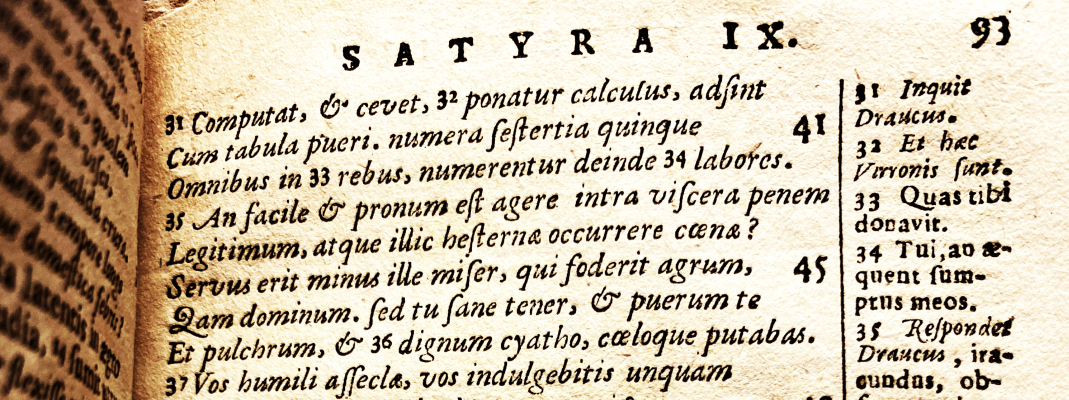
One Dutchman inventively represents Juvenal’s intentions, while another tries to make the most offensive passages seem more innocent. For example, in the ninth Satire, verse 44 et seq., the male prostitute Naevolus says of his greedy client:
‘It doesn’t come naturally, / stirring my hearty tool in his pleasure / until I meet yesterday’s soup! / No, ploughing land is better than your master, / if you must act slavishly anyway…’ (D’Hane-Scheltema 1984).
Abraham Valentijn translates (1682):
‘No, friend, do you consider labour so light and easy when you put a measure of gold sufficiently to the heart, and take it back badly gilded? In this way a slave who digs the land would have better days, than he who does it to his master.’ Although the badly gilded (brown) rod is descriptive enough, Valentine skipped yesterday’s meal. Oh well… Rather rough, but still, the Latin poetry is faithfully transferred, just a little softened in the Dutch prose.
Lukas Schermer (1709) leaves out the first sentence entirely, and turns it into something very innocent:
‘Then a simple slave, / Who has to dig in the country daily with the moat, / Would fare much better than his master in his misery.’
Young Schermer was undoubtedly taken aback by the task of accurately translating the obscene Ninth Satire. Only when his publisher, Willem van Kessel, ‘objected that one could change the most offensive passages with a modest gloss’, did he start the work. And those dirtiest passages were neatly cleaned up.
No modest gloss in Britain: the translation by politician Stephen Hervey, in the populair collection of John Dryden that was instigated by publisher Jacob Tonson and first published 1693, makes it clear as (albeit brown) glass:
‘Was it an Ease and Pleasure, cou’d’st thou say/ (Where Nature’s Law forbids) to force my way/ To the digested Meals of yesterday?/ The Slave more toil’d and harrass’d will be found,/ Who Digs his Master’s Buttocks, than his Ground’.
SECOND SATIRE
 You get the impression that the race of sodomites, the men who preferred to have sex with other men, was not entirely unknown to the attentive seventeenth-century reader. Undoubtedly, the translator’s friendly nudge helped them understand the meaning. Let’s examine two excerpts from the Second Satire to gain further insight. First, we have the contemporary translation by d’Hane (from line 8).
‘Every street is teeming with / doom-mongering, half-soft scribes / preaching good and evil, / while they are precisely the biggest perverts / of all those soft Socrates-types / and with their rustic, hairy limbs / suggest a lot of toughness, but still like to have castrated/ the ripe figs from their smooth asses / to the amusement of the doctors. / Their language is scarce, because they prefer to keep quiet, / their hair even shorter than an eyebrow… / Certainly, / a real intersex is much more real, / someone who, upon seeing him, I immediately call / a miscarriage of nature in terms of appearance / and in the way he walks, but he is / at least honest and his passion arouses / forgiveness and compassion. Worse are those / who go and reprimand such a disposition with / a Herculean sound, who preach moral sermons / while their behinds should be ashamed. / (…) (Laronia, a sharp-witted woman then remarks, from verse 40): Hmmm – that perfume that smells from the hair on your neck, / where do you buy it? No, don’t be ashamed, tell me, / who is that perfumer? – But listen, if you / are concerned with law and justice, then you should / first of all fix the sodomy law / and inspect our men, because / they make mistakes much more often than we do, but that is / covered up by the size of their close-knit / ranks. The mollies world knows / a lot of unity, certainly, but among women you never find / so much sex clamour, so decadent. / Flora and Media and their girlfriends / do not lick each other clean, but Hippo does it / with many a young man to the point of looking pallid.’
Heady stuff for a 17th century Dutchman, but there it is. The ‘sodomy law’ refers to the Lex Scantinia, of which we know very little. Its text has not been preserved. These lines by Juvenalis are one of the few sources. They indicate that the Scantinian law possibly was directed against free-born men in a passive role; but experts disagree. In any case, it was not a law against ‘the Sodomites’, because a penal provision against homosexual acts as such was only introduced in the year 342, when the emperors had become Christians, and the Roman Empire was in its twilight years.
In the Latin text, the ‘intersex’ bears the non-Roman name Peribomius. This is also a Greek derivation: peri bômon means ‘around the pole’! A generic name, therefore—the gay hustler, Billy Bumboy, or Joe Slit. Did seventeenth-century people guess that meaning? The Dutch undoubtedly knew the name Perizonius, a family of preachers and famous professors. That’s why Valentijn spells his name with an n.
It is striking that Peribomius looks like a queer person. He apparently has a homosexual nature. Peribomius is not someone who wants to do it with both men and women, like most Romans: those doom-mongering scribes, for example.
Abraham Valentijn’s translation, 302 years earlier than d’Hane: ‘Which street or district is not full of shameful villains. You punish the dark sins with a Socratic tone, but you are the filthiest Sodomist that comes out of it. From your rough limbs and barren arm hair one would say that you had a manly heart in your body: but from your swollen haemorrhoids on your bald anus, which the Medicine master cannot cut off without laughing, you can see what you are taking in hand. They speak seldom, and are glad to keep silent, having their hair shaved off to appear as philosophers. So then Peribonius is certainly to be considered a better man as being simple and upright in his affairs, because in his countenance and gait it is easy to see what bad figs he is bruising: but I attribute this to his clumsy temper, the simplicity of this servant is worthy of pity; but this shorn bunch knows better, and indulges their lusts excessively against their conscience.
This kind is much smarter, who punish these horrors with violent threats, but while recommending virtue, they lie down shaking their buttocks. (…)’
(Laronia:) I think you smell a bit spicy, and your rough neck stinks terribly of balm. Where do you buy that filth? Don’t be afraid, tell me freely which chemist sells it. If you want to bring out the laws against defects, you should bring up all those of Scantinius against Sodomy. Look, examine the men thoroughly before you pull us by the hair, you will find that they have a lot more on their horns than we do; but what is it, the number of those lumps is so great that they excuse each other. Those sissy shitwimps are united in one accord: such horrors are never found among us females. For Tedia does not slick Cluvia, nor Flora Catulla. But Hippo snuggles under young men like a woman and then inherits a swollen shaft and haemorrhoids.’ Valentijn explains more and interprets Juvenal’s words, but he does not excuse anything.
François van Bergen rewrote Juvenal in 1693:
‘Which part of the city is not left / by these hypocritical fellows? You! Dare you still punish / that filth? Dare you bark against those horrors, / who under the appearance of piety do the worst themselves? / Their rough face together and bristly hand, this strengthens / the people in a delusion of strict, godly conduct; / While the Physician heals their lower limbs, contaminated by filthy trade / with laughter. They speak little, / (for that is the wisdom of the wise) and are silent with pleasure; / their hair is cut shorter than their eyebrows. / I praise Peribomius who did not dissemble his corrupted morals: I blame the fate that he showed with his gait, face, / and clothing, that he did not hate these horrors. / This simplicity is worthy of lamentation; his madness / deserves forgiveness…’
Van Bergen adds many footnotes, including (14): ‘This man was born under such a confluence of Stars (constellation) that he could not live otherwise, and therefore he also does well that he is not ashamed of his craft. Everyone knows how great power the heathens attributed to the influence of such and such stars.’ Note (15): ‘Since this one was thus forced by fate, his simplicity in not feigning his faults is much more worthy of lamentation as punishment: that madness should be forgiven, because he was forced by the Stars.’
The continuation of Van Bergen’s translation:
‘But tell me, I pray you, where do you buy these balm scents? / What is that smell that I can detect in your rough neck? / Do not be ashamed, you tell me the merchant. / If a strict law must awaken, / then wake up the Scantinian before all the others. / Look, search the Men, you and each your comrades; / of which each one is more involved than any of us women. But they are strengthened by their might and great number. / There is close unity among the effeminate rabble, who are smarter / than we are; for in our race I never find / such a shameful example or abomination: there is no woman / that ever commits those horrors with another woman. But Hippo was still violated by young men, / and violates them in turn, infected with both sins.’ Note (41): ‘Scantinian Law … made against the Sodomites, and against all other godless unlawful lustful people. Laronia wanted to have this Law awake, because ‘then were so many men infected with these horrors.’ Note (43): ‘Hippo was presented here as a publicly known godless Sodomite.’
Valentijn and Van Bergen both faithfully follow the disposition that Juvenal suggests. François van Bergen probably once saw one of these abominable sodomites and wondered how he had acquired his inclination.
TENTH SATIRE
Finally, a piece of the Tenth Satire. This is about beautiful women who would have preferred to be a little less beautiful—because their beauty has caused them so much discomfort. Adolescent boys can have similar problems…
First, the translation by Mrs. d’Hane (from verse 295): ‘Just as much / an elegant son causes his parents / constant fear and worry. Because only rarely / does outward beauty go hand in hand with virtue / and even when, in the primordial Sabine style / such a boy has been brought up strictly in the doctrine and / Mother Nature with a gentle hand has also allowed him to be / pure of mind, delicately blushing of face / – and what help or guardian / would be better for a young man? – / even then, he is often still not allowed to be a man / because a rich decadent / wins him over with gifts and even dares to charm / his parents In this way. Never / has a tyrant In his depraved castle / an ugly one deformed to be a eunuch, / and all those boys with whom Nero made love, / have never been crook-legged, weak in the neck, / pot-bellied or hunched… So, parents, / all who are blessed with handsome sons, / celebrate big time for what else / may happen: he may become known / as everyone’s lover, must be constantly afraid / of angry husbands, and will one day / taste the happiness of Ares and be caged / in a net of revenge; and vengeance can / sometimes go further than what the law can swallow: / they stab him or flog him / unconscious or stuff a fish with teeth into his anus!‘
Roman tradition used the flathead mullet (mugil cephalus), a fish up to half a meter long, to punish adulterers caught red-handed by a husband. The husband would push this fish into his anus, symbolizing the deepest humiliation of a free man. Carrots were also used, perhaps when there was no fish available.
Marietje d’Hane put it succinctly, but Abraham Valentijn also had a proficient command of his native language:
‘And then, a son who is well-behaved, makes sure that the parents are always miserable and full of fear. It happens that you rarely find beauty and chastity together: although the strict parents with a rough brusqueness, like the Sabine coarse-knuckles, instill in their sons modest manners, a kindly character and chaste comportment, and a face that easily blushes with honourable shame (for what more can Nature, which is more powerful than all supervision and care, grant to a young person?) they cannot possibly become honest men: when the cunning seducers themselves come on board the parents with great presents, they are so bold in their gifts. Never was a tyrant so cruel that he castrated a deformed youngster in his castle: never did Nero abduct a nobleman’s son with a clubfoot, much less a goiter, or a front and back hump. Go then, and rejoice in your beautiful son, who in proportion has to expect all the greater danger, the more beautiful he is.’
Jacob Westerbaen wrote in surging verse lines, 25 years before Valentine:
‘And what affects the sons: show me one somewhere / Who is beautiful of body and well made of limbs, / I point out to you parents who live in fear and worry. / (…) Though he may blush easily, though he be chaste of nature / (Which often preserves the youth more / Than all care and teaching) he may not remain honourable / He will be pursued and solicited by matchmakers and old rag-wives and daily quarrelled with. / Yes, sometimes one does not even leave one’s parents alone. / Money and gifts make brokers hope / That they can now or then bribe the pious. / Go now, and be a tad happy with your fine lad, / Who will daily find more danger at hand, / He will by everyone pass off as an adulterer / And fear (…) the spite and sorrow of a corrupt man / As punishment for such an act or thought, / (…) Also, sorrow sometimes makes the laws stepped over; / That men are allowed to who catch such a one. / This one kills him, and with whips, well tied, / That the red sweat runs down his ribs, / Or strike him black or blue with canes and clubs / And makes him jump and hop around the room, / Until finally, tired of those strange dances, / He gets out of the house through one hole or another.’
We see Westerbaen skipping everything he finds immoral, just pulling a new text out of his wig. Changing masculine terms into feminine ones without Juvenal’s text permitting it is also done by other translators, not quoted extensively here: Laurens Bake, lord of Wulvenhorst (1677), and two years later the literary society Nil Volentibus Arduum (= Nothing is difficult for those who want it), although they do mention Nero’s sexual slavery:
‘Never has a tyrant violated a deformed maid [!] / In his great castle; nor Nero ever bound / A filthy clubfoot led away to debauchery. / Nor crooked hunchback, with whom one mocks and rails.’ (Bake)
‘Never did one see an ugly or deformed boy emasculated / Out of cruel lust in the Courts of the Tyrants. / Crook-legged boys, or hunchbacked, and bellied, / Or knobbly at the throat has Nero never abused, / And forced by wrong lust to dirty service.‘ Note: ‘In the time of Nero the most beautiful and well-made boys were sought out, to perform all kinds of services in his court: whom he had emasculated for that purpose, yes his lewd tracklessness even went so far, that he tried to make one of them into a wife (…)’ (Nil volentibus arduum)
The more ‘respectable’ translators concealed or disguised Juvenal’s bold language. They comprehended the meaning of Latin just as well as the men who, with evident delight, translated everything concisely into lively Dutch. One would conclude that seventeenth-century Dutch people knew certain forms of homosexual behaviour and homosexual identity: those sissy shitwimps, who were forced by the Stars, that wasted rabble, so different from the Sabine coarse-knuckles who try to instill a chaste comportment in their children. Apparently, just about everyone knew what was for sale in the Republic of the United Netherlands. Restricted by the prejudices of the late seventeenth century on the one hand and by the raw verses of Juvenal on the other, the homosexual disposition could be clearly addressed in widely read writings: From his face and gait it is clear what bad figs he is bruising.
Paul Snijders
Thanks to Prof.dr. Eric M. Moormann for his help with Latin
LITERATURE
D.J. Juvenalis, Satyra X of Tiende Berispdicht in Nederduitsche Vaerzen vertaald… door Nil Volentibus Arduum. 4 editions from 1679 to 1713. The second edition was used, published by Erven Jakob Lescaille, Amsterdam 1700.
De Schimpdigten van D. Junius Juvenalis en Aulus Persius Flaccus in ’t Neerduyts vertaeld door Abraham Valentijn. Leiden, Johannes van der Linde, 1682. Second edition 1703.
Alle de Schimpdichten van Decius Junius Juvenalis en A. Persius Flaccus, door verscheide Dichteren in Nederduitse vaarzen overgebracht. Haarlem, Wilhelmus van Kessel, 1709. The translations by Van Bergen, Schermer, Westerbaen and Bake were taken from this edition.
Juvenalis, Satiren. Vertaald door M. d’Hane-Scheltema. Amsterdam, Athenaeum-Polak & Van Gennep, 1983. A revised edition was published in 2003, after I wrote this article. The last reprint dates from 2007.
Theo van der Meer, Sodoms zaad in Nederland. Het ontstaan van homoseksualiteit in de vroegmoderne tijd. Nijmegen, SUN, 1995.
Theo van der Meer, ‘Sodomy and Its Discontents: Discourse, Desire, and the Rise of a Same-Sex Proto-Something in the Early Modern Dutch Republic’. In: Historical Reflections vol. 33 No. 1, Spring 2007.
This article was first published in Dutch in Gay 2002. Cultureel jaarboek voor mannen. Amsterdam, Vassallucci, 2001.
© Copyright Paul Snijders 2001-2024

English

 antiquariaat Fokas Holthuis